This court artist sketch by Elizabeth Cook shows Naa'imur Zakariyah Rahman, left, and Mohammed Aqib Imran in the dock at Westminster Magistrates' Court in London, December 6, 2017. (Elizabeth Cook/PA via AP)
LONDON, United Kingdom — A British man who pledged allegiance to the Islamic State group was found guilty on Wednesday of plotting to behead Prime Minister Theresa May in a suicide attack.
Naa’imur Zakariyah Rahman, 20, planned to bomb the gates of Downing Street, kill guards and then attack May.
Rahman thought he was being helped by an IS group handler when in fact he was speaking to undercover officers. He had picked up what he thought was an explosives-packed rucksack when he was arrested last November.
“Before his arrest prevented it, he was, he believed, just days away from his objective, which was no less than a suicide attack, by blade and explosion, on Downing Street and, if he could, upon the Prime Minister Theresa May herself,” said prosecutor Mark Heywood.
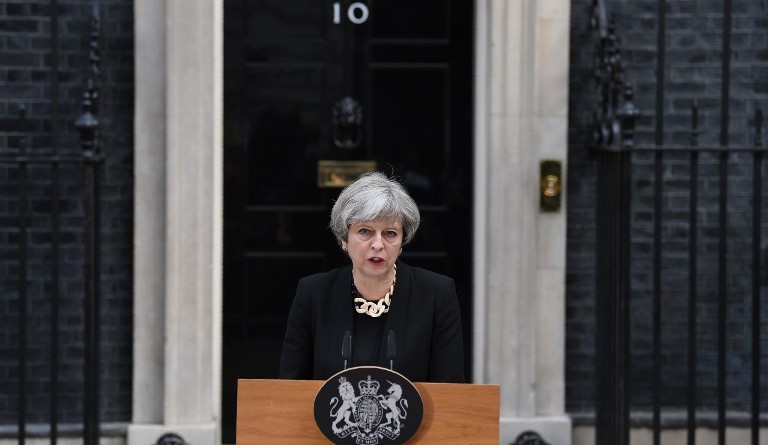
Britain’s Prime Minister Theresa May delivers a statement outside 10 Downing Street in central London on June 4, 2017, following the June 3 terror attack. (AFP PHOTO / Justin TALLIS)
In a chat with an undercover security service agent on the Telegram messaging app, Rahman said: “I want to do a suicide bomb on parliament. I want to attempt to kill Theresa May.”
Get The Times of Israel's Daily Editionby email and never miss our top stories
Rahman continued: “My objective is to take out my target. Nothing less than the death of the leaders of parliament.”
He told an undercover police officer that he would make a “10-second sprint” for the door of 10 Downing Street, with his main objective to “take her head off.”
Rahman earlier admitted helping his friend Mohammad Aqib Imran, 22, join the Islamic State group in Syria by recording a sponsorship video.
Advertisement
Heywood said the two men shared the “warped ideology” of Islamic State.
Help us report truthfully on social media
As a multimedia journalist, my job is to take the quality, fact-based journalism produced by The Times of Israel newsroom and make it accessible across every platform — from Instagram posts to podcasts to short-form videos.
This is how many, especially young people, consume news these days. But misinformation is rampant on social media. Our team at ToI produces accurate, responsible short-form reporting on Israel and the Jewish world.
If you believe in the importance of factual social media journalism, please consider joining our reader support group, The Times of Israel Community. Your financial support is essential to sustain responsible multimedia reporting.
We’re really pleased that you’ve read X Times of Israel articles in the past month.
That’s why we started the Times of Israel - to provide discerning readers like you with must-read coverage of Israel and the Jewish world.
So now we have a request. Unlike other news outlets, we haven’t put up a paywall. But as the journalism we do is costly, we invite readers for whom The Times of Israel has become important to help support our work by joining The Times of Israel Community.
For as little as $6 a month you can help support our quality journalism while enjoying The Times of Israel AD-FREE, as well as accessing exclusive content available only to Times of Israel Community members.
Thank you, David Horovitz, Founding Editor of The Times of Israel


 Add ToI as a Preferred Source on Google