Dec. 4: Rallies and sit-ins planned over weekend to support family of last hostage
Chief justice scolds Levin for refusing to meet him, says Israeli democracy in 'turbulent vortex' * IDF says it hit Hezbollah weapon depots in series of strikes in south Lebanon
The Times of Israel liveblogged Thursday’s events as they unfolded.
New TV poll has anti-Netanyahu bloc moving up — slightly
A new poll by Channel 12 has the current opposition at 69 Knesset seats (including Arab parties) and the coalition at 51.
Channel 12 notes that the anti-Netanyahu bloc gained one seat and the pro-Netanyahu bloc lost one seat, the first such change in several weeks.
In the survey, Likud is still in the lead with 25 seats; Naftali Bennett’s unnamed party gets 21; The Democrats 12; Yesh Atid 9; Yisrael Beiteinu 9; Shas 9; Gadi Eisenkot’s Yashar! is at 8; United Torah Judaism 7; Otzma Yehudit 6; Hadash–Ta’al 5; Ra’am 5. Religious Zionism manages to pass the electoral threshold with 4.
Below the threshold are Benny Gantz’s Blue and White, Yoaz Hendel’s Reservists and Balad.
Rallies and sit-ins planned over weekend to support family of last hostage
With the body of one hostage, Ran Gvili, remaining in Gaza, more than a dozen events are planned for this weekend in support of his family.
The Hostages and Missing Families Forum has held rallies for the hostages on most Saturday nights for the last two years. With the burial of Dror Or and the return of Sundthisak Rinthalak’s body on Wednesday, the Gvili family decided it was time to halt the main rally and create other gatherings.
A rally in support of the Gvili family will be held at the entrance to Meitar, the southern community where the Gvili family lives, on Saturday night.
There will also be a rally in Shaar Hanegev, while the Nir Oz community will gather in Carmei Gat on Saturday night, with former hostages and hostages’ families participating.
Around the country, communities are gathering on Friday and Saturday night, including in Eilat, in the Upper Galilee, Zichron Yaakov, and more.
Sit-ins and flag marches will be held around the country on Friday and Saturday, and Shabbat services will be held in Hostages Square and in the town of Yavne on Friday afternoon.
In Jerusalem, where the official Hostages’ Forum tent was dismantled last week, the Safeguarding our Shared Home protest group that helped organize the hostages’ rallies is returning to a Saturday night march called “Jerusalem in the Streets for Israel,” from Aza Road to the President’s Residence, the site of the protests held against the judicial overhaul prior to October 7, 2023.
Levin accuses Amit of ‘repeatedly trampling on the majority of the public’
Justice Minister Yariv Levin accuses Supreme Court President Isaac Amit of refusing to respect democracy and lists a litany of complaints he has against the head of the judiciary, in response to Amit’s criticism of Levin for boycotting him since he was elected to the position.
“What did you think would happen when you and your friends took over the Judicial Selection Committee with an illegal order?” says Levin, in reference to the High Court’s order in January for Levin to hold a vote in the Judicial Selection Committee on appointing a new Supreme Court president, after he refused to do so for 16 months.
“What did you imagine to yourself when you forced a ‘president’ of the court upon the citizens of Israel who tramples on the majority of the public again and again?” demands Levin.
He also criticizes Amit and the Supreme Court for various decisions that went against the government’s wishes.
Levin continues, saying he is “dismantling brick by brick the fortress of lies that you and your friends inhabit,” and is “building the legal system anew as it was in its days of greatness, under presidents such as [Moshe] Landau and [Meir] Shamgar.”
Report: Trump expected to announce phase 2 of Gaza plan by month’s end
US President Donald Trump is expected to announce the transition to the second phase of his peace plan for Gaza in the next couple of weeks, Channel 12 reports, citing senior American officials who share details on the plan’s progress.
Officials tell the Hebrew network that Trump’s announcement could precede the Christmas holiday, shortly after which Prime Minister Benjamin Netanyahu is expected to meet with the president in the US.
The officials say that the US and mediators are currently holding talks with Hamas over an agreement that would lead the terror group to give up its governing power in Gaza and begin the process of disarmament, core issues of the second phase that have remained unresolved since the ceasefire came into effect in October.
Under the agreement, Hamas would first relinquish heavy weapons such as missiles and rockets, and later, in a longer process, give up lighter weapons, according to the report. Hamas’s acceptance of the agreement would be a precondition for implementing the second phase of the plan – including the IDF’s withdrawal beyond the current Yellow Line — the report adds.
A senior American official tells Channel 12 that “in the coming weeks, we will reach the moment of truth. Hamas will have to decide whether to give up its rule and begin disarming in exchange for an IDF withdrawal, or refuse and face the consequences.”
The second phase of the plan — which neither Israel nor Hamas has signed onto yet — also envisions a Board of Peace headed by Trump overseeing the management of Gaza, along with the establishment of an International Stabilization Force that will secure the Strip.
The American officials say that Trump will head the board along with roughly 10 leaders from Arab and Western states. Under them, there would be an international committee led by former British prime minister Tony Blair, along with Trump’s envoys Jared Kushner and Steve Witkoff, as well as other senior figures from around the world.
Under that body would be the proposed committee of Palestinian technocrats, which would include roughly 12 to 15 Palestinians from business and management fields, who are not affiliated with either Hamas or Fatah.
Some of those Palestinians are currently in Gaza, while others would arrive from abroad to serve on the committee, according to the report. The US is said to be in the final stages of coordinating the list of candidates with Israel, the PA, and Arab states to ensure consensus.
Chief justice scolds Levin for refusing to meet him, says Israeli democracy in ‘turbulent vortex’
Supreme Court President Isaac Amit chastises Justice Minister Yariv Levin for the latter’s ongoing refusal to meet with him, saying that by so doing Levin is boycotting the entire judiciary.
Amit also expresses concern for harsh rhetoric directed against the judiciary as well as repeated, severe disturbances by members of the public inside courtrooms, and says further that in recent years “Israel’s ‘airplane’ of democracy has fallen into a turbulent vortex from which we have not yet emerged.”
In a speech at a conference of the Israeli Association of Public Law in Haifa, Amit says Levin’s 18-month refusal to meet with him and his predecessor Uzi Vogelman meant that key positions within the judiciary which need the cooperation of the justice minister and the Supreme Court president cannot be filled, including a president for the Lod-Central District Court, and deputy-presidents for 19 other courts.
“What reason is there to refrain from appointing a vice president to the Jerusalem Family Court? Why refrain from appointing a vice president to the Krayot Magistrate’s Court? Why harm all the litigants in the Central District by preventing the appointment of a president to the [Lod] District Court?” Amit asks in his speech.
He says he has repeatedly reached out to Levin to restart cooperation, but that his requests have been ignored.
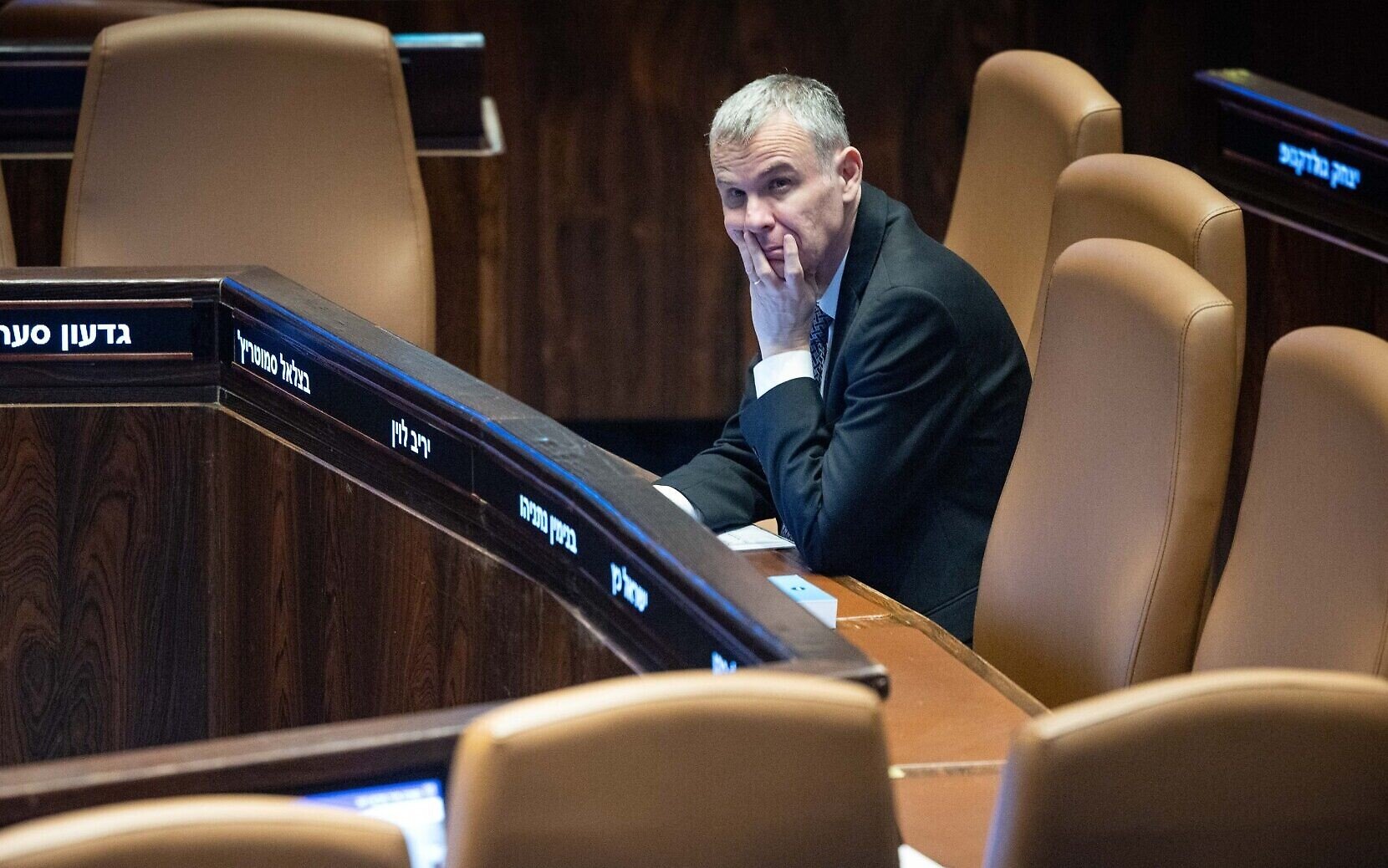
“For about a year and a half, the justice minister has been boycotting the judicial system, thereby boycotting the Israeli public who turn to the courts,” says Amit.
“The justice minister’s conduct has one clear purpose, which he himself said last April: ‘What was built here over decades takes time to dismantle, it doesn’t end in one day.’ These words speak for themselves,” he adds.
Levin stopped meeting with Vogelman in mid-2024, when Vogelman refused to accede to a demand from the justice minister to ditch the seniority system for appointing a president, whereby the Supreme Court justice with the most years on the court becomes the sole candidate for the position. The system is intended to prevent politicization of the selection process.
Levin then refused to call a vote in the Judicial Selection Committee for appointing a new president, since he did not have enough votes to appoint his preferred pick, Yosef Elron, leading the High Court of Justice to eventually order Levin to hold a vote in January this year after 16 months in which he had refused to do so.
Levin has boycotted Amit ever since, refuses to meet with him or address him as president, and has even failed to publish his appointment as president in the state gazette, as required by law.
PMO: Israeli delegation held talks in Cairo today to secure return of final hostage body
Israel sent a delegation to Cairo this morning for discussions with mediators aimed at securing the return of the final deceased hostage held in Gaza, Ran Gvili, Prime Minister Benjamin Netanyahu’s office announces in a statement.
The delegation, led by government hostage point man Gal Hirsch and including IDF, Shin Bet, and Mossad representatives, held talks to secure “the immediate return of the last abducted hostage,” the statement reads.
“At the conclusion of the meeting, it was agreed to concentrate an intensive and immediate effort that will lead to the full completion of the hostage-and-missing-persons mission,” the statement concludes.
The statement does not say whether the delegation has concluded its visit or remains in Cairo.
Israel’s Kan told EBU members it would ‘not apologize for our success’
Israel’s public broadcaster says it told Eurovision participants that attempts to boycott Israel are a slippery slope and that the country would not apologize for its success at the last two competitions.
Speaking to members of the European Broadcasting Union at its general assembly in Geneva ahead of today’s vote, representatives from Kan warned that boycotting Israel would harm free expression and could have unintended consequences.
“The attempt to remove Kan from the contest can only be understood as a cultural boycott,” the broadcaster’s director general Golan Yochpaz told EBU members, according to Kan. “A boycott may begin today with Israel, but no one knows where it will end or who else it may harm… Are EBU members willing to be part of a step that harms freedom of creation and freedom of expression?”
Yochpaz said that Kan is proud of the songs and artists it has sent to Eurovision over the years, and “I will not stand here and apologize for our success.”
A number of countries had expressed anger after Israel did exceedingly well in the popular votes in 2024 and 2025, and alleged voter fraud in the televote. The EBU dismissed such claims, but unveiled a series of reforms last month to address such concerns, which were adopted today by EBU members in a vote that allowed Israel to stay.
Herzog celebrates Eurovision decision: ‘Israel deserves to be on every stage’
President Isaac Herzog, who took part in efforts to ensure Israel was allowed to remain in Eurovision, celebrates the EBU decision to let it stay in the contest.
“Israel deserves to be represented on every stage around the world, a cause to which I am fully and actively committed,” says Herzog in a statement. “I am pleased that Israel will once again participate in the Eurovision Song Contest, and I hope that the competition will remain one that champions culture, music, friendship between nations, and cross-border cultural understanding.”
Herzog thanks those “friends who stood up for Israel’s right to continue to contribute and compete at Eurovision. This decision demonstrates solidarity, fellowship, and cooperation, and reinforces the spirit of affinity between nations through culture and music.”
After antisemitism allegations, BBC to require staff to take anti-discrimination training
Following widespread criticism of how it broadcast Israel’s war in Gaza, the BBC has ordered all staff members to complete a training course on antisemitism.
According to a note sent by BBC Director-General Tim Davie yesterday, staff will have six months to complete anti-discrimination e-learning courses on antisemitism and Islamophobia.
“As an organization, we stand united against any form of discrimination, prejudice, or intolerance,” Davie wrote.
The Board of Deputies of British Jews says it welcomes the announcement, which follows months of discussions it held with the BBC, including a meeting held on Tuesday, which addressed antisemitism training, concerns relating to BBC Arabic, and wider Middle East coverage.
“The BBC finds itself in a moment of challenge and opportunity,” Board of Deputies President Phil Rosenberg says. “It can continue in the same vein, with the same problems, or it can make changes that restore trust and pride in the central place of our national broadcaster in an ever-more fraught and fractious media and societal landscape. We hope that today’s announcement on antisemitism training to all staff is the start of a more positive journey.”
Davie announced his resignation from his position last month after a leaked internal memo highlighted editorial bias in the British public broadcaster’s coverage of the Israel-Hamas war, in the editing of a speech by US President Donald Trump, and on transgender issues. He will remain in the position until the board finds a replacement.
Israel seizes dozens of archaeological artifacts from villa in West Bank’s Area B
Israel’s Civil Administration says it seized dozens of archaeological artifacts from a site north of Ramallah in Area B today and transferred them to the Museum of the Good Samaritan archaeological site in Area C.
According to the statement, the artifacts were confiscated after Palestinians built a villa on the site of “Burj Lasana,” which was continuously inhabited from the Iron Age (1200-586 BCE) to the Crusaders period (1099-1260 CE). Located on top of a hill, the site include the remains of a a Crusaders’ fortress, a Byzantine church and a ritual bath.
The Civil Administration, a branch of the Defense Ministry’s Coordinator of Government Activities in the Territories (COGAT), is in charge of civilian affairs in the West Bank. Under the Oslo Accords, the Palestinian Authority maintains civilian and security control over Area A of the West Bank, Israel over Area C, while in Area B, Israel maintains security control and the PA maintains civilian control.
According to the statement, the artifacts include coins, stone columns and column capitals. The inspectors also found a metal detector used to identify metal remains underground.
The neglected status of archaeological sites in the West Bank has been denounced by both experts and activists for many years.
The current government has spearheaded an effort to bring control over antiquities in the region under an Israeli civilian body, which critics say Israel has no authority to do, and many charge would represent a step towards a de facto annexation in the field of archaeology.
“Protecting antiquities sites is a central part of our work and of our responsibility to preserve the history of the region,” says a statement from the Enforcement, Investigations and Intelligence Department in the Archaeological Unit of the Civil Administration.
“Any damage to an ancient site harms not only the artifact itself, but also our ability to understand and document the historical narrative it reflects. We will continue to act tirelessly, using all tools at our disposal, to eradicate the destructive phenomenon of antiquities theft and to protect the region’s national heritage assets and historical record.”
Slovenia will also not take part in next Eurovision
Slovenia’s RTV SLO confirms that it will also back out of the competition.
Its representative at the EBU asserts that Eurovision has become “hostage to the political interests of the Israeli government,” according to the broadcaster.
RTV SLO says it was among those who called for a secret vote to be held, along with Spain, Montenegro, the Netherlands, Turkey, Algeria and Iceland. Ultimately, members voted to accept a package of reforms as enough to allow Israel to remain in the competition.
EasyJet says it will resume flights to and from Tel Aviv on March 29
British low-cost carrier easyJet announces that it will resume flight operations to and from Tel Aviv’s Ben Gurion Airport starting March 29 next year.
“We are pleased to be resuming flights between London Luton, Amsterdam and Milan Malpensa and Tel Aviv,” an easyJet spokesperson says in an e-mailed statement. “We plan to resume flying to Tel Aviv from additional European bases next winter season at the end of October instead of next March.”
“We continually review all of our routes and remain committed to resuming more flying to and from Tel Aviv,” the easyJet spokesperson adds.
In July, the UK carrier, which had been expected to restart its flight operations at the end of October, announced that it would extend the suspension of all routes to and from Tel Aviv through March 28, 2026.
Israeli military drone makes emergency landing in north
An Israeli military drone made an emergency landing near Kibbutz Mishmar HaEmek in northern Israel due to “technical malfunction” earlier today, the IDF says.
The drone was then collected by troops, the military adds.
Netherlands, Spain and Ireland quit 2026 Eurovision over Israeli participation
The public broadcasters of the Netherlands, Spain and Ireland confirm that they will back out of next year’s Eurovision in protest of Israel’s inclusion.
Iceland intends to consider whether to remain.
The Netherlands’ public broadcaster, AVROTROS, issues a statement saying that its decision “follows a careful and extensive deliberation process” and included consultations with the Israeli ambassador.
“After weighing all perspectives, AVROTROS concludes that, under the current circumstances, participation cannot be reconciled with the public values that are fundamental to our organization,” it says.
Spain’s RTVE also confirms it will quit next year’s competition “following the vote” held today in Geneva.
And Irish broadcaster RTE says it “feels that Ireland’s participation remains unconscionable given the appalling loss of lives in Gaza,” and it will not participate in or broadcast next year’s contest.
Spain is a member of the “Big Five” Eurovision nations, which give the biggest financial contributions to the competition alongside France, Germany, the UK and Italy.
‘Large majority’ of members voted to allow Israel to stay in Eurovision, says EBU
The European Broadcasting Union issues an official statement confirming that “a large majority” of members voted to back new Eurovision reforms, allowing for “all EBU members” who wish to take part to do so.
The EBU statement does not explicitly mention Israel, but confirms that its members showed “clear support” for the new reforms and that there was “no need for a further vote” on who would be allowed to participate.
“The result of this vote demonstrates our members’ shared commitment to protecting transparency and trust in the Eurovision Song Contest, the world’s largest live music event,” says EBU President Delphine Ernotte Cunci in a statement, thanking members for “their thoughtful, respectful and constructive contributions.”
The reforms unveiled by the EBU last month aimed to address some of the concerns expressed after Israel ran away with the popular vote in 2024 and 2025. Moving forward, votes per person will be capped at 10, not 20; the EBU will “discourage” governments from running public campaigns for their entrants, and bar contestants from coordinating with such campaigns; and professional juries will be brought back for the semifinal rounds, in conjunction with the popular vote.
The EBU says that broadcasters will now have to confirm their participation in next year’s competition in Vienna, and the full list of participants will be announced before Christmas.
UK pro-Palestinian activist says raid on Elbit factory was about destroying weapons
A British pro-Palestinian activist on trial over a raid targeting Israeli defense firm Elbit says she and her co-defendants wanted to “cause as much property damage as we could,” but said she was opposed to violence.
Charlotte Head, 29, and five others are on trial at Woolwich Crown Court over what prosecutors have described as a meticulously planned assault by Palestine Action on the Elbit Systems UK facility in Bristol, southwest England, last August.
All six are charged with aggravated burglary, violent disorder and criminal damage, with one of Head’s co-defendants also charged with causing grievous bodily harm with intent for allegedly hitting a police officer with a sledgehammer.
They all deny the charges. Head told jurors she and her co-defendants had decided to take action because “all else had failed.”
Head admits she drove a repurposed former prison van carrying fellow activists through fences outside the factory and then into a loading bay in the early hours of August 6, 2024.
She says the plan was to “go in and destroy as many weapons as we could find.”
Head is asked by her lawyer Rajiv Menon: “Did you use violence against security guards or a police officer?” She replies: “No, never.”
Prosecutor Deanna Heer told jurors as the trial began last month that one of the six defendants, Samuel Corner, 23, hit a female police sergeant with a sledgehammer in the back, causing a lumbar spine fracture.
Head, asked on Thursday if she would have participated in action targeting Elbit if she knew someone would have used violence, says: “No, it was not a part of the plan.”
The trial continues.
Israel cleared to participate in next Eurovision after EBU vote
The Kan public broadcaster reports that Israel will be able to participate in next year’s Eurovision, following a vote by members of the European Broadcasting Union in Geneva.
According to Kan, members voted in an overwhelming majority to adopt Eurovision reforms unveiled by the EBU last month aimed at quelling concerns raised by some member states over Israel’s participation.
Since that vote passed, a separate vote on ousting Israel will not be held, Kan reports.
A number of countries are now expected to pull out of the contest after threatening that they would not take part if Israel was still allowed to do so.
IDF says it fired at terror operative who crossed into Israel-controlled zone
Troops of the 7th Armored Brigade stationed in the southern Gaza Strip opened fire on a Palestinian terror operative who crossed the Yellow Line today, the military says.
The IDF says the operative posed “an immediate threat” to the soldiers.
“The troops opened fire on the terrorists to remove the threat, and a hit was identified,” the military says.
Report: Spain forces vote on Israel’s Eurovision participation at EBU confab
According to a Spanish-language news site, Spain has forced a secret vote on Israel’s Eurovision participation at the European Broadcasting Union general assembly in Geneva.
EBU members are meeting in large part to discuss efforts to oust Israel from the competition, with a number of countries, including Spain, Slovenia, Ireland and Iceland, threatening to back out of the contest if Israel isn’t barred. The EBU had originally called for a vote to be held in November on the issue, but pushed off the decision following the October ceasefire, and revealed a number of reforms last month aimed at avoiding a vote entirely.
The 20-minute news site reports that Spain’s public broadcaster RTVE gathered signatures from at least eight countries requesting that a secret ballot on the issue be held at the meeting, which it says is enough to force a vote.
There is no immediate comment from the EBU or from Kan, Israel’s public broadcaster. Kan sent its director-general, Golan Yochpaz, and attorney Ayala Mizrachi to argue its case, and they reportedly told delegates that the broadcaster has not violated any regulations that would justify removing it from the competition.
According to reports from inside the assembly, Ukraine and Germany argued in favor of Israel staying in the contest, while Slovenia, Spain and Turkey — which is an EBU member but does not compete in Eurovision — called for it to be barred.
Earlier today, German Culture Minister Wolfram Weimer told Reuters that “if the EBU decides that Israel may not participate, Germany should refuse to take part. Israel belongs in the Eurovision Song Contest. There must not be an ESC without Israel.”
Ex-general to lead probe into IDF’s handling of intel on Hamas attack plans pre-Oct 7
IDF Chief of Staff Lt. Gen. Eyal Zamir has appointed a former general to head a panel of experts that will investigate the military’s handling of intelligence reports received since 2018, which outlined Hamas’s intent to launch a wide-scale attack against Israel — a topic not included in the army’s initial October 7 probes.
Maj. Gen. (res.) Roni Numa, who retired from the military in 2018 after serving as head of the Central Command, will lead the team that will include several other former senior officers, the military says.
The decision comes after a different team of former senior officers, led by Maj. Gen. (res.) Sami Turgeman, conducted a review of the IDF’s internal probes into the failures on October 7. The team found many of the probes to be inadequate, and also pointed to several topics that were not investigated at all, chief among them was the intelligence reports of Hamas’s attack plan, codenamed in the army “Jericho’s Walls.”
The military had, over the years, dismissed Hamas’s plans as unrealistic and unfeasible, all while the terror group continued its preparations for October 7.
This evening, Zamir presented the IDF’s top brass with his summary of Turgeman’s report, which included his “insights and lessons drawn from the report, along with key points for integrating them into the IDF’s work plan in the coming years,” the army says.
Zamir told the officers that “to synchronize all future processes arising from the report and to monitor their implementation,” an oversight committee will be established, headed by Deputy Chief of Staff Maj. Gen. Tamir Yadai. In the coming weeks, a learning session will be held by the General Staff Forum, during which top officers will discuss the implementation of the lessons in their respective units, the IDF says.
The military says that Zamir, in his summary, outlined several “main courses of action” for the military’s “evolution” in the coming years. Among them were that a surprise war should serve as a “compass for the IDF’s operational readiness,” that a ground offensive should be a “central component of the IDF’s capabilities,” and that “professional processes” in the Intelligence Directorate should be strengthened.
“We are moving to the next phase regarding the investigations of the events of October 7, which is the stage of integrating the lessons into the IDF’s work plan and implementing them,” Zamir says in remarks provided by the IDF. “It is our duty to confront failure directly and extract everything we can from it to ensure it does not recur, and to learn everything possible to improve the IDF’s capabilities.
“I believe this process will accompany the IDF for years to come, and we must ensure that it is thoroughly integrated into all components of the system,” he adds.
Father of slain Tanzanian hostage thanks Israel, IDF for efforts to bring him home
Loitu Mollel, the father of slain Tanzanian hostage Joshua Loitu Mollel, writes to President Isaac Herzog thanking him for a recent letter of sympathy and expressing gratitude for the IDF’s efforts to bring his son’s body back from Gaza last month.
“Joshua had travelled to Israel with the purpose of learning, gaining experience, and growing in the field of agriculture,” writes the elder Mollel in a letter seen by The Times of Israel. “Unfortunately, he fell into the hands of Hamas and was killed in a most tragic and inhuman manner.”
“We are deeply thankful to everyone who contributed in any way to locating Joshua’s body and ensuring his return home for a proper burial,” he continues. “We also extend our heartfelt appreciation to the Israel Defense Forces for their tireless efforts to bring Joshua’s remains back so that he could be accorded his final respect. In addition, we are grateful to the Hostages and Missing Families Forum for their unwavering campaign, ‘BRING THEM HOME NOW.’”
“May Almighty God Bless Israel,” he concludes.
Mollel, 21, an agricultural intern at Kibbutz Nahal Oz near the border with Gaza, was seized alive, then murdered by Hamas terrorists on the morning of October 7, 2023, and his body was taken to Gaza.
Woman said killed, several people wounded by IDF fire in Gaza City
A woman was killed and others injured by Israeli gunfire in Gaza City’s eastern Tuffah neighborhood, on the Hamas-controlled side of the Gaza ceasefire line, Al Jazeera reports, citing field medics.
The circumstances are unclear. The IDF does not immediately comment.
PA news agency: 12-year-old boy seriously wounded by IDF bullet to the head in Qalqilya
A 12-year-old was hit in the head by Israeli gunfire near the northern entrance to the West Bank city of Qalqilya, the Palestinian Authority’s WAFA news agency reports, citing the Red Crescent.
The boy was taken to the hospital and is in serious condition, WAFA says.
Palestinian media reported earlier today that the IDF imposed a curfew on parts of Qalqilya.
German broadcaster backs Israel in Eurovision debate
The public broadcaster organizing Germany’s entry for Eurovision says that Israel is entitled to compete in the contest, as European broadcasters debate whether to exclude the country over its conduct in Gaza.
The broadcaster SWR says in a statement sent to AFP that “the Israeli broadcaster Kan fulfils all the requirements for participation” in the contest.
German Chancellor Friedrich Merz, a strong supporter of Israel, said in October that the prospect of Israel being excluded was “scandalous” and that he would advocate Germany boycotting the contest in that case.
The European Broadcasting Union (EBU) is currently holding a two-day meeting in Geneva to discuss the issue, with several countries threatening to pull out if Israel is allowed to take part.
SWR also stresses that the “competition is organized by EBU broadcasters, not governments.”
“We are confident a solution can be found in keeping with the principles” of the the competition, it says.
FBI makes arrest in investigation into pipe bombs placed in DC on eve of Jan. 6 riot
The FBI has made an arrest in its nearly 5-year-old investigation into who placed pipe bombs in Washington on the eve of the Jan. 6, 2021, riot at the US Capitol, a law enforcement official tells The Associated Press.
The arrest marks the first time investigators have settled on a suspect in an act that had long vexed law enforcement, spawned a multitude of conspiracy theories and remained an enduring mystery in the shadow of the dark chapter of American history that is the violent Capitol siege.
The arrest took place this morning, and the suspect is a man, the official says. He was arrested in Virginia, according to another person familiar with the matter. No other details are immediately available, including the charges the man might face.
The pipe bombs were placed on the evening of Jan. 5, 2021, near the offices of the Democratic and Republican national committees in the District of Columbia. Nobody was hurt before the bombs were rendered safe, but the FBI has said both devices could have been lethal.
In the years since, investigators have sought the public’s help in identifying a shadowy subject seen on surveillance camera even as they struggled to determine answers to basic questions, including the person’s gender and motive and whether the act had a clear connection to the riot at the Capitol a day later when supporters of President Donald Trump stormed the building in a bid to halt the certification of the Republican’s 2020 election loss to Democrat Joe Biden.
Seeking a breakthrough, the FBI last January publicized additional information about the investigation, including an estimate that the suspect was about 5-foot-7, as well as previously unreleased video of the suspect placing one of the bombs.
The bureau had for years struggled to pinpoint a suspect despite hundreds of tips, a review of tens of thousands of video files and a significant number of interviews.
IDF says it struck Hezbollah weapon depots in south Lebanon
The IDF says it has completed a wave of airstrikes against Hezbollah weapon depots in southern Lebanon.
The strikes were carried out after the military issued evacuation warnings for residents of the southern Lebanon villages of Jbaa, Mahrouna, Mjadel, and Baraachit.
The IDF says the weapon depots were placed “in the heart of the civilian population,” and they “constituted a violation of the understandings between Israel and Lebanon.”
“This is yet another example of Hezbollah’s cynical use of Lebanese civilians as human shields, and continued operations from within civilian areas,” the military says.
צה"ל תקף מחסני אמצעי לחימה של ארגון הטרור חיזבאללה בדרום לבנון
צה"ל תקף לפני זמן קצר מספר מחסני אמצעי לחימה של ארגון הטרור חיזבאללה בדרום לבנון.
המחסנים שהותקפו מוקמו בלב אוכלוסייה אזרחית, זוהי דוגמה נוספת לשימוש הציני של ארגון הטרור חיזבאללה באזרחי לבנון כמגן אנושי ולפעילות… pic.twitter.com/RV5xKokXft
— צבא ההגנה לישראל (@idfonline) December 4, 2025
IDF officers censured, dismissed over death of soldier during Krav Maga training
Several intelligence officers have been censured or dismissed from their roles over the death of a soldier during Krav Maga training earlier this year.
On March 26, Sgt. Yosef Haim Tzvi Serlin, 19, who was in combat training in the Military Intelligence Directorate’s Unit 504 — which specializes in HUMINT, or human intelligence — collapsed and died during training at an army base in northern Israel.
A probe conducted by a panel of experts into the circumstances of Serlin’s death was presented to his family, following the completion of a medical review, the army says.
The investigation team, headed by a brigadier general, looked into orders, procedures, and documents from exercises in the unit, and questioned officers, soldiers, and Krav Maga experts in the army. The team also received testimonies from soldiers present during the incident.
The probe found that Serlin carried out the Krav Maga drill, which was part of the unit’s training program. At one point during the exercise, he was injured, and after attempts to administer medical treatment, he was declared dead. The IDF says that for privacy reasons, the medical circumstances will not be detailed.
The investigation team determined that there were “errors” that deviated from professional guidelines, and the “manner in which the drill was conducted contradicted the orders and instructions” of the IDF’s chief infantry and paratrooper officer.
In light of the team’s findings, the chief of the Intelligence Directorate, Maj. Gen Shlomi Binder, decided on the following steps:
The commander of Unit 504, a brigadier general, will receive a formal censure.
The commander of Unit 504’s combat soldiers, a lieutenant colonel, will be denied a promotion for six years.
An officer with the rank of captain will be dismissed from his role immediately and will not be allowed to serve in a role where he commands over other soldiers for two years.
Another officer with the rank of captain was dismissed from the IDF entirely.
The IDF says that the incident is also still under investigation by the Military Police, the findings of which will be sent to the Military Advocate General for examination.
Palestinian prisoner agencies name three Gazans who died in Israeli custody in 2024
Palestinian prisoner agencies announce the 2024 deaths of three Gazans detained by Israel following what the agencies say is the military’s response to queries by the agencies and left-wing legal group Hamoked.
Citing the response, the Palestinian Authority’s Commission of Detainees’ Affairs and the Palestinian Prisoners’ Society name deceased prisoners as Taisir Sabbaba, 60; Khamis Ashour, 44; and Khalil Haniyeh, 35. Their families were updated following reception of the military response, the agencies say, without specifying when the response was received.
In nearly identical statements, the agencies say Sabbaba, a father of nine, died on December 31, after two months in Israeli custody; Ashour, a father of six, died on February 8, 2024, after a single day in Israeli custody; and Haniyeh, a father of four, died on December 25, after nearly a year in Israeli custody.
The Commission and the PPS say over 100 Palestinian prisoners have died “as a result of widespread torture” in Israeli custody since October 7, 2023.
The IDF does not respond to a request that it verify having sent responses to Hamoked and the Palestinian agencies. Hamoked does not respond to a request for comment past office hours.
Iran’s Guards warn US vessels during drill in Gulf
Iran’s Revolutionary Guard Corps kicks off naval wargames in the Gulf, issuing warnings to US warships in the area, more than five months after the 12-day war with Israel that briefly drew in American forces.
State TV says the drill showcases the “sacrifice and spirit of resistance” of the IRGC’s naval forces “to confront any threat” against Iran following the June war.
Naval units “issued warnings to American vessels present in the region, conveying their firm message,” the report says, though the content of the messages is not immediately clear and US forces in the Gulf do not comment.
State media adds that the Guards deployed air-defense systems under electronic-warfare conditions that “were able to detect aerial and maritime targets using artificial intelligence.”
The Gulf, and the strategic Strait of Hormuz at its bottleneck leading to the Sea of Oman, channels about 20 percent of the world’s oil exports each year.
On Wednesday, IRGC deputy commander‑in‑chief Ali Fadavi said “no country can diminish the role of the Strait of Hormuz,” vowing the Guards’ protection of the waterway.
IDF says it has begun airstrikes on Hezbollah targets in Lebanon
The IDF announces that it has begun a wave of airstrikes on Hezbollah targets in southern Lebanon, after issuing evacuation warnings for sites in four towns.
Residents of Mjadel and Baraachit are instructed by the IDF to evacuate the alleged Hezbollah sites and at least 300 meters around them.
Earlier, the IDF had warned residents of Jbaa and Mahrouna ahead of strikes.
IDF confirms Hamas battalion commander and deputy who helped plan Oct. 7 killed, with 2 others
The IDF officially confirms that the commander of Hamas’s East Rafah Battalion, his deputy, and two other terror operatives were killed while trying to escape a tunnel in the southern Gaza Strip on Sunday.
The four were spotted emerging from the tunnels in eastern Rafah, an IDF-held area where dozens of Hamas fighters were believed to be trapped underground. According to the military, the four operatives were killed by troops and the Israeli Air Force.
The IDF says that following a review of intelligence, it can officially confirm that Mohammad Bawab, the East Rafah Battalion commander; Ismail Abu Labda, the deputy battalion commander; Tawfiq Salem, a company commander; and Abdullah Hamad, the son of a senior Hamas official, were the four operatives killed.
Bawab and Abu Labda were responsible for planning the battalion’s invasion of southern Israel during the October 7, 2023, onslaught, the military says.
Hamad, the son of senior Hamas official Ghazi Hamad, served as a security officer in Bawab’s team, according to the army.
Anti-Hamas militia leader Yasser Abu Shabab killed in ‘internal clash’ in Gaza, Israeli sources say
Anti-Hamas militia leader Yasser Abu Shabab was killed in what is described as an “internal clash” in the southern Gaza Strip, according to Israeli defense sources.
Abu Shabab was taken to a hospital in Israel, where he died of his wounds, the sources say.
There has been no official comment from Abu Shabab’s militia, or Israeli authorities.
Israel investigating reports that anti-Hamas militia leader Yasser Abu Shabab has been killed
Israeli defense authorities are looking into reports that Yasser Abu Shabab, the leader of an anti-Hamas militia based in the southern Gaza Strip, has been killed.
Abu Shabab had cooperated with Israel, and his clan is based in an IDF-held area of the Strip. Israel also supplied his militia with weapons.
Mossad chief David Barnea speaks with his designated successor, Roman Gofman
Mossad director David Barnea speaks with his recently chosen successor Maj. Gen. Roman Gofman, currently the prime minister’s military secretary, to congratulate him on his appointment as the next head of the spy agency, says the Mossad.
“The Mossad director wished Maj. Gen. Gofman success in leading the organization during this historic period for the security of Israel,” says the Mossad in a statement.
Channel 12 reported earlier today that Barnea had put forward two other names to succeed him, who were not selected.
‘Brave, professional, experienced’: IDF chief welcomes Gofman being tapped as next Mossad director
IDF Chief of Staff Lt. Gen. Eyal Zamir met with Maj. Gen. Roman Gofman today to congratulate him on being selected as the next director of the Mossad, the military says.
In their meeting, the IDF says that Zamir “emphasized that cooperation between the organizations is important for the security of the state, and that the IDF will stand behind him and assist as needed in order for him to succeed in his role.”
“I welcome the decision to appoint Maj. Gen. Roman Gofman as director of the Mossad. Roman and I have known each other for many years, from his various roles in the Armored Corps to the positions he has held in recent years,” Zamir says in remarks provided by the IDF.
“Roman is a brave, professional, and experienced officer. I am convinced that he will carry out the role with great success in the face of the challenges facing the State of Israel. The IDF, and I personally, will assist him in the handover process so that he can assume his position successfully,” he adds.
Gofman currently serves as military secretary to Prime Minister Benjamin Netanyahu.
Netanyahu says proposed state budget ‘addresses all of Israel’s security needs’
At the start of the meeting to approve the 2026 state budget, Prime Minister Benjamin Netanyahu stresses that the proposed budget “addresses all of Israel’s security needs.”
He says that in the ongoing war that erupted on October 7, 2023, “we have achieved tremendous accomplishments. Our victories on seven fronts make one thing clear: Israel is the strongest country in the Middle East.”
That strength also comes from Israel’s “strong and stable economy,” the premier says, adding that “investments are flowing and will continue to flow, the stock market is breaking records, the shekel strengthened, interest rates fell, and unemployment is at a low. And all this during a war.”
Netanyahu says that the proposed budget will lower income tax.
“We also intend to reduce regulation and streamline our government systems,” he says.
“We will continue to develop the northern and southern communities that were harmed — they will flourish more than ever,” he pledges. “And the most important thing in this budget — assistance and grants for IDF career soldiers and reservists and for their families, because they deserve it. We will provide them with all the support and the framework they need — a framework we have already built, and it will expand even more.”
Finance Minister Bezalel Smotrich attributes Israel’s “fantastic macroeconomic data” to “divine assistance,” then to “strong market forces, a strong economy, initiative, creativity, the DNA of a nation that for 2,000 years has learned to grow from every crisis.”
He tells assembled ministers that their responsibility is to navigate the economy “through stormy waters — without populism, knowing where to expand — for reservists, evacuees, survivors, rebuilding the north and south, and everything the army and security services need — but also where to cut, where to set boundaries, and where to take responsibility for less popular steps.”
Iraq vows to amend list of terror groups after inclusion of Hezbollah and Houthis draws protest
Iraq’s Committee for Freezing Terrorists’ Funds says it will correct an official list of designated terrorist organizations following furor from pro-Iran voices in the country over the inclusion of Hezbollah and the Houthis.
Both terror groups, based in Lebanon and Yemen, respectively, are backed by Iran and seek Israel’s destruction.
The committee says in a statement carried by Iraq’s state news agency that Iraq approved a list of “entities and individuals associated with ISIS and Al-Qaeda” that will have their funds frozen following a request by the government of Malaysia. Most of the groups and people on the list were from Southeast Asia.
“Other entities’ names were included due to the list being published before undergoing revision,” the statement says, without naming either Hezbollah or the Houthis. “The Iraqi Gazette will be corrected with the removal of entities and parties from the list of entities associated with the terrorist organizations ISIS and Al-Qaeda.”
Afterward, the office of Iraqi Prime Minister Mohammed Shia al-Sudani repeated those claims in its own statement on the state news agency. The premier’s office also announced an investigation “to determine responsibility and hold accountable those responsible for the error contained in the decision” and included in Iraq’s official gazette number 4848, which was published on November 17.
The premier’s statement also affirmed that Iraq’s position “on the aggression against our people in Lebanon or in Palestine are matters of principle which are non-negotiable and reflect the will of the Iraqi people.”
Sudani’s statement comes amid reports in Arabic media that he faces an uphill battle to hold onto the leadership of his parliamentary bloc — which includes pro-Iranian elements — despite its victory in last month’s elections.
The list received wide media attention in Iraq on Thursday morning after pro-Iranian lawmaker Mustafa Sanad pointed out on Facebook that Hezbollah and the Houthis were on the list of groups slated to have their funds frozen.
He lamented that the two Iran-backed groups “are classified as terrorist organizations” while US President Donald Trump “is nominated for the Nobel Peace Prize.”
“Shame on you,” he added, addressing the Iraqi government, which he said had adopted “a disgraceful stance” not taken by other Arab governments.
An Iraqi government adviser cited by Qatari-owned newspaper Al-Araby Al-Jadeed says Hezbollah and the Houthis were designated as terror groups as part of Iraq’s commitments to the US Treasury. The US designates both as terror groups. The commitments were taken to avoid sanctions on Iraqi institutions including the country’s central bank and state oil company, the adviser says.
Another political source cited by the outlet distances the Iraqi government from the decision, which the source attributes to the country’s judiciary.
IDF issues warning to two Lebanese towns ahead of airstrikes targeting Hezbollah
The IDF issues a warning to residents of two towns in southern Lebanon ahead of airstrikes against Hezbollah infrastructure.
“The IDF will attack military infrastructure belonging to the Hezbollah terror organization throughout southern Lebanon, in response to its prohibited attempts to rebuild its activities in the area,” warns Col. Avichay Adraee, the IDF’s Arabic-language spokesman.
With the announcement, the IDF publishes maps showing the locations of sites that are going to be targeted, in the towns of Jbaa and Mahrouna.
“You are located near buildings used by Hezbollah, and for your own safety, you must evacuate them immediately and move at least 300 meters away,” Adraee says.
#عاجل ‼️ إنذار عاجل إلى سكان جنوب لبنان
????سيهاجم جيش الدفاع على المدى الزمني القريب بنى تحتية عسكرية تابعة لحزب الله الإرهابي في أنحاء جنوب لبنان وذلك للتعامل مع المحاولات المحظورة التي يقوم بها حزب الله لإعادة إعمار أنشطته في المنطقة
????نحث سكان المباني المحددة بالأحمر في… pic.twitter.com/PLgduIorls— افيخاي ادرعي (@AvichayAdraee) December 4, 2025
Dozens of masked Israelis riot, hurl stones after illegal outpost evacuated, IDF says
Dozens of masked Israelis rioted and hurled stones at Palestinian motorists in the West Bank a short while ago, after authorities evacuated an illegal settler outpost in the area, the military and police say.
IDF troops and police officers were dispatched to an area near Shilo Junction, following reports of “dozens of masked Israeli civilians who were burning tires and throwing stones at Palestinian vehicles traveling on Route 60,” a joint statement says.
Another report was received of several masked Israelis setting fire to a Palestinian car and attacking the occupants, the army says. Israeli firefighters extinguished the blaze and are investigating the cause.
The IDF says it is aware of reports that a Palestinian girl suffering from smoke inhalation was evacuated by an Israeli passerby from the scene and received treatment by the Red Crescent at the entrance to the settlement of Eli.
As a result of the stone throwing, the military says several Palestinians were wounded, and damage was caused to a car.
“Security forces are currently searching the area for the suspects,” the IDF and police say, adding that they “condemn and act against violence of any kind.”
לאחר הריסת שלושה מבנים מאחז בשומרון: יהודים יידו אבנים על כוח צה״ל ושוטרי מג״ב. בנוסף, כמה עשרות רעולי פנים עצרו רכב פלסטיני בבנימין והציתו אותו. ילדה פלסטינית נפגעה משאיפת עשן pic.twitter.com/oYvec8AoVp
— רועי שרון Roy Sharon (@roysharon11) December 4, 2025
Netanyahu praises his chosen Mossad director for fighting on October 7
After announcing his choice of Military Secretary Maj. Gen. Roman Gofman to be the next Mossad director, Prime Minister Benjamin Netanyahu lauds the officer’s “leadership, creativity, sophistication, and ingenuity on a global scale.”
Speaking at the start of the meeting to approve the government’s 2026 budget, Netanyahu stresses that Gofman worked closely with the Mossad intelligence agency throughout the ongoing war.
“He also has two very strong traits — initiative and willingness to engage,” Netanyahu says, noting that Gofman learned boxing as a youth after being harassed.
Gofman, he notes, was the most senior IDF officer wounded in combat during the October 7, 2023, attack. As a brigadier general, Gofman hurried from his home to engage with Hamas terrorists, organizing police volunteers in a firefight at Sha’ar Hanegev Junction just outside of Sderot.
“He was wounded there, recovered, and has been doing tremendous work for Israel’s security,” says Netanyahu. “I am confident that he will continue to do so even more strongly in his next role in the Mossad.”
At least 11 Palestinians reportedly wounded in settler attacks across West Bank
Palestinian sources report that at least 11 Palestinians were wounded in multiple attacks by settlers across the West Bank.
Seven Palestinians were wounded in a settler attack on farmers north of Hebron in the southern West Bank, the Palestinian Authority’s news agency WAFA reports.
All seven were taken to a hospital in nearby Halhul after settlers from the Karmei Zur settlement attacked them with stones, clubs and tear gas, WAFA says.
Footage from the area published by Palestinian media appears to show settlers throwing rocks over a road. It was unclear if the incident captured in the footage was the same as the one reported by WAFA.
???? شاهد | مستوطنون يهاجمون مركبات المواطنون بالحجارة على الشارع الالتفافي قرب بلدة بيت أمر شمال الخليل. pic.twitter.com/OQqIkUrjiO
— شبكة يافا الإخبارية (@yaffa_ps) December 4, 2025
Citing a security source, the outlet also reports that four settlers severely beat an 18-year-old Palestinian man west of Ramallah. The victim was taken to a hospital, where his condition was described as stable, according to WAFA.
Meanwhile, the Palestinian Red Crescent Society reports that a 26-year-old man was hit in the foot by IDF gunfire in Qalqilya; a 64-year-old man was assaulted by settlers near the Allenby Bridge border crossing with Jordan; and a man and his daughter were assaulted by settlers south of Nablus, on the Ramallah-Nablus road and their vehicle was set on fire.
#صورة| المركبة التي هاجمتها وأحرقتها مليشيات المستوطنين على طريق رام الله نابلس وأصيب رجل وابنته بداخلها. pic.twitter.com/okcN2mxLQl
— بوابة اللاجئين الفلسطينيين (@refugeesps) December 4, 2025
Netanyahu: Israel ‘determined’ to bring back body of last slain hostage, Ran Gvili
Israel “is determined” to bring back to Israel the body of police Master Sgt. Ran Gvili, the last slain hostage held in Gaza, says Prime Minister Benjamin Netanyahu at a government meeting to approve the 2026 state budget.
“We are determined to return Rani for burial in Israel and will spare no effort to do so,” says Netanyahu, a day after the body of another slain hostage, Sudthisak Rinthalak, was handed over to Israel from Gaza terror groups via the Red Cross. “My wife and I are in continuous contact with his wonderful family. We will bring him back just as we brought back 254 hostages.”
Gvili was killed and abducted while battling terrorists in the border community of Alumim on the morning of October 7, 2023.
Lithuanian court convicts the leader of a coalition party of inciting hatred against Jews
A Lithuanian court convicts the leader of one of the parties in the country’s coalition government for making antisemitic comments and fines him €5,000 (about $5,800).
The district court in the capital, Vilnius, finds that Remigijus Žemaitaitis incited hatred against Jews, grossly downplayed Nazi Germany’s crimes and grossly minimized the Holocaust in an offensive and insulting manner. The punishment fell short of prosecutors’ call for him to be fined €51,000 (around $60,000) and ordered to pay into a fund for victims of crimes.
The case relates to social media posts and public statements from May and June 2023 in which, among other things, Žemaitaitis wrote, “Apparently, for our journalists and local Lithuanian Jews, the demolition of schools in Palestine is yet another pastime?!” He also quoted an antisemitic nursery rhyme and made comments related to events during World War II.
Judge Nida Vigelienė says that “Žemaitaitis chose and used language that was degrading, violated human dignity and demonstrated hatred.”
Žemaitaitis resigned from Lithuania’s parliament in 2024, after the country’s constitutional court ruled that he had broken his oath and violated the constitution with his statements.
But he returned in an election later last year at the head of the populist Nemuno Aušra party, which went on to enter a coalition government led by the center-left Social Democrats.
Žemaitaitis isn’t a member of the Cabinet of Prime Minister Inga Ruginienė.
In Thursday’s ruling, the Vilnius court finds that his rhetoric exceeded the limits of freedom of expression.
Žemaitaitis, who denies any wrongdoing and is expected to appeal, wasn’t present at the hearing. He tells reporters afterward that “everybody understands that this is a politicized decision.”
The Social Democrats say on Facebook that any form of antisemitism, hate speech or Holocaust denial is unacceptable and incompatible with their values. They say they respect the court’s decision, but note that it isn’t yet final.
China to provide $100 million in humanitarian aid for Gaza, Xi says
China will provide $100 million in aid to help alleviate the humanitarian crisis in Gaza and support reconstruction efforts, Chinese President Xi Jinping says.
Xi makes the remarks at a joint press conference with French President Emmanuel Macron after their meeting in Beijing.
Likud attempt to block ‘Reservists’ party name reportedly fails
An attempt by the ruling Likud party to block the name of the new HaMiluimnikim (“The Reservists”) party has reportedly failed, the new party and Hebrew media report.
Yesterday, Ynet reported that Likud, Prime Minister Benjamin Netanyahu’s party, submitted a petition to the party registrar seeking to block the name “The Reservists.” Likud argued that the name “misleads” and “damages public order and feelings.”
Likud claimed that, because military reservists make up a significant slice of Israeli society, and because they hail from across backgrounds and ideological persuasions, the word is not an appropriate name for a political party.
“The term ‘reservist’ has become one that represents part of the Israeli experience, a term that has turned a group of people with varied characteristics into a national symbol representing unity,” reads a copy of the petition published by Ynet.
“The group of ‘reservists’ includes citizens from all parts of society — religious, secular, rural, urban… from different backgrounds, and citizens with different worldviews and political opinions.”
But Ynet reports that the registrar blocked the petition. HaMiluimnikim likewise said the attempt failed.
“The party registrar rejected Likud’s objection and announced the approval of the name of HaMiluimnikim,” the party says in a statement.
HaMiluimnikim’s chairman, former communications minister Yoaz Hendel, says in a statement that he welcomes the decision by the party registrar to reject the petition.
“The ruling party, which encourages draft dodging and harms the serving public, tried to prevent us from representing it. The term ‘reservists’ forces them to look into an uncomfortable mirror,” he says.
The dispute emerges as the Knesset debates the government’s latest bill regulating IDF conscription and exemptions for yeshiva students, proposed by Foreign Affairs and Defense Committee chairman Boaz Bismuth. HaMiluimnikim fiercely opposes the bill, and it has drawn vocal backlash, including from within Likud itself.
A spokesperson for Justice Minister Yariv Levin, under whose ministry the party registrar operates, told The Times of Israel yesterday that the minister “has no connection” to the petition and that he himself wasn’t even aware of it.
High Court to review justice minister’s power to appoint a supervisor in a criminal investigation
In a review of a decision it made last month, the High Court of a Justice will hold a hearing with a full panel of all 11 serving justices on the question of whether the justice minister is legally entitled to appoint a supervisor for a criminal investigation, when the attorney general and state attorney have a conflict of interest in said investigation.
The decision comes following a request from Israel Democracy Guard, a liberal organization, for a review hearing on the High Court’s ruling in November that the justice minister has that authority. That ruling was handed down regarding Justice Minister Yariv Levin’s decision to appoint a supervisor for the Sde Teiman video leak affair.
The selection process has been rocky. Last night, the High Court struck down Levin’s second pick for the supervisor role. In November it invalidated his first pick for the position, but upheld his right to make the appointment.
Today’s ruling, however, will not pause that selection process, Supreme Court President Isaac Amit states.
Amit sets February 18 as the date for the submission of final briefs ahead of the review hearing, and says a date will be set in the first half of 2026 for the hearing itself.
Israel Democracy Guard filed its request for an additional hearing on the matter because it argued the original ruling set an unprecedented principle enabling political involvement in the criminal prosecution process, which required greater judicial scrutiny.
Netanyahu taps his military secretary, Roman Gofman, as the next Mossad director
Prime Minister Benjamin Netanyahu taps his Military Secretary Maj. Gen. Roman Gofman as the next Mossad director, Netanyahu’s office announces.
The current chief of the spy agency, David Barnea, will end his five-year term in June 2026. According to Channel 12, Netanyahu’s selection of Gofman means that he passed over the two candidates suggested by Barnea.
The appointment is being submitted to the Advisory Committee for Senior Appointments for review.
Gofman rose through the IDF Armored Corps, becoming a division commander before moving out of combat roles.
“Gofman is a highly distinguished officer,” says Netanyahu’s office in a statement. “His appointment as the prime minister’s military secretary in the midst of the war… proved that he possesses exceptional professional capabilities, from his rapid entry into the role to his immediate and significant involvement in the seven arenas of the war.”
The PMO says that Gofman “maintained continuous coordination with all intelligence and security agencies, especially the Mossad.”
Netanyahu’s office lauds Gofman’s “creativity, initiative, ingenuity, deep knowledge of the enemy, complete discretion, and strict confidentiality.”
“The prime minister believes that Maj. Gen. Gofman is the most qualified and suitable candidate to serve as Mossad director and wishes him great success in this important role,” says the PMO.
‘A budget that crushes the middle class’: Lapid slams Smotrich’s proposals ahead of vote
Opposition Leader Yair Lapid slams Finance Minister Bezalel Smotrich after the latter holds a press conference promising that the 2026 state budget would lower taxes and the cost of living.
“Finance Minister Smotrich’s problem is that we know how to read a budget. There is no connection between what he says and what is hidden in this budget,” says Lapid in a statement.
“What Smotrich and [Prime Minister Benjamin] Netanyahu put on the government table today is a budget that crushes the middle class and raises taxes. This budget will cost every working family at least another NIS 1,000 a month. Property taxes will go up, prices will go up, [groceries] will cost even more. In this budget, we continue to transfer NIS 60 billion a year to finance Haredi tax evasion, we continue to maintain 15 unnecessary and expensive government ministries, we continue to transfer political bribes in the billions,” he asserts.
He promises changes if the opposition takes power following next year’s elections.
“In the next budget, we’ll take the money from those who avoid service, close unnecessary ministries, stop the corruption spree, and use that money to lower prices and taxes for the working people who keep this country alive,” he pledges, claiming that the current budget comes “at the expense of reservists and taxpayers.”
According to Channel 12, Shas chairman Aryeh Deri is also pushing back and is said be conditioning his support for the budget on the allocation of millions of shekels in food assistance to Haredi families.
Deri’s spokesman denied the report last night, stating that it was “part of the anti-Haredi propaganda campaign” and that Deri “is not seeking to favor the Haredim, but to prevent the exclusion of the poor Haredim.”
‘Breaking those who are trying to break you’: Smotrich targets banks, chains ahead of budget vote
Holding a press conference ahead of today’s planned cabinet vote on the 2026 state budget, Finance Minister Bezalel Smotrich takes aim at big banks and chains, pledging to lower the cost of living and vowing to oppose the budget unless his proposed reforms are included.
Israelis have been “winning on the economic front,” he claims, asserting that the government had “managed the situation responsibly” during the past two years of war, providing solutions for the troops, displaced people and small and medium-sized businesses.
He added, “While you, the citizens of Israel, mobilized, the banks stood on the sidelines, took advantage of the high interest rates, and raked in enormous, unimaginable profits at your expense.”
“The same goes for the monopolies. They raised prices again and again, simply exploiting the war, and pocketed huge profits at our expense,” Smotrich continues, presumably referring to large chains in the retail and food sectors.
He pledges, “We are finally going to deal with them” in the 2026 budget. “We are now going to make sure they pay, and you receive,” he says.
Smotrich accuses the banks of “extortion and exploitation” and promises to open the banking market to competition by allowing additional small banks to enter the market, which “will allow every citizen of Israel to pay less interest on credit and receive more on their deposits.”
Touting his proposed dairy reform, Smotrich also pledges to lower the cost of living for clothing, food and other basic goods while also lowering taxes so that “those who go to work and contribute to the economy will keep more money in their pockets.”
“We want you to be able to buy more, and for less. If the retail monopolies do not drastically lower prices, you will order the clothes you like at reasonable prices from elsewhere. We are breaking those who are trying to break you,” he says in reference to his recent announcement that he will raise the exemption on value added tax on personal imports from $75 to $150.
“These reforms are the core of the upcoming budget. Without them, there will be no state budget,” he says.
Smotrich’s plan to cut taxes appears to clash with Prime Minister Benjamin Netanyahu’s call, to which Smotrich has previously objected, to massively increase defense spending by hundreds of billions of shekels in the coming years.
Israel and Lebanon to hold 2nd meeting later this month on economic cooperation – report
Israeli and Lebanese representatives agreed to hold another meeting later this month to continue exploring economic cooperation, after the two neighbors held their first direct talks in decades yesterday, Channel 12 reports, citing Israeli officials.
The officials tell the Hebrew network that the meeting lasted over an hour and was “good,” adding that representatives of both countries are expected to come to the next meeting with “practical proposals” to promote economic cooperation in areas such as agriculture, technology, transportation and infrastructure.
The Prime Minister’s Office does not immediately respond to a request for comment on the report.
Prime Minister Benjamin Netanyahu’s office said Wednesday that the meeting was held “in a positive spirit,” and that Israel emphasized that “the disarmament of Hezbollah is mandatory, regardless of progress in economic cooperation.” Israel and the United States have pushed Lebanon to disarm the terror group inacordance with the terms of a ceasefire agreement signed a year ago that ended the 2023-2024 conflict between Israel and Hezbollah.
An Israeli official tells Channel 12, “The fact that Israel is entering and taking part in economic elements inside Lebanon is a clear statement that Hezbollah has finished its role in Lebanon. We are prepared to move forward together with the Lebanese government, but it must deal with Hezbollah.”
Lebanese Prime Minister Nawaf Salam, following the meeting, said economic cooperation would only follow a peace agreement between the sides.
“Economic [talks] will be a part of normalization, normalization will follow peace. It cannot precede peace,” Salam said, when asked about Israel’s statements that it was hoping to build ties and economic cooperation with Lebanon.
“We are far from being there,” he told reporters at his office.
Reuters contributed to this report.
Katz visits soldiers wounded yesterday in Gaza attack
Defense Minister Israel Katz visits the soldiers wounded in yesterday’s attack by terror operatives on troops in the southern Gaza Strip.
Five soldiers were injured, one of then seriously, when an RPG was fired at an armored vehicle in the Rafah area. In response, the IDF struck a Hamas operative in the Khan Younis area.
“We will continue to act forcefully against any violation and against Hamas’s terror infrastructure in Gaza, until the last hostage is returned and until all Hamas capabilities are destroyed,” Katz says in a statement.
Hamas: At least 13 Palestinians arrested in West Bank; Qalqilya closes schools due to IDF curfew
At least 13 Palestinians have been arrested today across the West Bank, Hamas’s Asra prisoner affairs office says.
They include one person from near Ramallah, five from near Hebron, two from near Jenin, three from near Nablus and two, including a 16-year-old, from near Qalqilya, the office says.
Meanwhile, Palestinian media reports that the IDF has imposed a curfew on parts of Qalqilya, in the central West Bank. The governorate announced on Facebook this morning that activities in government offices, schools and kindergartens were suspended for the day.
Ashkelon man arrested on suspicion of spying for Iran for thousands of dollars
Police have arrested an Ashkelon resident on suspicion of spying for Iran over the course of several months, the police and Shin Bet say in a joint statement.
The suspect, 37-year-old Amir Malka, earned several thousand dollars as compensation for his alleged espionage activities.
He was arrested last month, in an investigation carried out by Jerusalem District detectives and the Shin Bet. Police do not elaborate on the nature of the alleged espionage.
He is to be indicted in the Beersheba District Court today.
Malka faces his charges as security agencies ramp up their efforts to deter Israelis from spying for Iran. Iran has cast a wide net in recruiting Israelis to conduct acts of espionage, particularly since the 12-day war in June between Israel and Iran.
It appears that the Shin Bet has shifted its approach in recent weeks — rather than simply cracking down on offenders, the agency is now trying to work with municipalities and enlisting their help in spreading information to combat the phenomenon.
In a video message earlier this week, Bat Yam’s Mayor Tzvika Brot urged residents who had made contact with Iranian agents to come forward, implying that they would face reduced consequences if they admitted to the offense.
UN Security Council delegation in Syria on first-ever visit
A United Nations Security Council delegation arrived in Syria, state media reports, the first-ever visit to the country, coming just days before the first anniversary of the ousting of longtime ruler Bashar al-Assad.
The delegation arrived via the Jdeidet Yabus border crossing between Lebanon and Syria and “is scheduled to meet a number of Syrian officials” and members of civil society, state news agency SANA reports.
Shortly after that, the agency says, the delegation was visiting Damascus’s heavily damaged suburb of Jobar.
The diplomats are expected to meet Syria’s new authorities, including President Ahmed al-Sharaa, and are to visit neighboring Lebanon on Friday and Saturday.
While the United Nations works to reestablish itself in Syria, the Security Council recently lifted sanctions against Sharaa, a former jihadist whose forces led the offensive that ousted Assad on December 8 last year.
The UN has urged an inclusive transition in the multi-ethnic and multi-confessional country after nearly 14 years of civil war.
Slovenian UN ambassador Samuel Zbogar told a press conference on Monday that “the visit to Syria and Lebanon is the first official visit of the Security Council to the Middle East in six years, the first visit to Syria ever.”
Slovenia currently holds the rotating presidency of the UN’s top body.
The trip comes “at a crucial time for the region,” and for both countries, Zbogar said, noting the new authorities’ efforts toward Syria’s transition as well as a year-old ceasefire in Lebanon between Israel and the Hezbollah terror group “which we see daily that is being challenged.”
He noted that “there’s still a bit of lack of trust in the UN-Syria relationship, which we try to breach with this visit.”
The delegation will also “convey messages what we expect from Syria regarding inclusivity, fighting against terrorism and other elements,” he added.
Denmark unveils $18.7 million plan to fight antisemitism
Denmark’s government has unveiled a new plan to combat rising antisemitism, pledging 120 million Danish kroner ($18.7 million) through 2030 to boost security, education and research.
The new measures will increase security funding for Jewish institutions, strengthen efforts against online hate and introduce new programs for children and young people, the country’s Justice Ministry says. A coordinator on antisemitism will be appointed for schools, and a new association will be created to combat antisemitic hate crimes. The initiatives build on earlier cross-party agreements that expire at the end of the year.
The plan follows a sharp increase in antisemitic incidents in Denmark since the Hamas-led October 7, 2023, attack on Israel and the ensuing war in Gaza.
Reports from the Denmark Jewish Community’s Department for Mapping and Registering Anti-Semitic Incidents show that the country saw 207 antisemitic incidents in 2024, up from 121 the previous year and just nine in 2022. Police have registered more than 500 hate crime reports linked to the search key “Judaism” since late 2023.
“Jews in Denmark should neither feel persecuted nor harassed,” Justice Minister Peter Hummelgaard says, calling for “tough and firm consequences” for those spreading hate. Foreign Minister Lars Løkke Rasmussen says antisemitism “is an attack on the values on which our society is built.”
Australian woman charged over months-long string of anti-Israel graffiti
A woman has been charged by police for a months-long string of anti-Israel graffiti attacks in Sydney’s eastern suburbs, Australian media reports.
Acupuncturist Shona Barker, 71, is accused of defacing public property, real estate signs, and residential buildings over a six-month period, according to Sky News.
New South Wales Police came to her home early yesterday morning and charged her with six offenses, including four counts of intentionally marking premises without consent in aggravated circumstances.
The arrest follows a community-driven effort to identify the culprit after repeated graffiti incidents.
According to the report, Jewish residents of the suburb of Rose Bay set up discreet, motion-activated cameras and conducted early-morning surveillance over three months, capturing multiple videos of her allegedly spray-painting signs and structures across the community.
“We just had enough of it,” a resident tells Sky News.
EXCLUSIVE: Police have tonight charged a 71-year-old grandmother over a string of anti-Israel graffiti incidents in Sydney's eastern suburbs.
Police visited Rose Bay acupuncturist, Shona Barker, charging her with six graffiti offences.
Video report here:https://t.co/MoHSyl0OrZ— Sharri Markson (@SharriMarkson) December 2, 2025
Small intestine of boy who died of flu donated to 36-year-old in rare transplant
The small intestine of a six-year-old who died of the flu yesterday was transplanted into Daniel Haim Biton, 36, at Rabin Medical Center (Beilinson), the hospital says.
The procedure was the third intestine transplant of its kind in Israel, says Dr. Eviatar Nesher, director of the hospital’s transplant department, who performed the surgery with other hospital staff. The transplant took about seven hours.
“This is one of the most complex and rare transplants, requiring precise coordination between many teams and high surgical skills,” says Nesher.
The boy’s parents chose to donate their son’s organs after his death, the hospital says.
Biton has lived for 17 years without a functioning digestive system and has been fed by a central venous catheter.
He says he now wants to fulfill his dream: to “eat like everyone else and become a chef.”

Israeli who entered West Bank’s Qalqilya, allegedly to search for stolen car, is rescued
Overnight, an Israeli man was rescued from Qalqilya after he entered the northern West Bank Palestinian city to allegedly search for his stolen car.
The Civil Administration, a branch of the Defense Ministry’s Coordinator of Government Activities in the Territories (COGAT), says it received a report overnight of an Israeli wandering around Qalqilya in a situation that “posed a real danger to his life.”
“Upon receiving the report, officers from the Ephraim District Coordination and Liaison office acted to provide immediate protection to the Israeli, and at the same time, to transfer him to IDF troops through coordination channels,” the Civil Administration says, referring to the Palestinian Authority.
According to a preliminary investigation, the man entered Qalqilya, which is near the Green Line, on foot to find his vehicle, which he claimed had been stolen several hours earlier.
After being located, the man was handed over to Civil Administration officers, who then handed him over to the Israel Police for interrogation.
Israelis are barred from entering West Bank areas controlled by the Palestinian Authority.
Israel’s future at Eurovision to be debated at two-day meeting starting today
Israel’s participation in the Eurovision Song Contest will be debated at a two-day meeting of member broadcasters in Geneva starting today, following calls to exclude the country over the Gaza war.
Countries including Iceland, Ireland, Spain and the Netherlands have threatened in recent months to pull out of the 2026 contest if Israel takes part.
Others, including Belgium, Finland and Sweden, have also indicated they were considering a boycott over the situation in Gaza.
Host Austria, meanwhile, has expressed strong support for Israel remaining in the contest, as has Germany, with a broadcasting industry source telling Reuters that Berlin could even withdraw if Israel is kicked out.
Kan, Israel’s public broadcaster, said its representatives at the meeting will “present Kan’s position regarding attempts to disqualify Israel from the competition.”
The European Broadcasting Union (EBU), which organizes the competition, had planned to convene member broadcasters in November for a vote on the issue.
But a few days after the October 10 announcement of a ceasefire agreement between Israel and Hamas in Gaza, the EBU postponed a decision until its ordinary general assembly, taking place today and tomorrow.
Then, last month, in an apparent bid to avoid a contentious vote, the EBU announced that it had changed its voting rules to address members’ concerns and to strengthen “trust and transparency.”
During this week’s meeting, broadcasters will therefore be asked to consider whether the new measures are sufficient or whether they still wish to see a vote on Israel’s participation.
The EBU rule changes came after the past two contests saw the Israeli acts receive little backing from professional juries but a surge of support from the public vote.
That catapulted Eden Golan from the depths of the jury rankings to fifth place in Malmo, Sweden, in 2024, and Yuval Raphael to second place in Basel, Switzerland, this year.
Bismuth to Haredi weekly: ‘You can’t force people to enlist in the army’
Likud MK Boaz Bismuth, who is spearheading the effort to pass a bill regulating ultra-Orthodox conscription, tells a leading Haredi publication that people can’t be forced to join the Israel Defense Forces.
“You can’t force people to enlist in the army,” Bismuth says in an interview with the Mishpacha weekly, according to a quote splashed across its front page this morning. “What, you’re going to put everyone in jail? What nonsense.”
The chair of the Knesset Foreign Affairs and Defense Committee adds, “I’m a person who loves and respects the Haredim. I won’t let it get that far.”
#שער חדשות_אקטואלי pic.twitter.com/LC7k6jTpCO
— עיתון משפחה (@Mishpacha_M) December 3, 2025
Most young men in Israel are obligated to enlist under Israel’s mandatory conscription.
Bismuth’s comments come as his bill has come under fire from opposition lawmakers, reservists’ groups and some within his own coalition for preserving exemptions from the draft for most Haredi men and featuring weak sanctions. The military has said it faces an acute manpower shortage.
Defenders of the bill have argued that it will add thousands to the military’s ranks in an approach that promotes consensus. Bismuth has called it a “balanced law” that is “good for the army” and “good for yeshiva students.”
Herzog: Slain hostage Sudthisak Rinthalak ‘can finally be laid to rest with dignity’
President Isaac Herzog sends condolences to the family of slain hostage Sudthisak Rinthalak, whose body was returned to Israel from Gaza yesterday, as well as to the people of his home country of Thailand.
“For 789 painful days, Sudthisak was held hostage in Gaza,” Herzog says in a statement. “His family back in Thailand have waited in agony for his return. Now, Sudthisak can finally be laid to rest with dignity.”
Herzog adds, “On behalf of the people of Israel, I send my deepest condolences to King Maha Vajiralongkorn of Thailand, Sudthisak Rinthalak’s family, and the entire Thai people. I also express my appreciation for the Thai community in Israel, who continue to contribute so much to our country.”
The president’s statement notes that Rinthalak, an agricultural worker who was killed in the Hamas-led October 7, 2023, onslaught, was one of 31 Thai nationals taken hostage that day. During the attack, 39 Thai nationals were murdered.
Herzog vows to keep pushing for the return of the body of the last slain captive held in Gaza, police Master Sgt. Ran Gvili.
“When we say we won’t stop until every last hostage is home, we mean it,” he says.
Sudthisak Rinthalak was an agricultural worker who came from Thailand to Israel to support his family.
On October 7th, 2023, Sudthisak was brutally murdered and abducted by terrorists into Gaza. A total of 39 Thai nationals were murdered and 31 Thai nationals were taken captive… pic.twitter.com/DRv28R0IZK
— יצחק הרצוג Isaac Herzog (@Isaac_Herzog) December 4, 2025
Most citizens of nine EU countries see ‘high risk’ of war with Russia, poll finds
A majority of citizens across nine EU countries see a high risk of war breaking out between the bloc’s members and Russia, according to a survey by polling group Cluster 17 published today in the French international affairs journal Le Grand Continent.
The poll’s findings, based on a sample of almost 10,000 people from the nine countries, come more than three-and-a-half years into the conflict sparked by Russia’s 2022 full-scale invasion of Ukraine and amid fears the war could spread further.
France’s top general Fabien Mandon last month warned Russia was preparing for a new confrontation by 2030. Russian President Vladimir Putin said Tuesday that if Europe wants war, “we are ready right now.”
The US is currently brokering negotiations aimed at ending the war.
The poll showed 51 percent of respondents believe there is a “high” or “very high” risk that Russia could go to war with their country in the coming years. The study was conducted with a sample of 9,553 people at the end of November.
The countries involved in the study were France, Germany, Italy, Spain, Poland, Portugal, Croatia, Belgium and the Netherlands, with samples of more than 1,000 people in each country.
The fear of open conflict with Russia varied.
In Poland, which has borders with Russia and its ally Belarus, 77% of respondents considered the risk high or very high.
Body returned from Gaza on Wednesday identified as that of Thai national Sudthisak Rinthalak
Military and Foreign Ministry representatives have notified the family of Thai national Sudthisak Rinthalak that his body was returned to Israel by Palestinian terror groups, after forensic experts completed identification efforts.
Rinthalak, an agricultural worker from Thailand, was murdered by Hamas-led terrorists near Kibbutz Be’eri on October 7, 2023, and his body was taken captive to Gaza by the Palestinian Islamic Jihad terror group. He was 42 years old.
Rinthalak’s body was located by the Islamic Jihad in the northern Gaza Strip yesterday morning. Islamic Jihad and Hamas handed over the body to the Red Cross in the afternoon, who then brought it to the IDF.
The body of just one slain hostage remains in Gaza: police officer Master Sgt. Ran Gvili, who was killed and abducted while battling terrorists in the border community of Alumim on the morning of October 7, 2023.
“The Israeli government shares in the deep sorrow of the Rinthalak family and of all the families of the fallen hostages,” the Prime Minister’s Office says in a statement.
The PMO says that Israel is “determined, committed, and working tirelessly” to bring back the final slain hostage for burial, adding that Hamas is “required to fulfill its commitments to the mediators and return them as part of the implementation of the agreement.”
Trump aides Witkoff and Kushner to meet Ukraine negotiator in Florida
Donald Trump’s special envoy Steve Witkoff, as well as son-in-law Jared Kushner, will meet with top Ukrainian negotiator Rustem Umerov in Florida on Thursday, according to a US official.
Trump’s envoys have just returned from Moscow, where their lengthy meeting with Russian President Vladimir Putin on ending the war with Ukraine did not produce a breakthrough.
Pentagon review faults Hegseth over Signal messages on Yemen strikes, sources say
A Pentagon investigation has faulted US Defense Secretary Pete Hegseth for using Signal on his personal device to transmit sensitive information about planned strikes in Yemen, saying it could have endangered US troops if intercepted, two people familiar with the document say.
However, the report by the Pentagon’s independent Inspector General did not weigh in on whether the information Hegseth posted was classified at the time since it acknowledged that he, as the head of the Pentagon, can decide what information is classified and what is not, the sources say.
The report has not yet been publicly released, something US officials expect to happen this week.
In a statement, the Pentagon says the review cleared the US defense secretary, comments echoed by Hegseth himself later on social media.
“No classified information. Total exoneration. Case closed,” Hegseth says on X.
US renames Institute of Peace in honor of Trump
The United States Institute of Peace (USIP) has been renamed in honor of President Donald Trump, the State Department says, on the eve of a peace agreement signing ceremony between the Democratic Republic of Congo and Rwanda.
“This morning, the State Department renamed the former Institute of Peace to reflect the greatest dealmaker in our nation’s history. Welcome to the Donald J. Trump Institute of Peace. The best is yet to come,” the department posts on social media.
The post includes a picture of the USIP building, showing Trump’s full name added on a wall above the engraved name of the organization.
In February, Trump issued an executive order seeking to dismantle USIP. The organization’s president was removed from its headquarters by law enforcement, and the administration fired nearly all of its Washington-based staff, US media reports.
This morning, the State Department renamed the former Institute of Peace to reflect the greatest dealmaker in our nation's history.
Welcome to the Donald J. Trump Institute of Peace. The best is yet to come. pic.twitter.com/v7DgkoZphn
— Department of State (@StateDept) December 3, 2025
USIP was created in 1984 by former president Ronald Reagan. Funded by Congress, it is an independent non-profit organization aimed at preventing and resolving international conflicts.
Under previous presidents it had functioned not unlike a think tank, employing academics, researchers and experts on international affairs.
On Thursday, Trump is scheduled to attend the signing of a peace agreement between DR Congo President Felix Tshisekedi and Rwandan President Paul Kagame.
Trump has made no secret of his view of himself as a “peacemaker,” as well as his desire to win the Nobel Peace Prize.
Trump says Putin wants to end war, as US to hold new talks with Ukraine
US President Donald Trump says he believes Russia’s Vladimir Putin wants to end the Ukraine war despite inconclusive talks in Moscow, as US officials prepare for a follow-up meeting with Kyiv’s top negotiator.
Trump’s envoy Steve Witkoff and son-in-law Jared Kushner huddled into the early hours with Putin in the Kremlin but reached no breakthrough on halting Europe’s worst conflict since World War II.
The Kremlin said afterward it found parts of the US plan to end the war unacceptable, even though the proposal includes Ukraine ceding parts of the eastern Donbas region it still holds nearly four years after Russia’s invasion.
“I can tell you that they had a reasonably good meeting with President Putin,” Trump says about the talks, adding that the talks were “very good.”
Trump says it is too soon to tell what will happen “because it does take two to tango.”
Pressed on whether Witkoff and Kushner got any sense that Putin genuinely wants to halt Russia’s nearly four-year-old invasion, Trump replies: “He would like to end the war. That was their impression.”
Trump: Phase two of Gaza plan is ‘going to happen pretty soon’
US President Donald Trump says phase two of his Gaza peace plan is “going to happen pretty soon.”
Asked by reporters in the Oval Office when phase two will commence, Trump avoids answering directly saying the process is “going along well.”
“They had a problem today with a bomb that went off — hurt some people pretty badly, probably killed some people,” Trump says, referring to the attack earlier today on Israeli troops in Gaza. “But it’s going very well. We have peace in the Middle East. People don’t realize it.”
“Phase two is moving along, It’s going to happen pretty soon,” he adds.
Already on October 14, though, Trump had declared that phase two had already begun.
But Israel and Hamas have only signed on to phase one of his peace plan, which encapsulated the initial ceasefire, the IDF pullback in Gaza, the swap of hostages and Palestinian security prisoners, and humanitarian aid provisions.
No agreement has actually been reached regarding phase two, which pertains to the postwar management of Gaza. While the US managed to get a resolution through the UN Security Council last month to establish some of the necessary mechanisms for that to happen, the process has stalled amid questions regarding whether Hamas will disarm, who will join the so-called International Stabilization Force meant to secure Gaza, and where in the Strip the first reconstruction projects will commence.