

Live updates (closed)
 Add ToI as a Preferred Source on Google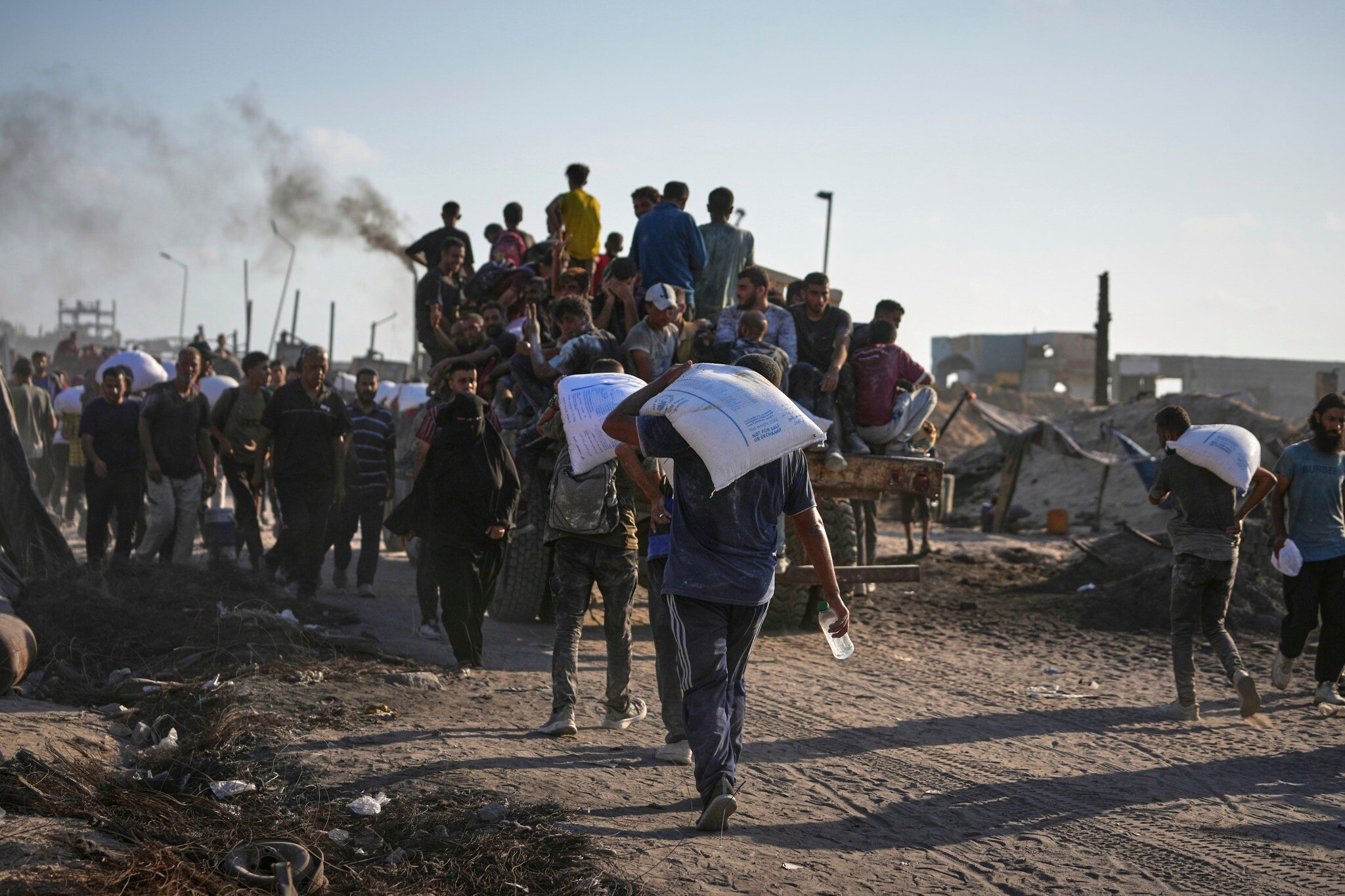
The Times of Israel liveblogged Thursday’s events as they unfolded.
Police confiscate gun from right-wing Arab Israeli influencer after road rage shooting
Police confiscate the handgun of right-wing Arab Israeli influencer Yosef Haddad, after arresting him earlier today for firing the weapon during an altercation with a motorcyclist in Jaffa.
Hebrew outlets reported earlier today that police had arrested both Haddad and the motorcyclist. Without naming Haddad explicitly, law enforcement announces that the “suspect who carried out the shooting has been released to house arrest, and the weapon was confiscated by the police.”
“The incident stemmed from a dispute over road use in which the car driver, who claimed he felt threatened, drew his firearm, cocked it and fired from within his vehicle,” police add.
No injuries were reported, and police are not aware of any prior contact between the two men. The investigation is ongoing.
Army denies IDF gunfire hit Palestinians in north Gaza: Warning shots fired toward threat, not crowd
The Israeli military denies that its gunfire hit Palestinians in an incident in the northern Gaza Strip today, after the Hamas’s government media office claimed 51 were killed and 648 were wounded while waiting to collect aid.
The IDF says that earlier today, it identified a crowd of thousands of Gazans near humanitarian aid trucks that entered northern Gaza from the Zikim Crossing, close to troops operating in the area.
“The forces fired warning shots in the area, not toward the crowd, but against the threat posed to them,” the IDF says.
The military says that according to a preliminary investigation, “there are no known injuries from IDF troops’ gunfire,” adding that the incident is under further investigation.
A military official says that the initial probe also found that “gunfire was heard from within the crowd and there were internal clashes among Gazans within the crowd, in addition to several incidents of people being run over by the aid trucks.”
Carney says Canada will recognize Palestinian state in September, joining France and UK
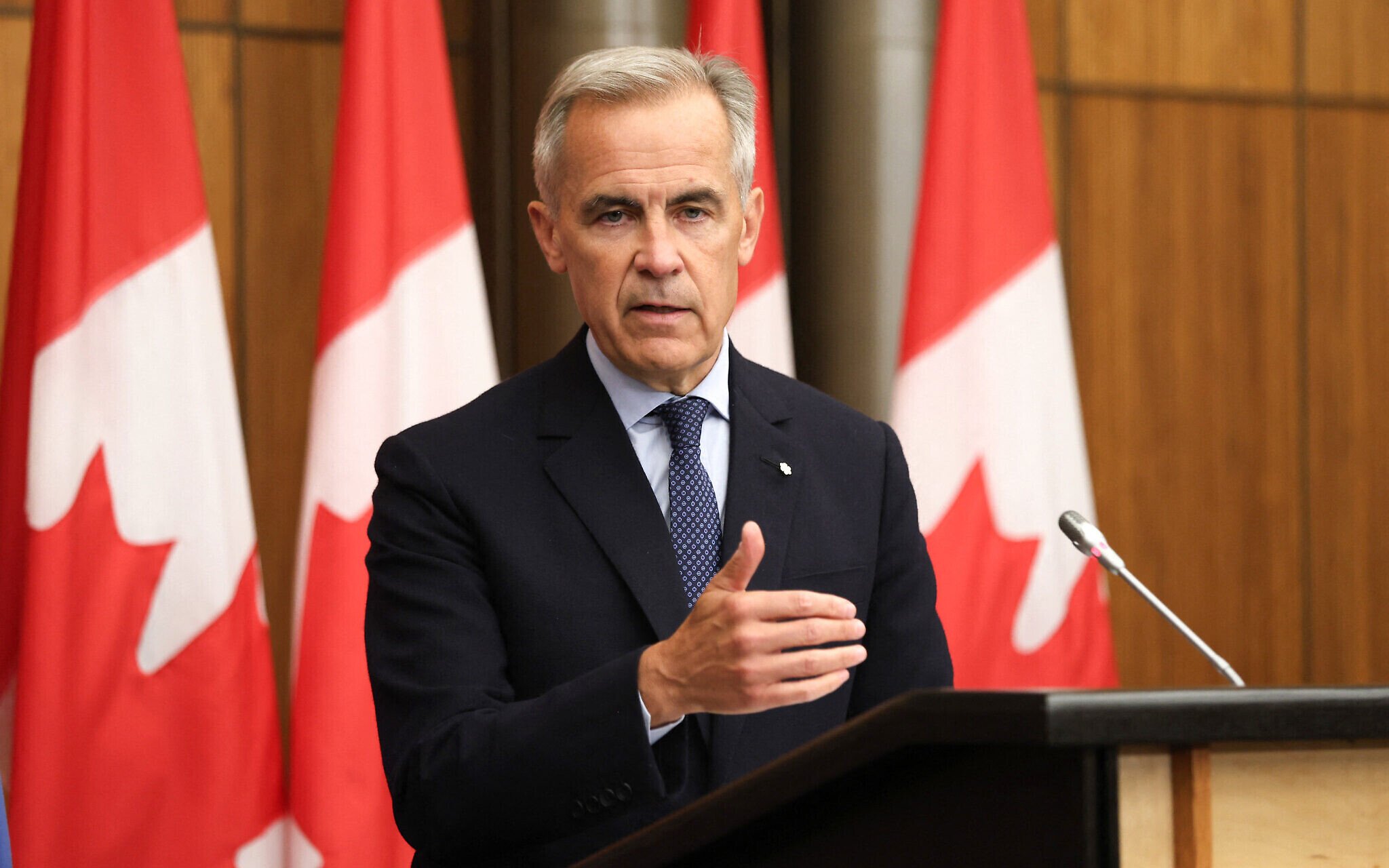
Canadian Prime Minister Mark Carney speaks during a press conference after a cabinet meeting to discuss both trade negotiations with the US and the situation in the Middle East, at the National Press Theatre in Ottawa, Ontario, Canada, on July 30, 2025. (Dave Chan/AFP)
Canada’s Prime Minister Mark Carney says his country will recognize a Palestinian state at the United Nations General Assembly in September.
He says the move is “predicated on the Palestinian Authority’s commitment to much-needed reforms” including elections, anti-corruption measures, and a demilitarized Palestinian state.
His announcement comes on the heels of recognition by fellow G7 states France and the UK.
Foreign Ministry slams Canadian announcement on Palestine recognition as ‘reward for Hamas’
Israel “rejects” Canada’s announcement that it will recognize a Palestinian state, says the Foreign Ministry.
“The change in the position of the Canadian government at this time is a reward for Hamas and harms the efforts to achieve a ceasefire in Gaza and a framework for the release of the hostages,” says the ministry on X, shortly after Prime Minister Mark Carney said his country would make the move at the UN General Assembly in September.
White House: Trump doesn’t think Hamas should be rewarded with Palestinian state recognition
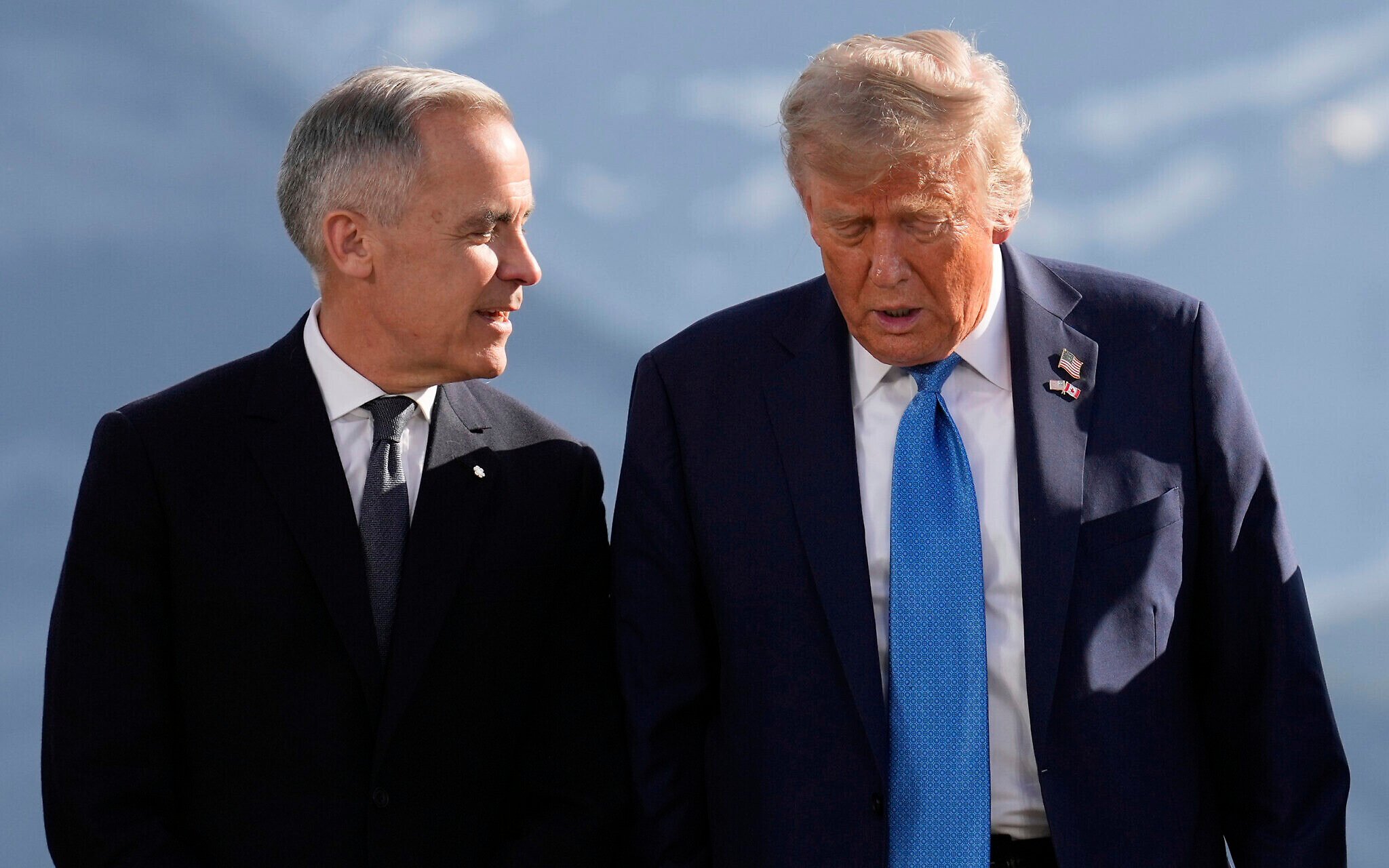
Canada's Prime Minister Mark Carney, left, talks with US President Donald Trump before a group photo at the G7 Summit, June 16, 2025, in Kananaskis, Canada. (AP Photo/Mark Schiefelbein)
The White House reiterates US President Donald Trump’s assertion that recognizing a Palestinian state would be “rewarding Hamas” after Canada joins the growing list of Western countries declaring their intention to take such a step in September.
“As the president stated, he would be rewarding Hamas if he recognizes a Palestinian state, and he doesn’t think they should be rewarded. So he is not going to do that. President Trump’s focus is on getting people fed,” a White House officials says in a statement sent out to reporters querying regarding the Canadian announcement.
Trump, in comments on Tuesday, avoided overly criticizing the UK and France for their plans to recognize a Palestinian state, asserting that their leaders have a right to their decisions.
The latest statement from the White House appears to maintain that same approach.
While Israel may have hoped that the US would actively seek to prevent countries from recognizing a Palestinian state, Washington does not appear be doing so.
Notably, the White House statement says Trump’s focus is on addressing the hunger crisis in the Gaza Strip, and not on releasing the remaining hostages amid the logjam in ceasefire negotiations.
Trump announced on Monday that he was working on a new Gaza aid plan that would see additional food centers established in the Strip to feed Gazans. The White House said on Tuesday that details would be forthcoming, but has yet to follow up.
While Trump said Tuesday that Israel would be responsible for running the new food centers, a senior Israeli official tells The Times of Israel that they are unaware of any such initiative in the works.
Mahmoud Abbas hails Canada’s ‘historic’ move to recognize Palestinian state
Palestinian Authority President Mahmoud Abbas welcomes Canada’s “historic” move to recognize a Palestinian state during a phone call with Canadian Prime Minister Mark Carney, Wafa reports.
Abbas “appreciated Canada’s historic position in recognizing the State of Palestine, which will enhance peace, stability, and security in the region,” the official PA news agency says.
Times of Israel staff contributed to this report.
Brown reaches deal with Trump administration, agrees to several measures against antisemitism

Students and community members hold an anti-Israel, pro-Palestinian rally at the encampment at Brown University in Providence, Rhode Island, on April 29, 2024. (Joseph Prezioso/AFP)
WASHINGTON — Brown University will pay $50 million to Rhode Island workforce development organizations in a deal with the Trump administration that restores lost federal research funding and ends investigations into alleged discrimination, officials say.
The university also agreed to several concessions in line with US President Donald Trump’s political agenda. Brown will adopt the government’s definition of “male” and “female,” for example, and must remove any consideration of race from the admissions process.
Brown President Christina H. Paxson says the deal preserves Brown’s academic independence. The terms include a clause saying the government cannot dictate curriculum or the content of academic speech at Brown.
“The university’s foremost priority throughout discussions with the government was remaining true to our academic mission, our core values and who we are as a community at Brown,” Paxson writes.
It is the latest deal between an Ivy League school and the Trump administration, which has used its control of federal funding to push for reforms at colleges he decries as overrun by liberalism and antisemitism.
The deal has numerous similarities with one signed last week by Columbia University, which the government called a roadmap for other universities. Unlike that agreement, however, Brown’s does not include an outside monitor.
The three-year agreement with Brown restores dozens of suspended grants and contracts. It also calls for the federal government to reimburse Brown for $50 million in unpaid federal grant costs.
The settlement puts an end to three federal investigations involving allegations of antisemitism and racial bias in Brown admissions, with no finding of wrongdoing. In a campus letter, Paxson anticipates questions about why the university would settle if it didn’t violate the law. She notes Brown has faced financial pressure from federal agencies along with “a growing push for government intrusion” in academics.
Brown agreed to several measures aimed at addressing allegations of antisemitism on its campus in Providence, Rhode Island. The school says it will renew partnerships with Israeli academics and encourage Jewish day school students to apply to Brown. By the end of this year, Brown must hire an outside organization — to be chosen jointly by Brown and the government — to conduct a campus survey on the climate for Jewish students.
Australian minister says Palestinian statehood recognition ‘a matter of when, not if’
SYDNEY — Australian Prime Minister Anthony Albanese says that he discussed the crisis in Gaza with his UK counterpart, Keir Starmer, and reiterated his government’s strong support for a two-state solution for Israel and the Palestinians.
Starmer this week said Britain was prepared to recognize a Palestinian state in September at the United Nations General Assembly in response to growing public anger over the images of starving children in Gaza.
Australia has not yet made a formal decision to recognize Palestinian statehood though Albanese supports Israel’s right to exist within secure borders and Palestinians’ right to demand their own state.
In a statement, Albanese says they agreed on the importance of using international momentum to secure a ceasefire, the release of all Israeli hostages and the acceleration of aid. They also want to ensure terrorist group Hamas does not play a role in a future Palestinian state.
Some of Israel’s closest allies, including France and Canada, have indicated they would recognize a Palestinian state amid growing international outrage over the dire humanitarian crisis in Gaza.
Israel has criticized France, Britain and Canada, saying their decision will reward Hamas.
Australian Treasurer Jim Chalmers says the treatment of hostages and any involvement of Hamas in a future Palestinian state remained major obstacles for Australia but adds the government would push for a two-state solution.
“It’s a matter of when, not if, Australia recognizes a Palestinian state … but I don’t want to put a time frame on it,” Chalmers tells ABC News.
Over half of US Senate Democrats back failed measures to block arms sales to Israel
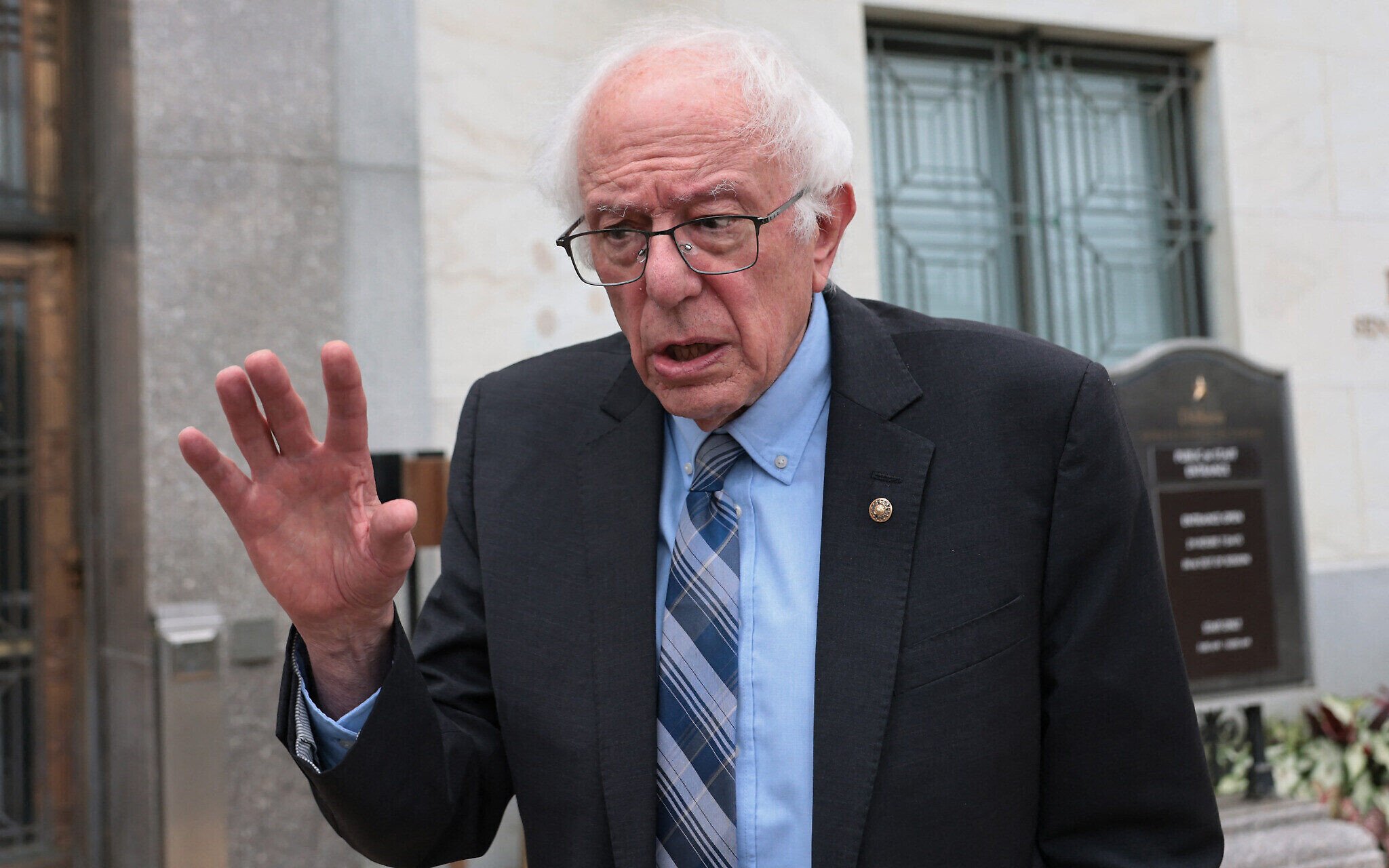
US Senator Bernie Sanders speaks with reporters about his meeting with NYC Mayoral Candidate outside the Dirksen Senate Office Building on July 16, 2025 in Washington. (Michael M. Santiago/Getty Images/AFP)
The US Senate rejects a pair of resolutions introduced by Senator Bernie Sanders that were aimed at blocking over $675 million in arms sales to Israel, though a majority of Democrats vote against the weapons transfers for the first time.
Twenty-seven Democrats vote to block the sale of tens of thousands of assault rifles to Israel, compared to 17 who vote with Republicans to advance the transfer.
Twenty-four Democrats vote to block the sale of 5,000 heavy bombs and guidance kits to Israel, compared to 20 who vote with Republicans to advance the transfer.
Sanders has brought such resolutions to the Senate floor throughout the Gaza war, and Wednesday’s were sure to fail like the previous ones, as Republicans hold a majority of seats in the chamber and can defeat the measures without Democratic support.
But the two votes show how Democrats have grown increasingly disillusioned with Israel’s prosecution of its war against Hamas.
The last time Sanders brought a resolution to the floor in April, only 15 Democrats voted to try and block a weapons sale. That marked a drop from the previous attempt in November 2024, when 19 Democrats voted to oppose such a transfer.
In a statement celebrating the shifting attitudes toward Israel in the Democratic Party, Sanders says the majority of the caucus “voted to stop sending arms shipments to a Netanyahu government which has waged a horrific, immoral, and illegal war against the Palestinian people.”
“The tide is turning. The American people do not want to spend billions to starve children in Gaza,” he adds. “The Democrats are moving forward on this issue, and I look forward to Republican support in the near future.”
Iran demands US pay compensation for war damage before nuke talks
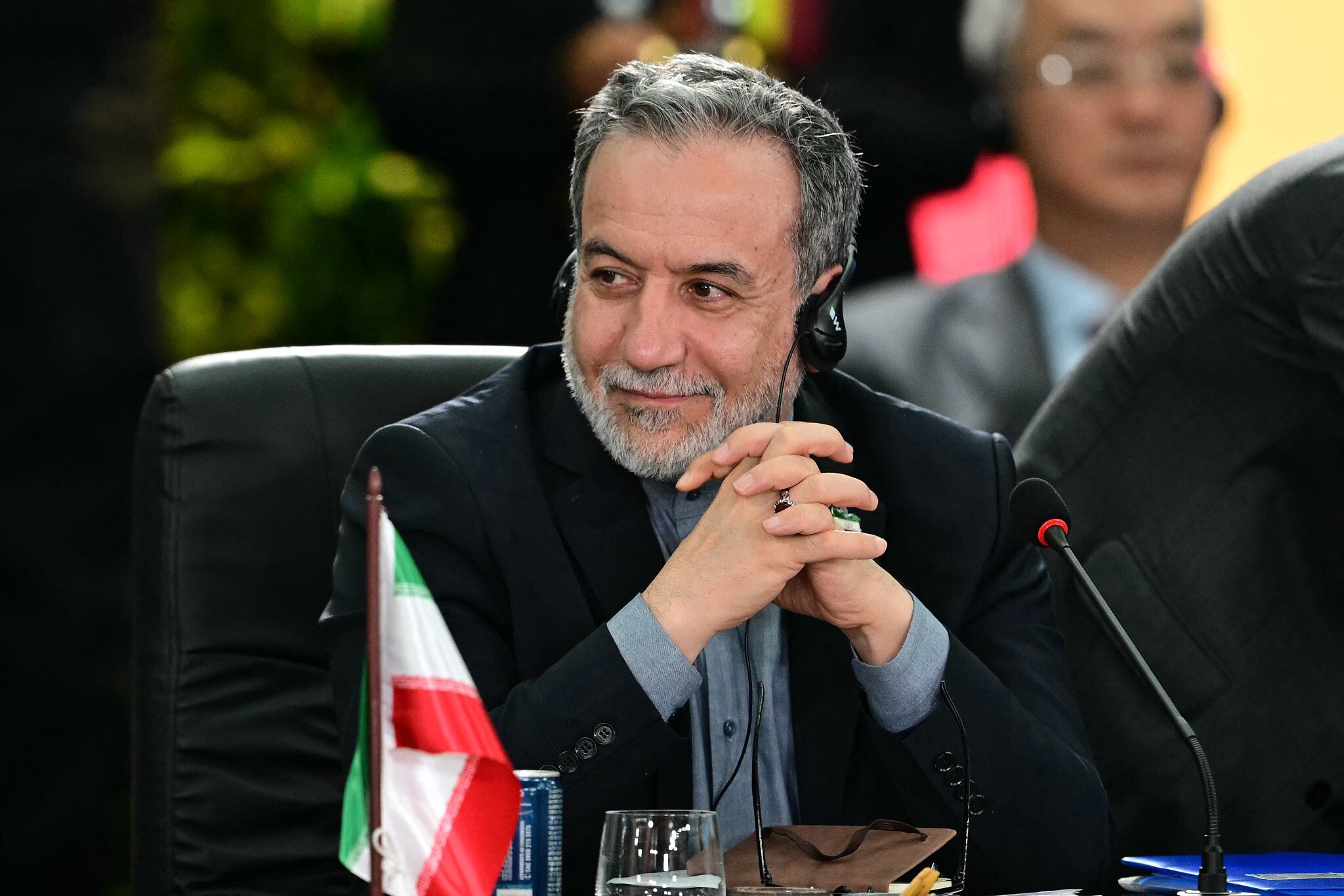
Iranian Foreign Minister Abbas Araghchi at the BRICS summit second plenary session in Rio de Janeiro, Brazil, on July 6, 2025. (Pablo Porciuncula/AFP)
Iran’s Foreign Minister Abbas Araghchi says he has exchanged messages with US envoy Steve Witkoff on restarting nuclear talks, telling the Americans that Tehran expects to be compensated for damage incurred in bombing attacks against its nuclear facilities ahead of negotiations, as it seeks “real confidence-building measures.”
“They should explain why they attacked us in the middle of… negotiations, and they have to ensure that they are not going to repeat that [during future talks],” he is quoted telling the Financial Times from Tehran. “And they have to compensate [Iran for] the damage that they have done.”
Nonetheless, Araghchi sounds an upbeat note on the prospect of talks aimed at curbing the Islamic Republic’s nuclear program.
“The road to negotiation is narrow but it’s not impossible. I need to convince my hierarchy that if we go for negotiation, the other side is coming with real determination for a win-win deal,” he is quoted saying.
However, he holds firm to Iran’s demand that it maintain nuclear enrichment capacity, a major sticking point in talks that collapsed when the US joined Israel’s military campaign against Iran last month.
“With zero enrichment, we don’t have a thing,” he says, noting that many in Tehran oppose even talking to the US over the issue. ““People are telling me, ‘Don’t waste your time anymore, don’t be cheated by them . . . if they come to negotiations it’s only a cover-up for their other intentions.’”
In the interview, Araghchi acknowledges that among the sites attacked during the 12-day conflict was a new enrichment plant near Isfahan, marking the first time an official in Iran has admitted the facility was hit. However, he denies enrichment was taking place at the site at the time.
Trump hints at blowing up Canada trade talks over Palestine recognition
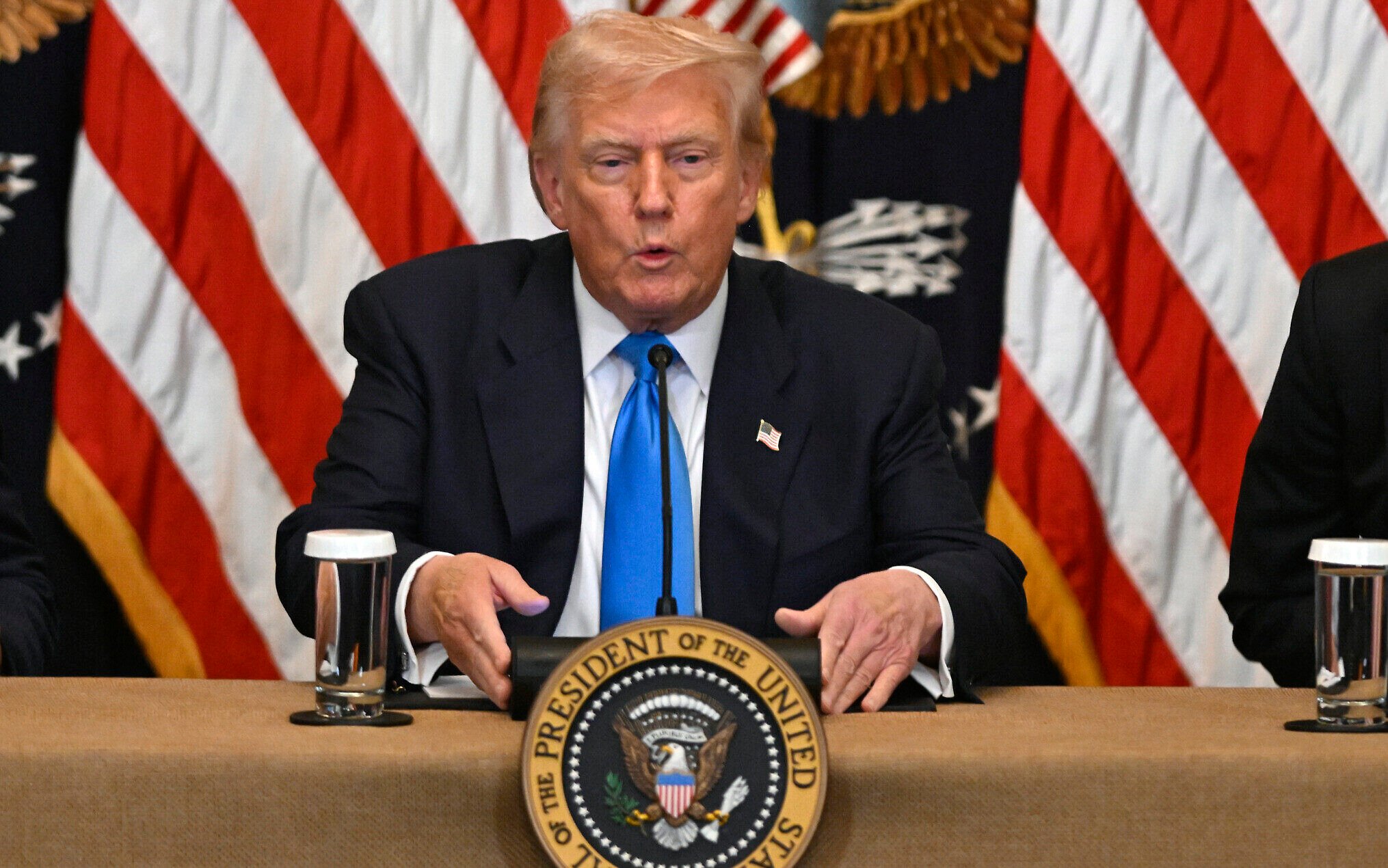
US President Donald Trump speaks at an event to promote his proposal to improve Americans' access to their medical records in the East Room of the White House, Wednesday, July 30, 2025, in Washington. (AP/John McDonnell)
US President Donald Trump criticizes Canada for announcing it will recognize a Palestinian state, linking the issue to efforts to negotiate a trade agreement with America’s northern neighbor for the first time.
“Wow! Canada has just announced that it is backing statehood for Palestine. That will make it very hard for us to make a Trade Deal with them. Oh’ Canada!!!” Trump writes in one of several Truth Social posts on trade that he has fired off since midnight.
The post appears to be a departure from previous remarks he has made on the decisions by the UK and France to recognize a Palestinian state, in which he noted that he disagreed with the moves, which would “reward” Hamas, but would not seek to influence their decisions.
It also seems to be the first time that Trump has signaled at retribution for countries who take the step, wielding one of his most powerful potential levers in in international relations.
The US is currently negotiating trade deals with a host of countries seeking to avoid steep tariffs on entry to the US market. Deals with the EU and Britain had been announced prior to their Palestine announcements.
Canada is one of the US’s largest trading partners and reaching a deal is seen as a top priority in Ottawa.
Trump said to warn Jewish donor that MAGA world ‘starting to hate Israel’
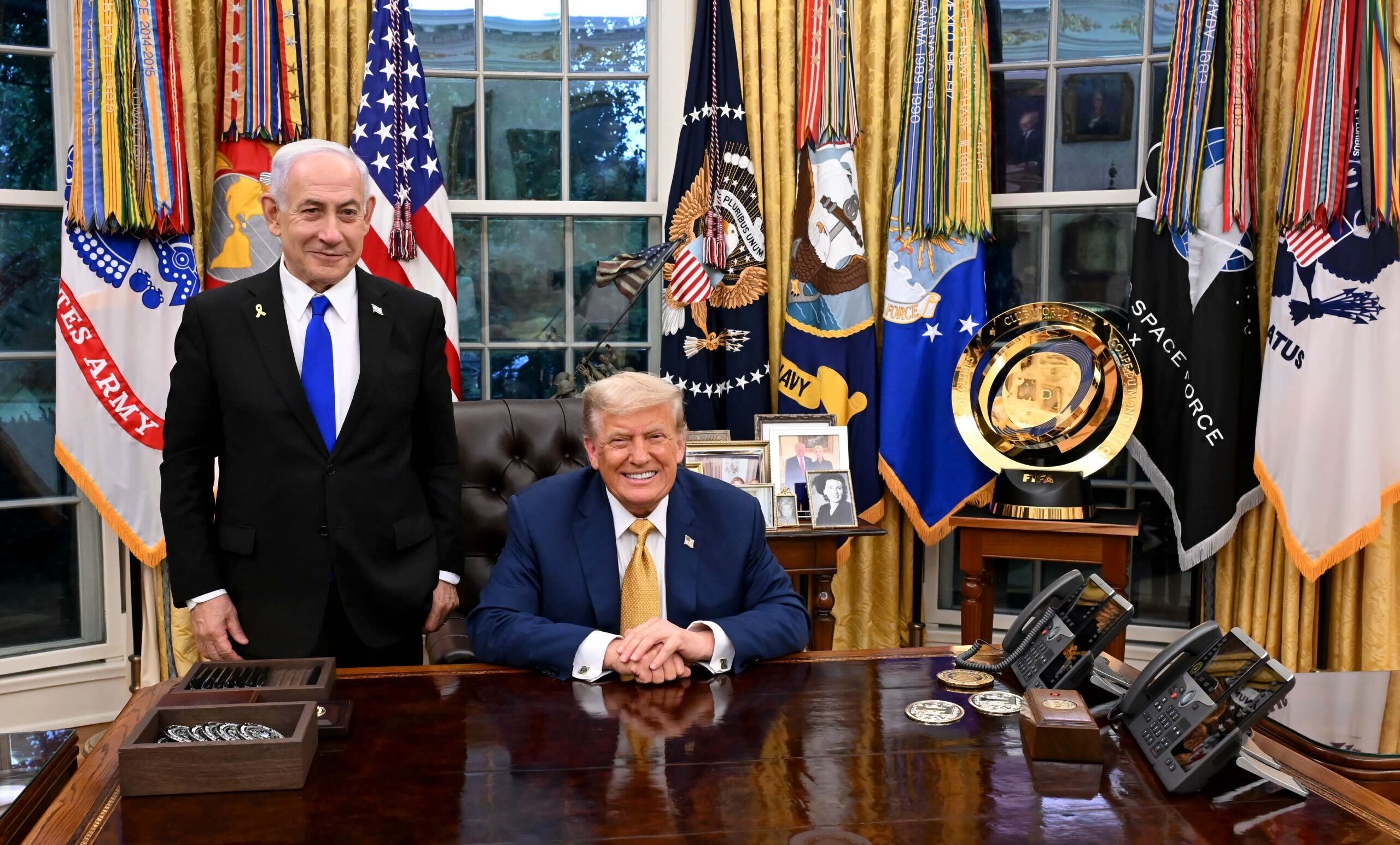
US President Donald Trump, right, meets Prime Minister Benjamin Netanyahu in the White House, July 8, 2025. (Avi Ohayon/GPO)
US President Donald Trump recently warned a Jewish campaign donor that his MAGA base was beginning to turn on Israel, the Financial Times reports.
“My people are starting to hate Israel,” Trump is quoted as having told the unnamed donor recently, citing a Mideast expert, also unnamed, with contacts inside the Trump administration.
The report describes the donor as “prominent.”
“There are people in the White House who are watching this narrative develop in the right wing, in the MAGA world, that is very anti-Israel, very anti-Jewish,” the expert is quoted saying.
The comments come as Israel has come under increasing criticism, including from Trump and other Republicans, due to images of hunger emerging from Gaza.
On Monday, far-right Rep. Marjorie Taylor Greene of Georgia, a MAGA stalwart who has promulgated antisemitic conspiracy theories and routinely calls for an end to foreign aid, called what is happening in Gaza “genocide.”
“It’s the most truthful and easiest thing to say that Oct 7th in Israel was horrific and all hostages must be returned, but so is the genocide, humanitarian crisis, and starvation happening in Gaza,” she wrote on X.
On Tuesday, US Ambassador to Israel Mike Huckabee denied the existence of a rift between Trump and Prime Minister Benjamin Netanyahu, calling it a “false” media narrative.
“The disconnect is with the media [that] wants there to be an anti-Israel message that they keep getting across; but it’s a false message,” Huckabee said.
Canadian Jewish umbrella group criticizes Palestine recognition as ‘pre-emptive’
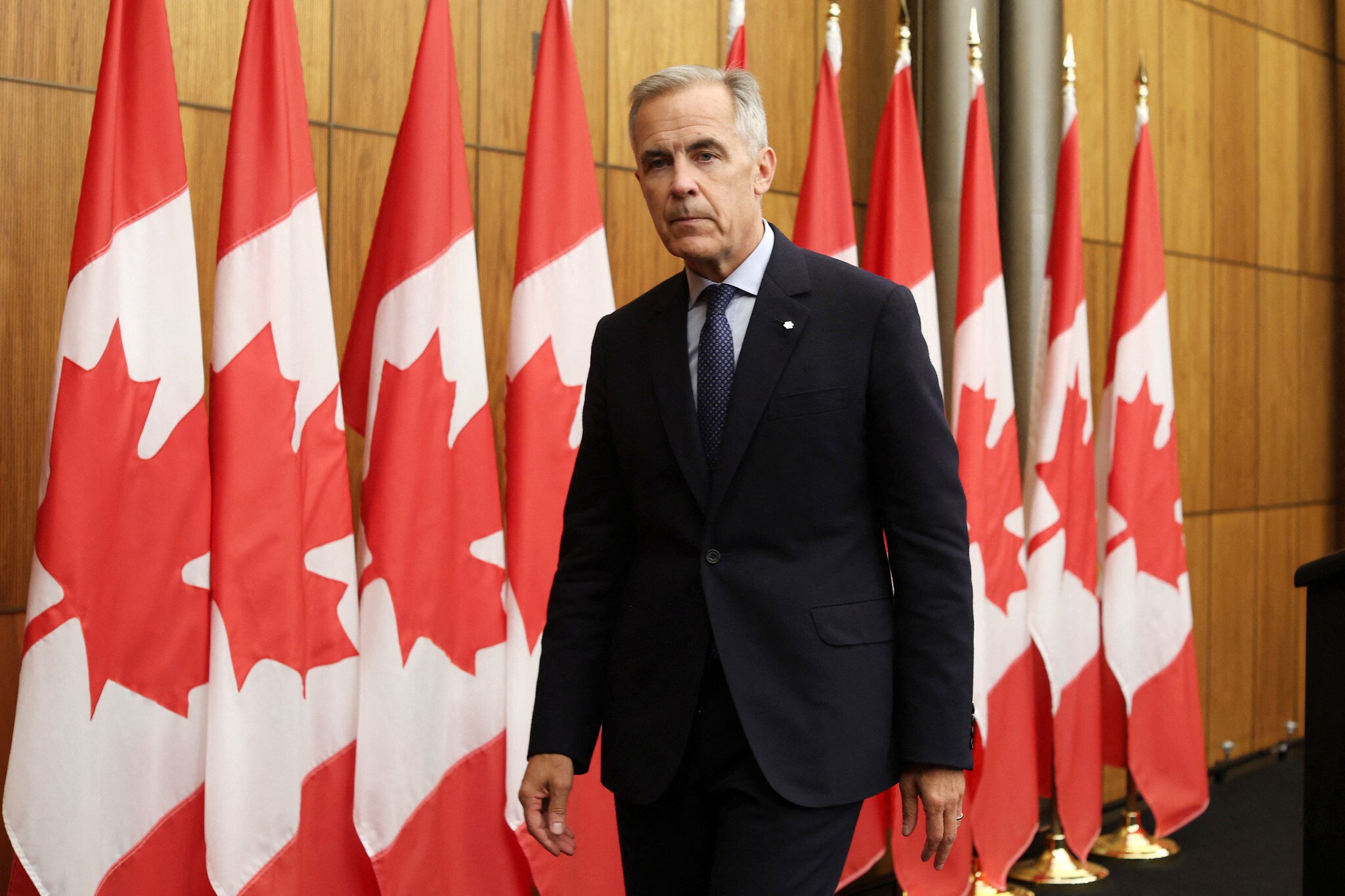
Canadian Prime Minister Mark Carney leaves after speaking during a press conference after a Cabinet meeting to discuss both trade negotiations with the US and the situation in the Middle East, at the National Press Theatre in Ottawa, Ontario, Canada on July 30, 2025. (Dave Chan / AFP)
Canada’s Centre for Israel and Jewish Affairs, which represents the country’s Jewish Federations, has come out against Canadian Prime Minister Mark Carney’s statement on Wednesday that Ottawa will recognize a Palestinian state at the United Nations General Assembly in September.
The announcement “is predicated on misplaced faith in vague commitments by Palestinian Authority President Mahmoud Abbas, notorious for his corruption, lack of democratic credibility, and funding of terrorists,” says CIJA head Noah Shack in a statement.
“Extending recognition absent real change on the ground is a recipe for another failed Palestinian pseudo-state controlled by terrorists,” Shack continues. “It is deeply concerning that the government did not link statehood recognition to the removal of Hamas and the return of Israeli hostages. This only emboldens Hamas and condemns Palestinians and Israelis—including the hostages and their families—to more suffering.”
“Our community seeks an end to this painful conflict and a better future where Israelis and Palestinians can coexist in peace,” Shack says. “This requires a Palestinian state to be Zionist—affirming the right of a democratic, Jewish state to exist in safety. Pre-emptive recognition of a Palestinian state undermines this core principle.”
Palestinian man reported killed during fiery settler rampage near Ramallah
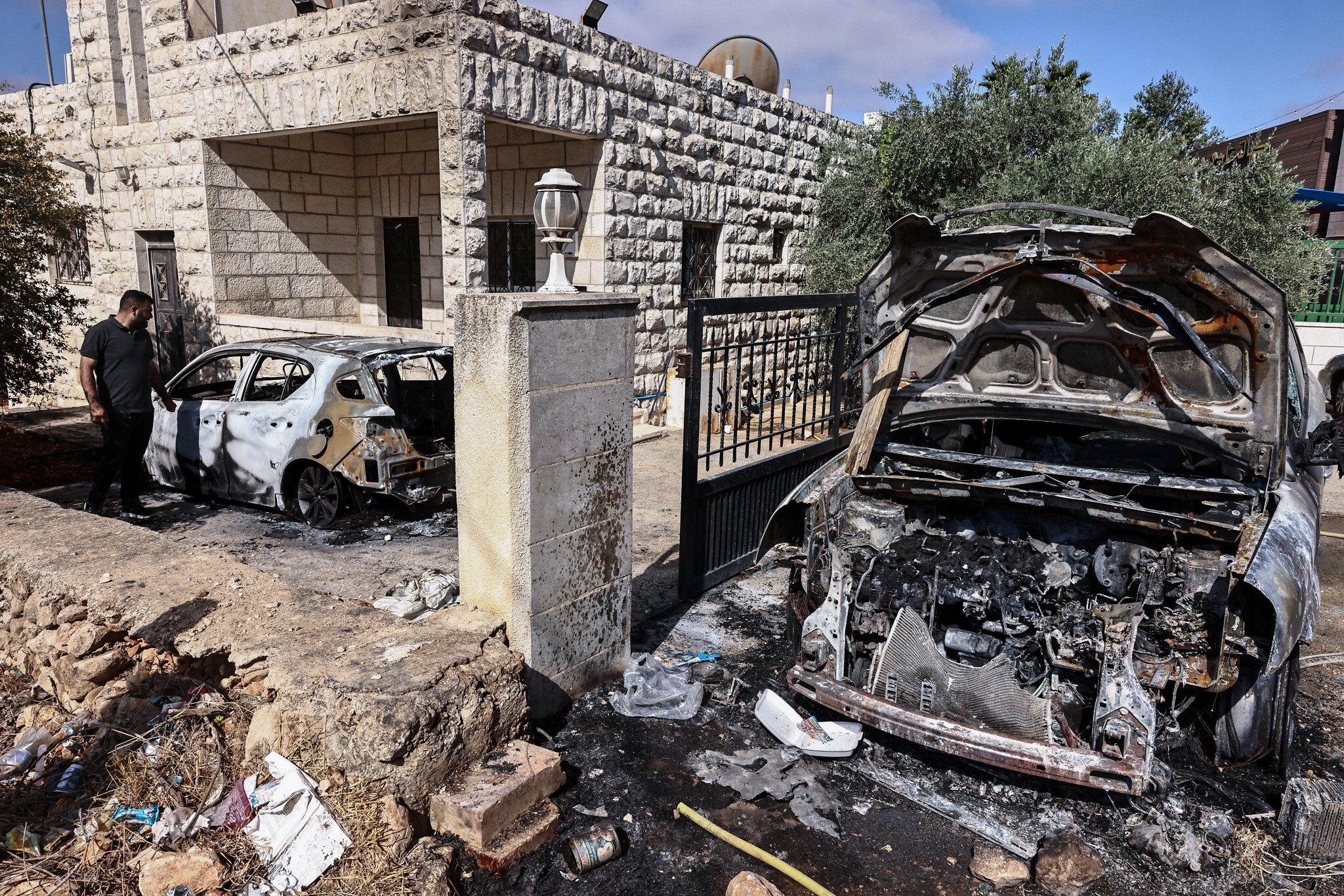
Palestinians say one person is dead after settler extremists allegedly rampaged through a West Bank town near Ramallah overnight, setting fire to cars and homes.
According to official Palestinian news agency WAFA, the man died of suffocation while trying to put out flames after a home in Silwad was set on fire.
zionist jewish settlers violence
Extremist zionist jewish settlers set fire on Palestinian property as they attacked Palestinian villages of Silwad, Ramon and Abu Falah west of occupied West Bank city of Ramallah! pic.twitter.com/dLVJjXuMFu
— Motasem A Dalloul (@AbujomaaGaza) July 31, 2025
The agency had earlier reported that the man was shot by troops, but the claim was later removed from its account.
An Israel Defense Forces spokesperson says the army is looking into the matter.
Footage from the town shows several homes and cars on fire. On one wall, Hebrew graffiti reading “Revenge [for] the shooting of Zio-Nazis” is seen alongside a star of David.
Earlier tonight, armed Israeli settlers attacked the Palestinian town of Silwad near Ramallah, occupied West Bank, killing one Palestinian and injuring several others.
Backed by Israeli occupation forces who fired on unarmed civilians, the settlers burned homes, vehicles, and… pic.twitter.com/kNFftEdZwC
— Quds News Network (@QudsNen) July 31, 2025
Attacks are also reported to have taken place in the nearby villages of Rammun and Khirbet Abu Falah.
آثار إحراق المـ."ستوطنين لمركبة ومنزل خلال الهجوم على بلدة سلواد شمال شرق رام الله. pic.twitter.com/aFvmoDijvh
— فلسطين بوست (@PalpostN) July 31, 2025
Activists say attacks by settlers against Palestinians in the area have intensified in recent months.
Toddler found okay after being accidentally left in car overnight
The Magen David Adom rescue service says a 3-year-old boy is doing fine after having been left in a closed car all night.
According to MDA, medics called to the scene in Rehovot at 8 a.m. checked the boy and found he did not require hospitalization.
Temperatures in the central city were 26º Celsius (79º F) overnight, and inched up to 27º C (81º F) by 8 a.m., according to official data from the Israel Meteorological Service.
Earlier this month, three children who had been forgotten were rescued from cars in life-threatening condition in two separate incidents within hours of each other.
According to data presented to Knesset in 2023, 45 children in Israel died between 2010 and 2022 after having been left in hot cars.
Elite IDF division pulls out of Gaza after completing mission in Strip’s north — army
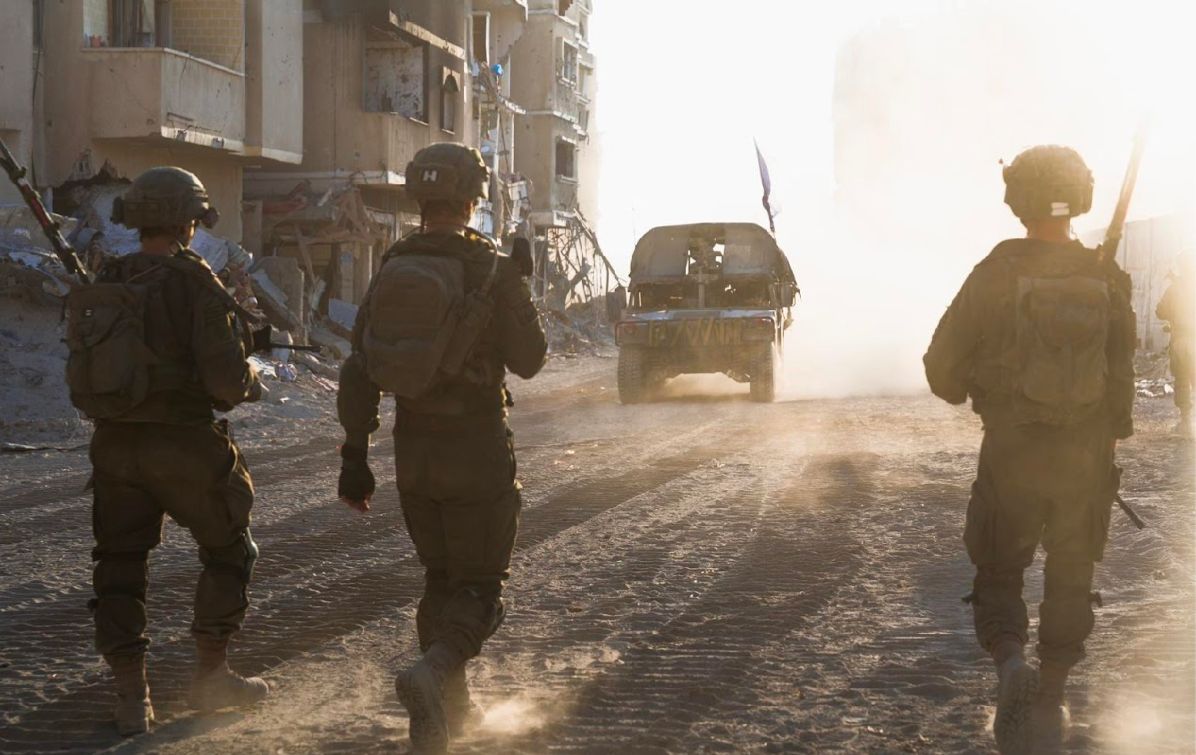
Illustrative: IDF soldiers are seen in the Gaza Strip in a handout photo released July 28, 2025. (Israel Defense Forces)
The IDF’s 98th Division has been withdrawn from the Gaza Strip following several months of operations in Khan Younis and Gaza City’s Shejaiya and Zeitoun neighborhoods.
The division, an elite formation of thousands of soldiers in paratrooper and commando units, was deployed to southern Gaza’s Khan Younis in May, before briefly being taken out of the Strip during the war with Iran in June. It was then redeployed to Gaza City.
The military says the division has completed its operations in northern Gaza “in accordance with operational planning.” The forces are now preparing for additional tasks, the IDF says.
The move leaves four divisions, constituting tens of thousands of troops, still inside Gaza.
Iranians went all in on gold amid war, report says
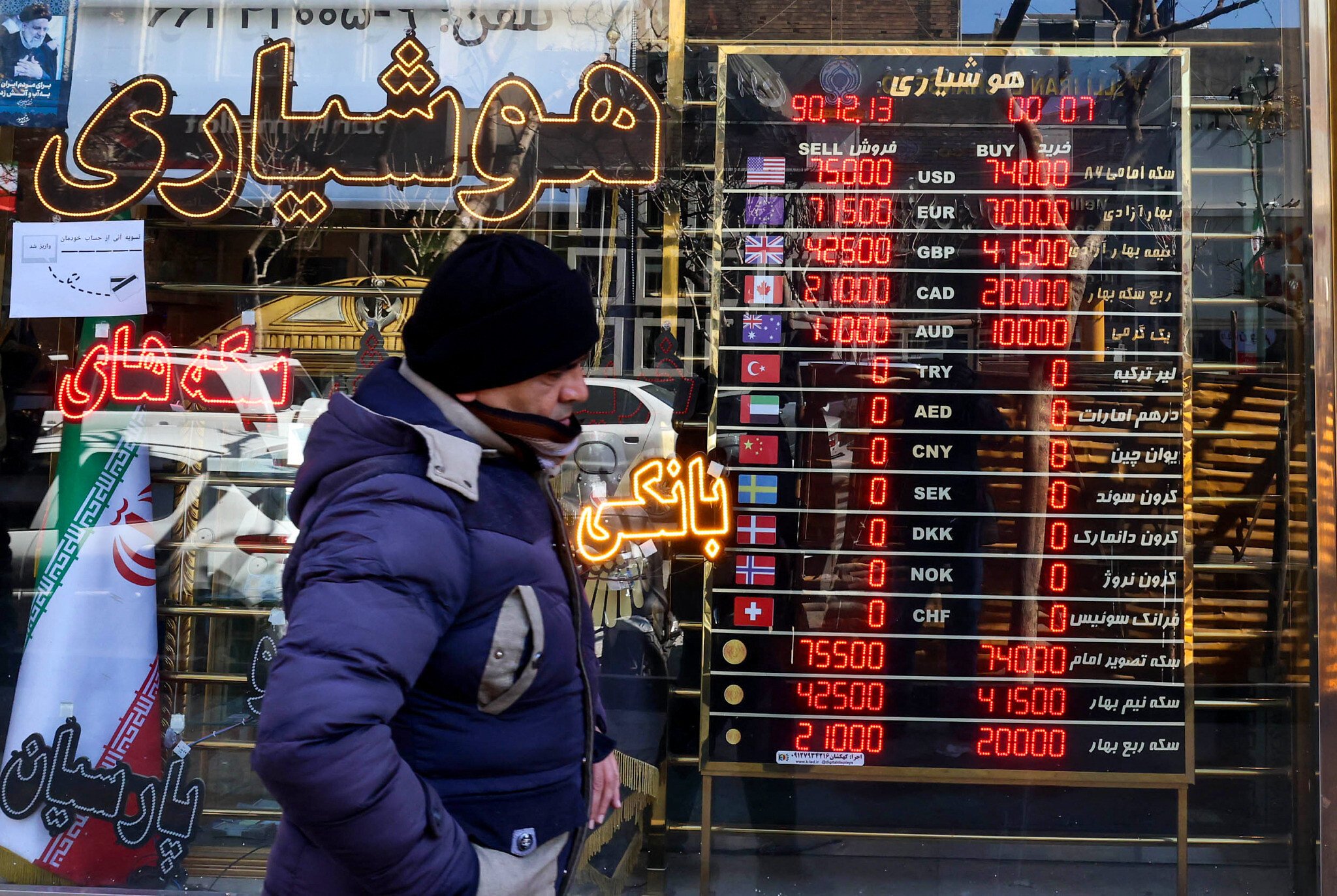
A man walks past a currency exchange shop in the Grand Bazaar in Tehran on March 3, 2025. (Atta KENARE / AFP)
Gold purchases surged in Iran during the second quarter of the year, marked by the country’s 12-day conflict with Israel, the World Gold Council says in a report.
Despite high prices, the overall volume of gold sales rose 20 percent compared to the same period last year, the council says, adding that demand for gold coins and bars is now at its highest level in six years.
Even as worldwide demand for gold coins and bars fell off by six percent in the second quarter over the previous three months, Iranians kept stocking up on earrings, pendants and other types of bling, the report says.
“Iran was the outlier -– consumers bought gold jewelry as a proxy investment, pushing demand in the quarter up 12 percent year on year,” says council analyst Louise Street.
Israel says another ‘starving’ Gazan in viral image actually suffers genetic disorder, in fresh debunk
The Defense Ministry is pushing back against claims that viral images of 14-year-old Palestinian Abdul Qader al-Fayoumi reflect starvation in Gaza, saying the teen suffered from a genetic neurological disorder and was treated in Israel in 2018.
In a post on its English-language X account, the Coordinator of Government Activities in the Territories (COGAT) accuses Hamas of exploiting images of ill children to spread misinformation and blame Israel.
Once again, Hamas is using photos of sick children to push the “starvation” narrative and blame Israel.
But the truth tells a different story.#TheFacts: 14-year-old Abdul Qader al-Fayoumi was treated in Israel back in 2018 for a genetic disease.Abdul was one of the hundreds… pic.twitter.com/4CcB2Md1ao
— COGAT (@cogatonline) July 31, 2025
“Hamas, meanwhile, keeps cynically exploiting them for its own twisted agenda, and part of the international media buys it,” the statement reads.
Reports out of Gaza last week claimed al-Fayoumi had died of starvation, describing him as a child. The COGAT post does not dispute his death.
COGAT says al-Fayoumi was one of hundreds of Gazans with similar conditions who were treated in Israeli hospitals before Hamas destroyed the Erez Crossing on October 7, 2023, as part of its surprise attack on southern Israel.
Since then, Israel has shifted medical evacuations to third-party countries via the Kerem Shalom Crossing and Ramon Airport. Over 3,700 Gazans — mostly patients in need of treatment and their escorts — have exited this way, according to Israeli officials.
According to COGAT, 180 patients and their escorts were transferred yesterday for further treatment in unspecified European countries and Jordan.
Images of starving Gazan children have intensified worldwide alarm and revulsion of the situation in the Strip, bolstering allegations that Palestinians are starving and that Israel is not doing enough to get aid to them.
Earlier this week, COGAT also responded to the circulation of a photo of 5-year-old Osama al-Rakab, clarifying that he too suffers from a genetic condition unrelated to the war and had been transferred for treatment in Italy last month.
Herzog set for Baltic jaunt next week
President Isaac Herzog will depart Sunday on a diplomatic visit to the Baltic states, his office announces.
Herzog will meet with his Lithuanian, Latvian, and Estonian counterparts as well as other senior officials, focusing on rallying global support for freeing the hostages held by Hamas in Gaza, assisting Israel’s diplomatic efforts “amid national challenges,” strengthening bilateral economic and security ties, and increasing international pressure on Iran, according to his office.
Herzog will be accompanied by a senior economic delegation from the Israel Export Institute, the Manufacturers Association of Israel, and the Israel Innovation Authority, to boost economic cooperation through meetings with counterparts, his office adds.
During the trip, the president will plan to meet with local Jewish communities and visit Holocaust memorial sites.
The trip follows Foreign Minister Gideon Sa’ar’s visit to the three Israel-friendly European Union member states earlier this month.
Lebanese president demands Hezbollah disarm before US ratchets up pressure
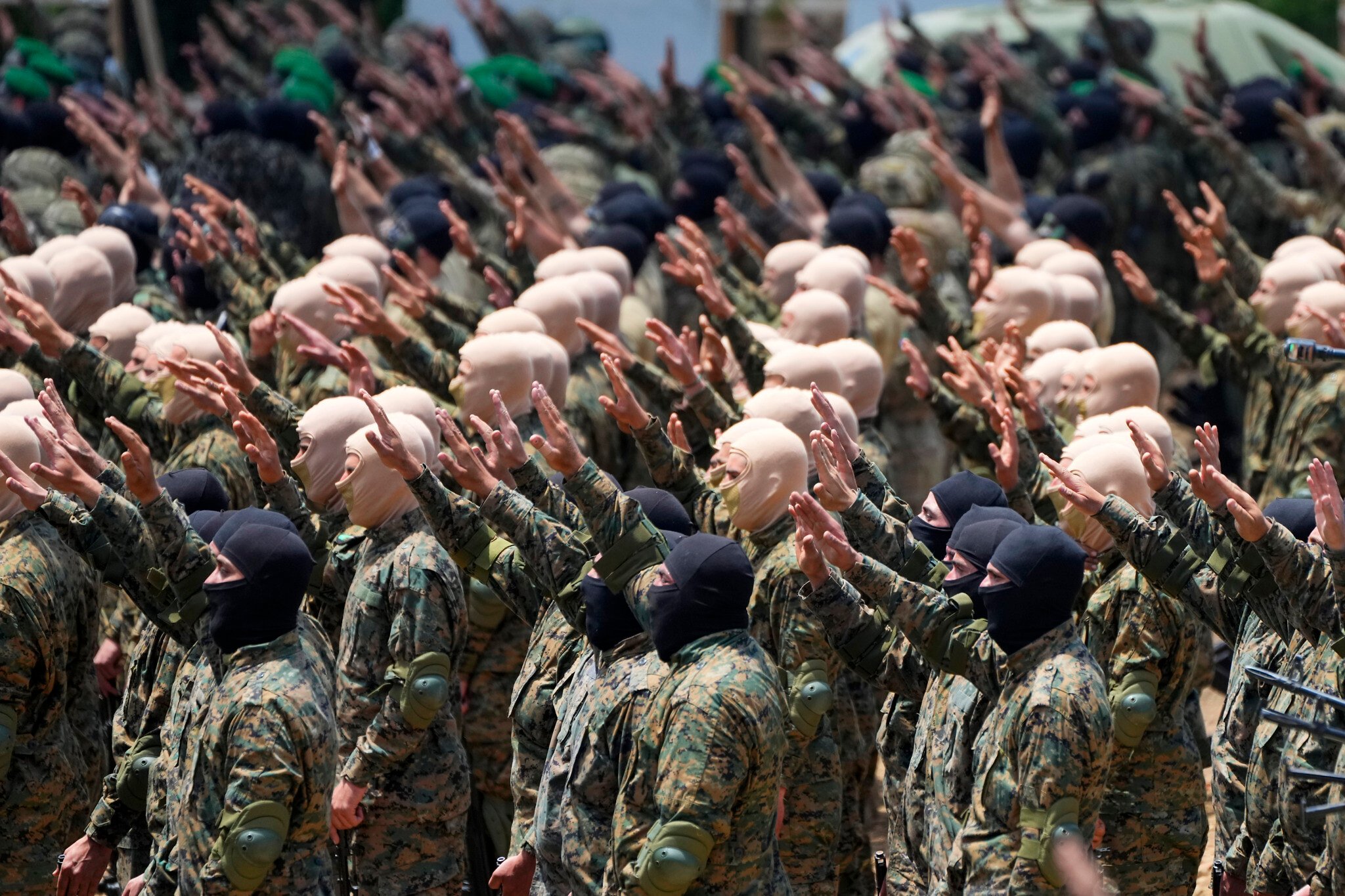
Gunmen from the Lebanese terror group Hezbollah carry out a training exercise in Aaramta village in the Jezzine District, southern Lebanon, May 21, 2023. (AP Photo/Hassan Ammar, File)
Lebanese President Joseph Aoun says his country is determined to disarm Hezbollah.
Aoun calls on the Iran-backed group and other Lebanese parties to seize the opportunity to hand over their weapons sooner rather than later, as Washington increases pressure on Hezbollah to give up its arms.
Beirut is demanding “the extension of the Lebanese state’s authority over all its territory, the removal of weapons from all armed groups including Hezbollah and their handover to the Lebanese army,” Aoun says in a speech to mark Army Day.
Aoun adds that the country will seek $1 billion annually for 10 years to support the army and security forces in Lebanon.
Hezbollah’s leader Qassem Naim said Wednesday that those demanding its disarmament were serving Israeli goals, rebuffing calls for it to lay down its arms.
Druze pair who entered Syria accused of trying to smuggle rifle back into Israel
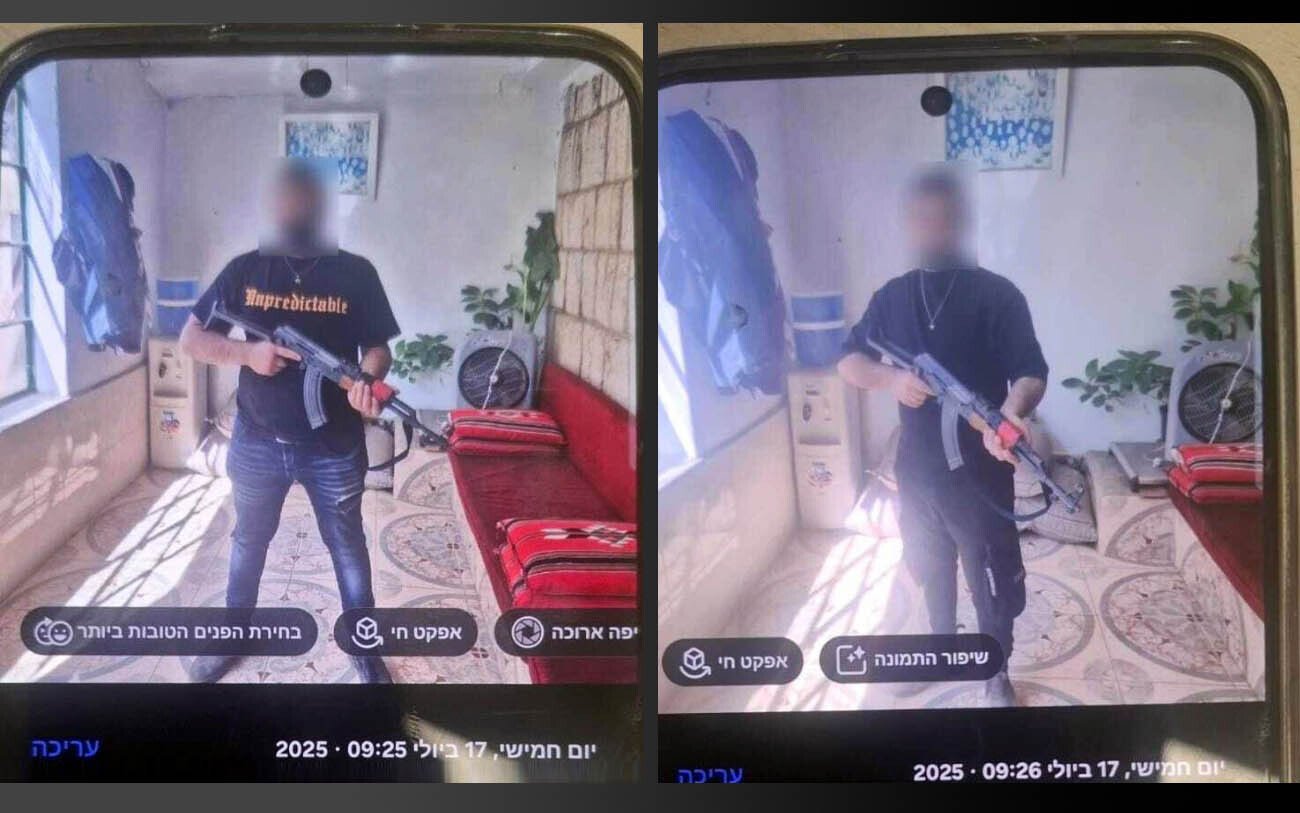
Photos of two Druze Israelis holding a Kalashnikov rifle are seen on a phone after the pair were detained while allegedly smuggling the gun into Israel from Syria, in a combination of photos released by police on July 31, 2025. (Israel Police)
Prosecutors plan to file charges against two Druze Israelis after they were nabbed trying to return home from Syria with a Kalashnikov rifle earlier this month, police say.
The two suspects, an 18-year-old from Kisra and 20-year-old from Beit Jann, had crossed into Syria along with around 1,000 other Druze inhabitants of Israel, seeking to rescue their coreligionists from attacks by Bedouin tribes and regime forces. Their names are not published.
The two returned to Israel on July 17 and were inspected by police, who found a Kalashnikov rifle and magazine in the personal belongings of the two young men. They were detained and the firearm was seized.
According to law enforcement, investigators searching the young men’s phones found photos and video of the two holding the same weapon that was seized from them at the border. It is unclear where the photos were taken.
Prosecutors will file an indictment against the pair in the Nazareth District Court later today and request they remain in detention until the end of legal proceedings, police say. They will be charged with unlawful departure to an enemy country and illegal import of a weapon.
Suspect in Melbourne synagogue arson appears in court day after arrest
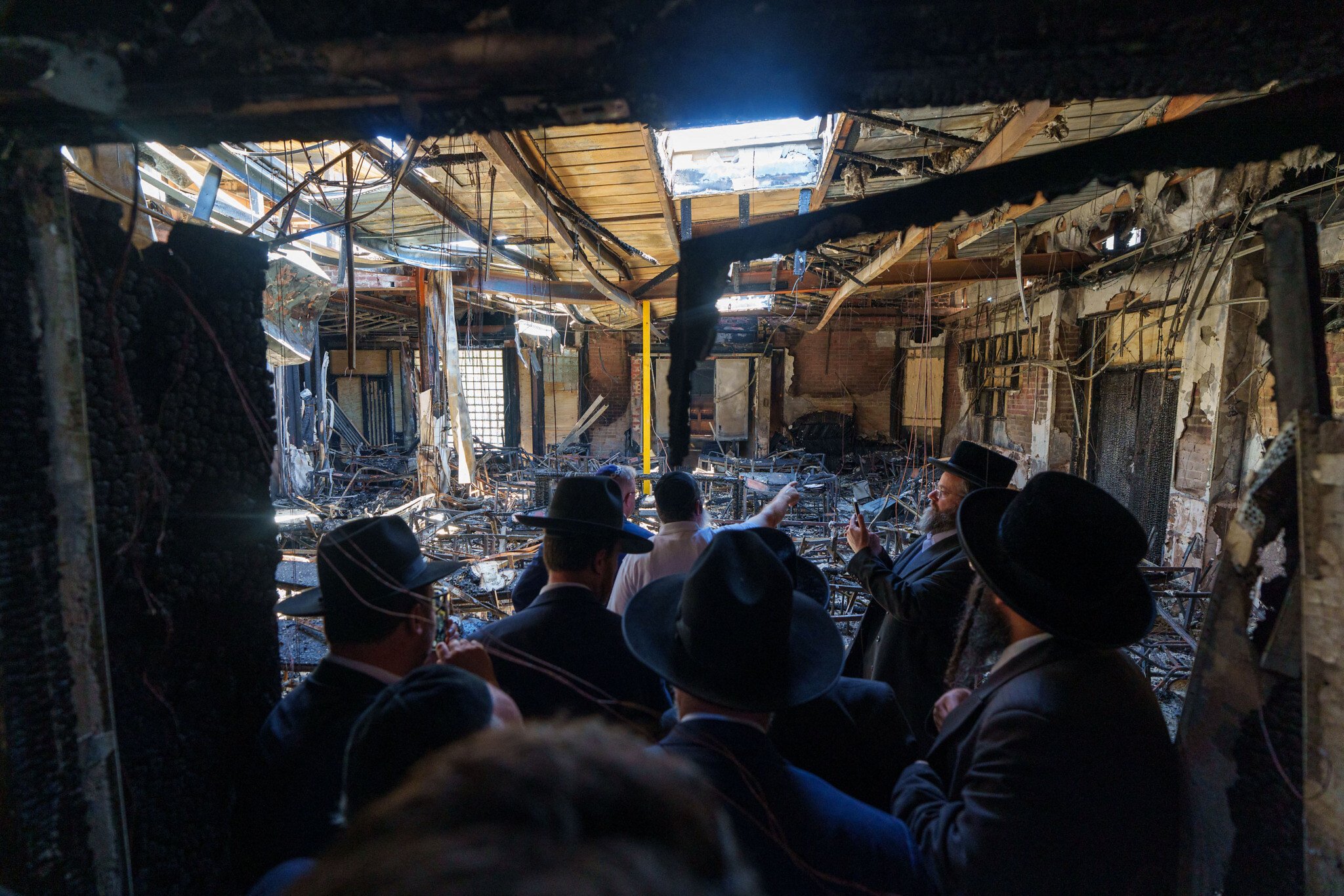
Australia's Prime Minister Anthony Albanese (C) and members of the local Jewish community visiting the torched Adass Israel Synagogue in Melbourne on December 10, 2024. (DEPARTMENT OF PRIME MINISTER AND CABINET / AFP)
A suspected arsonist accused of destroying a Melbourne synagogue appears in the Australian city’s Magistrates Court, a day after he was arrested at a Melbourne home.
Police allege Giovanni Laulu, 21, is one of three masked men who spread a liquid accelerant around the interior of the Adass Israel Synagogue then set it alight before dawn on December 6. A worshiper preparing for morning prayers suffered minor burns.
Laulu is charged with arson, reckless conduct endangering life and car theft.
Laulu confirms his name but otherwise remains silent during the brief court appearance. He does not enter pleas or apply to be released on bail. He is ordered to remain in custody at least until his next court date on August 6.
His lawyer tells Magistrate Brett Sonnett that Laulu has been in prison before.
Prosecutors are seeking 12 weeks to gather evidence against Laulu, saying 11 cellphones need to be analyzed.
Sonnett gives the prosecution until October 22 to present the case to Laulu’s lawyers.
Laulu is the first suspect to be caught, but police have foreshadowed more arrests. Police suspect there are also accomplices who planned the attack from overseas.
Federal and state police, plus Australia’s main domestic spy agency, have been investigating the crime, which is suspected to be politically motivated, amid a nationwide surge in antisemitic attacks thought fueled by the war against Hamas in Gaza. Police say more than 220 law enforcement officers have devoted more than 50,000 hours to the investigation.
Witkoff lands in Israel, set to meet Netanyahu at 2 p.m.
United States special envoy Steve Witkoff has landed in Israel for meetings on Gaza, Hebrew-language media reports.
Witkoff, US President Donald Trump’s point man on Gaza ceasefire efforts as well as nuclear talks with Iran, is expected to meet with Prime Minister Benjamin Netanyahu at 2 p.m., according to the Prime Minister’s Office.
President Isaac Herzog releases a statement welcoming the envoy, who has been a key mediator in the ongoing negotiations for a ceasefire and hostage-release deal.
“Witkoff’s visit is yet another effort, a vital and critical effort, that must not be missed… to achieve a deal to bring the hostages home,” he says.
According to Ynet, Witkoff is also expected to make a rare foray into Gaza during his trip. While there, he will visit aid distribution sites run by the US- and Israel-backed Gaza Humanitarian Foundation, whose operations have caused major international backlash over its failure to address the humanitarian situation and allegations of IDF shootings near distribution facilities.
This would mark Witkoff’s second trip to Gaza this year after he visited the Netzarim Corridor area in the Strip in late January, becoming the most senior US official to visit the territory in over a decade.
A US official said yesterday that Witkoff “will meet with officials to discuss next steps in addressing the situation in Gaza.”
The PMO has not shared additional details of the visit.
UTJ organ declares no compromise on IDF enlistment quotas, sanctions
Ultra-Orthodox newspaper Hamodia, seen as a mouthpiece for the Agudat Yisrael faction of the United Torah Judaism party, publishes an editorial rejecting any possible compromise on efforts to draft members of the community into the military, as ultra-Orthodox politicians demand the passage of legislation enshrining exemptions for yeshiva students into law.
“There will be no quotas or targets, neither 50 percent nor 2%,” reads the editorial, referring to efforts to negotiate rules that will set enlistment quotas and punishments against draft dodgers. “There will be no sanctions, and all discussions on the matter are irrelevant.”
The editorial comes a day after the top rabbinic leadership of the ultra-Orthodox community rejected any conscription legislation containing such enlistment targets during a meeting in the central Israel kibbutz of Ma’ale Hahamisha.
The Ashkenazi United Torah Judaism and Sephardic Shas parties have been pushing hard for the passage of legislation enabling ultra-Orthodox men to continue to avoid military conscription or other national service, in the wake of last year’s High Court of Justice ruling that such exemptions are illegal on equality grounds.
Earlier this month, UTJ quit the coalition after being presented with a copy of a proposed enlistment bill prepared by the Knesset Foreign Affairs and Defense Committee’s then-chairman, Yuli Edelstein, which reportedly contained quotas and sanctions. Shas also quit the government, but has remained part of the coalition, allowing Prime Minister Benjamin Netanyahu to stay in power.
On Wednesday, the IDF announced that it had completed sending out 54,000 draft orders to ultra-Orthodox men who are eligible for military service and have not yet enlisted.
Herzog slams far-right minister for terming hostages ‘prisoners of war’
President Isaac Herzog says he was “appalled” by comments made by Heritage Minister Amichay Eliyahu yesterday, in which the minister said that hostages held by Hamas in Gaza should be considered “prisoners of war” rather than hostages.
“I was appalled to hear in recent days that some are trying to normalize the issue of the hostages with terminology… They are not ‘prisoners of war’ — they are hostages. Hostages who must all return home as quickly as possible, every last one of them,” Herzog says, speaking in Hebrew during a visit to the Idan Hanegev industrial zone, where he met with Itzik Gvili, father of hostage Ran Gvili, who was killed in battle and abducted by Hamas on October 7, 2023.
Eliyahu, from the far-right Otzma Yehduit party, generated widespread outrage yesterday when he suggested that Israel should categorize the 50 Gaza hostages, 20 of whom are believed to be alive, as “prisoners of war,” saying that POWs “are only dealt with after victory,” referring to the defeat of Hamas.
During the meeting, Herzog calls for public sensitivity, saying “everyone who talks too much should think carefully about what’s coming out of their mouths, and how deeply it wounds and pains these dear and beloved families [of hostages.]”
Attorney general summoned to appear before cabinet Monday ahead of vote on firing
The government has summoned Attorney General Gali Baharav Miara to a hearing in front of the cabinet Monday where she will have an opportunity to defend her conduct in office before ministers vote on her dismissal.
The hearing is scheduled for 1:30 p.m. at the Prime Minister’s Office in Jerusalem, and a vote could be held immediately afterwards.
Last week, a newly established ministerial committee recommended to the government that it fire the attorney general due to “substantive and ongoing differences of opinion between the government and the attorney general, preventing effective cooperation.” The committee was recently created by the government after it was unable to fire her using the established method for sacking an attorney general.
The High Court of Justice has ruled that any decision by the cabinet to fire Baharav-Miara will not take immediate effect, in order to allow the court to rule on petitions against the dismissal process, which several government watchdog groups argue was implemented unlawfully.
Even if the court keeps her in place after the cabinet votes to fire her, the government is still planning to boycott Baharav-Miara, including not inviting her to cabinet meetings and other key government forums, The Times of Israel has learned.
Sweden urges EU to freeze trade pact with Israel
Sweden is calling on the EU to suspend the trade part of its association agreement with Israel over its conduct of the war in Gaza.
“The situation in Gaza is absolutely appalling, and Israel is failing to fulfill its most basic obligations and agreements on emergency aid,” Prime Minister Ulf Kristersson says in a post on X.
“Sweden therefore demands that the EU freeze the trade section of the association agreement as soon as possible,” Kristersson adds, calling on the Israeli government to allow “unhindered humanitarian aid into Gaza.”
The EU’s association agreement with Israel is a framework for trade and political relations. The bloc is Israel’s largest trading partner, accounting for nearly a third of Israel’s global trade, according to EU data.
German foreign minister jetting to Jerusalem for talks on Gaza amid Palestine recognition wave
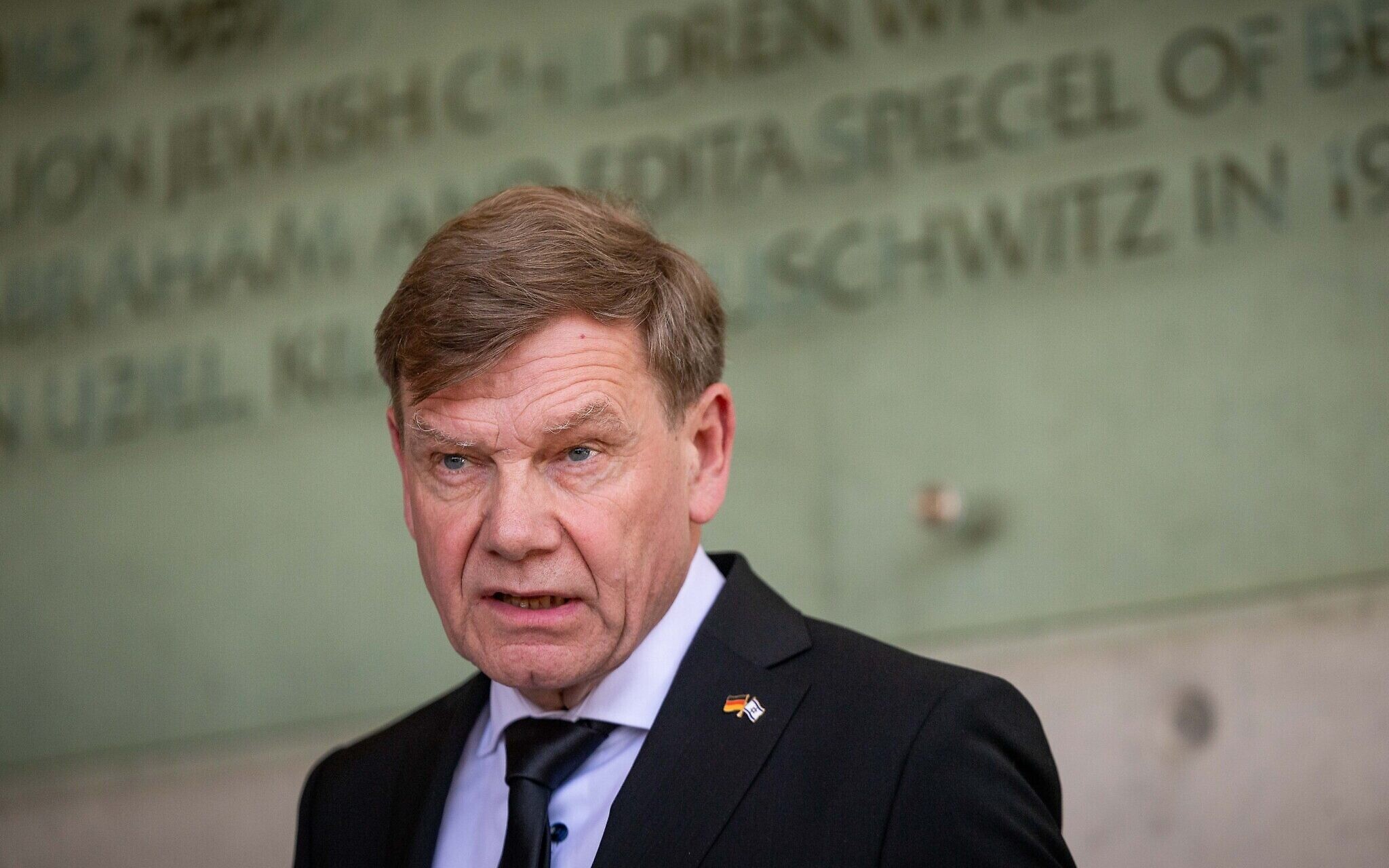
German Foreign Minister Johann Wadephul at the Yad Vashem Holocaust Memorial Museum, in Jerusalem on May 11, 2025. (Yonatan Sindel/Flash90)
German Foreign Minister Johann Wadephul will travel to Israel today and meet with Foreign Minister Gideon Sa’ar at 5:45 p.m. in Jerusalem, according to the Foreign Ministry and a German embassy spokesperson.
The two will hold “political talks,” primarily focused on the humanitarian situation in Gaza, and possibly discuss the recent wave of Western allies — excluding Berlin — that have formally expressed intent to recognize a Palestinian state, according to the embassy.
Wadephul will also hold meetings in the West Bank tomorrow before returning to Germany, the embassy adds.
The Foreign Ministry has not provided further details on the meeting’s agenda. Wadephul’s trip had not been previously announced.
Earlier this week, German Chancellor Friedrich Merz said that Germany, France and the United Kingdom were considering sending their foreign ministers to Israel on August 7 as they sought to ramp up international pressure over the humanitarian crisis in Gaza.
“We will probably ask the three foreign ministers [to] travel to Israel together next Thursday to present the position of… the three governments,” Merz said, adding that two of his country’s aircraft were en route to Jordan to help fly aid missions to Gaza.
No plans have been announced for visits by UK Foreign Secretary David Lammy or French counterpart Jean-Noel Barrot.
Germany’s Wadephul says too soon to recognize Palestinian state, but 2-state process can’t wait
Germany Foreign Minister Johann Wadephul says it is premature to recognize a Palestinian state, but the two-state process must begin now, warning Berlin could respond to “unilateral steps.”
“A negotiated two-state solution remains the only path that can offer people on both sides a life in peace, security, and dignity,” he says in a statement issued shortly before leaving for Israel and the West Bank.
“For Germany, the recognition of a Palestinian state comes more at the end of that process. But such a process must begin now.”
He says the recent UN conference on a two-state solution to the Israeli-Palestinian conflict — boycotted by the US and Israel — showed that “Israel is finding itself increasingly in the minority.”
“In view of the open threats of annexation by some in the Israeli government, a growing number of European countries are ready to recognize a state of Palestine without previous negotiations.”
Indonesia school curricula now showing Jews in better light, watchdog finds
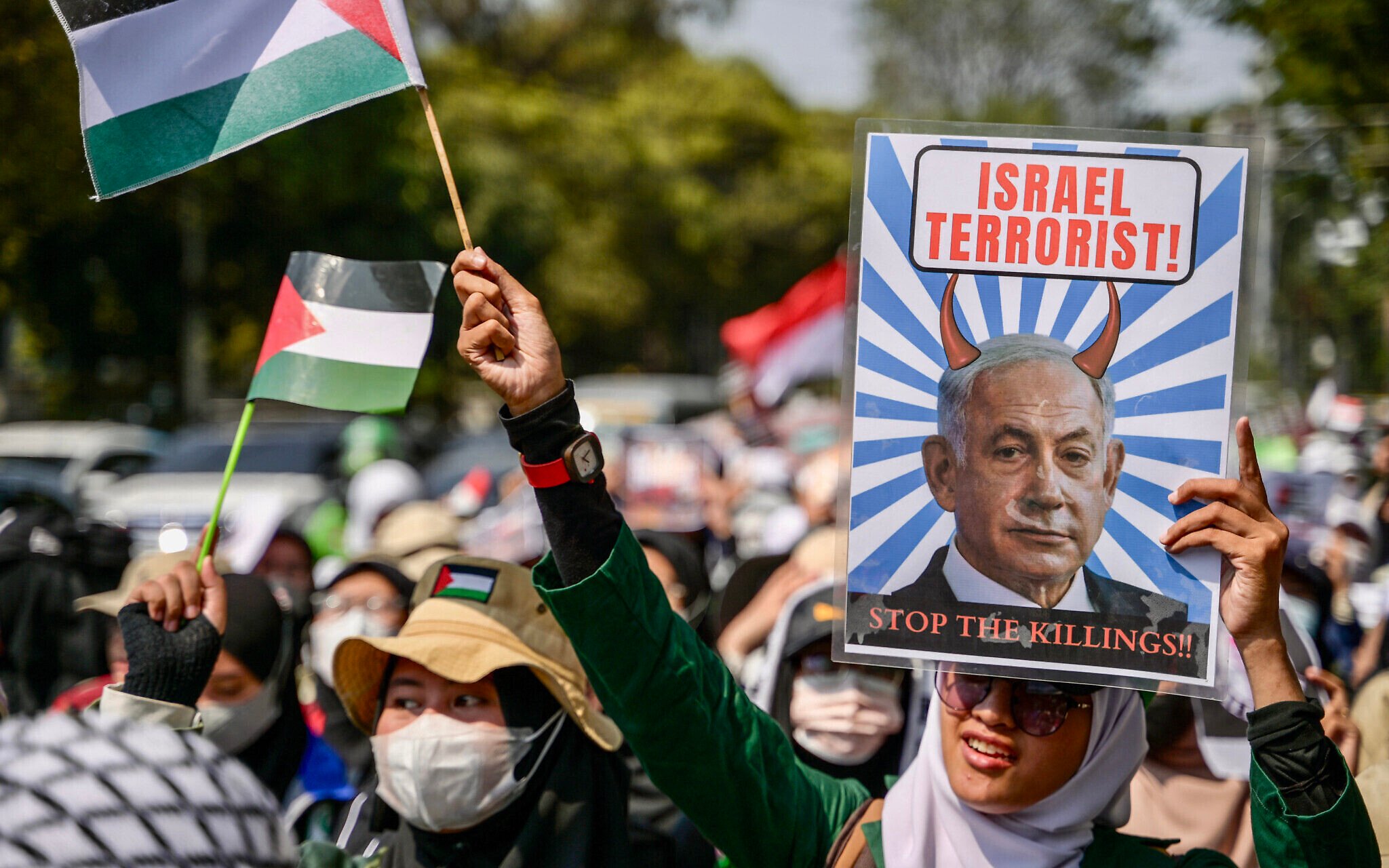
People take part in a rally in the Indonesian capital of Jakarta on October 20, 2023, amid the ongoing war between Israel and the Gaza-ruling Hamas terror group. (Bay Ismoyo/AFP)
The official school curriculum in Indonesia has shown a significant shift toward greater inclusivity and religious tolerance since 2013, a new report by Israel-and UK-based education watchdog IMPACT-se finds.
The study reviews over 40 humanities textbooks in the country’s Merdeka Curriculum, which it introduced in 2022 to modernize its teaching approach.
The textbooks now depict Jews and Judaism more positively, recognizing Jews as “People of the Book,” affirming elements of the Torah, and highlighting Prophet Muhammad’s respectful relations with Jews, IMPACT-se says. Antisemitic content found in previous editions, such as negative stereotypes or stories casting Jews as dishonest, has been removed.
It also eliminates negative portrayals of Israel and avoids references to the Israeli-Palestinian conflict. However, IMPACT-se says, it barely mentions the Holocaust.
Newly introduced content embraces religious and ethnic minorities in the world’s largest Muslim country, including local belief systems long excluded from religious instruction.
Passages condemning LGBT identities have also been removed, and gender equality is increasingly emphasized, IMPACT-se says.
“The attitude expressed in textbooks towards Jews and Judaism is increasingly positive,” says IMPACT-se CEO Marcus Sheff. “We look forward to seeing this trend continue as the curriculum evolves, shaping the views and attitudes of 58 million children.”
Woman who allegedly plotted Netanyahu assassination named
Anti-government activist Tamar Gershuni is named as the woman accused of plotting to assassinate Prime Minister Benjamin Netanyahu, Hebrew outlets report.
The 73-year-old resident of Tel Aviv allegedly planned to kill the premier after she was diagnosed with a terminal illness and understood she had only a short time to live.
העליון התיר לפרסם: תמר גרשוני, פעילת מחאה בת 74 מת"א, היא האישה שתכננה להתנקש בראש הממשלה נתניהוhttps://t.co/cF5vM8EvhD@hadasgrinberg pic.twitter.com/cWxWx0IB55
— כאן חדשות (@kann_news) July 31, 2025
Prosecutors claim the defendant sought to die as a martyr and “sacrifice her life” for the anti-government struggle, thereby “saving” Israel.
Her name was cleared for publication today after the Supreme Court rejected her appeal requesting the extension of a gag order on her identity.
Gershuni is a well-known figure in anti-Netanyahu protest circles but does not formally belong to any specific group, according to Ynet.
She was arrested after lawyer, anti-government activist and former Shin Bet agent Gonen Ben-Yitzhak informed the security agency of her plot to kill Netanyahu with an RPG grenade launcher.
Gershuni and her legal representation deny the charges against her, according to Hebrew outlets.
No plan to install new Jerusalem affairs minister, source says
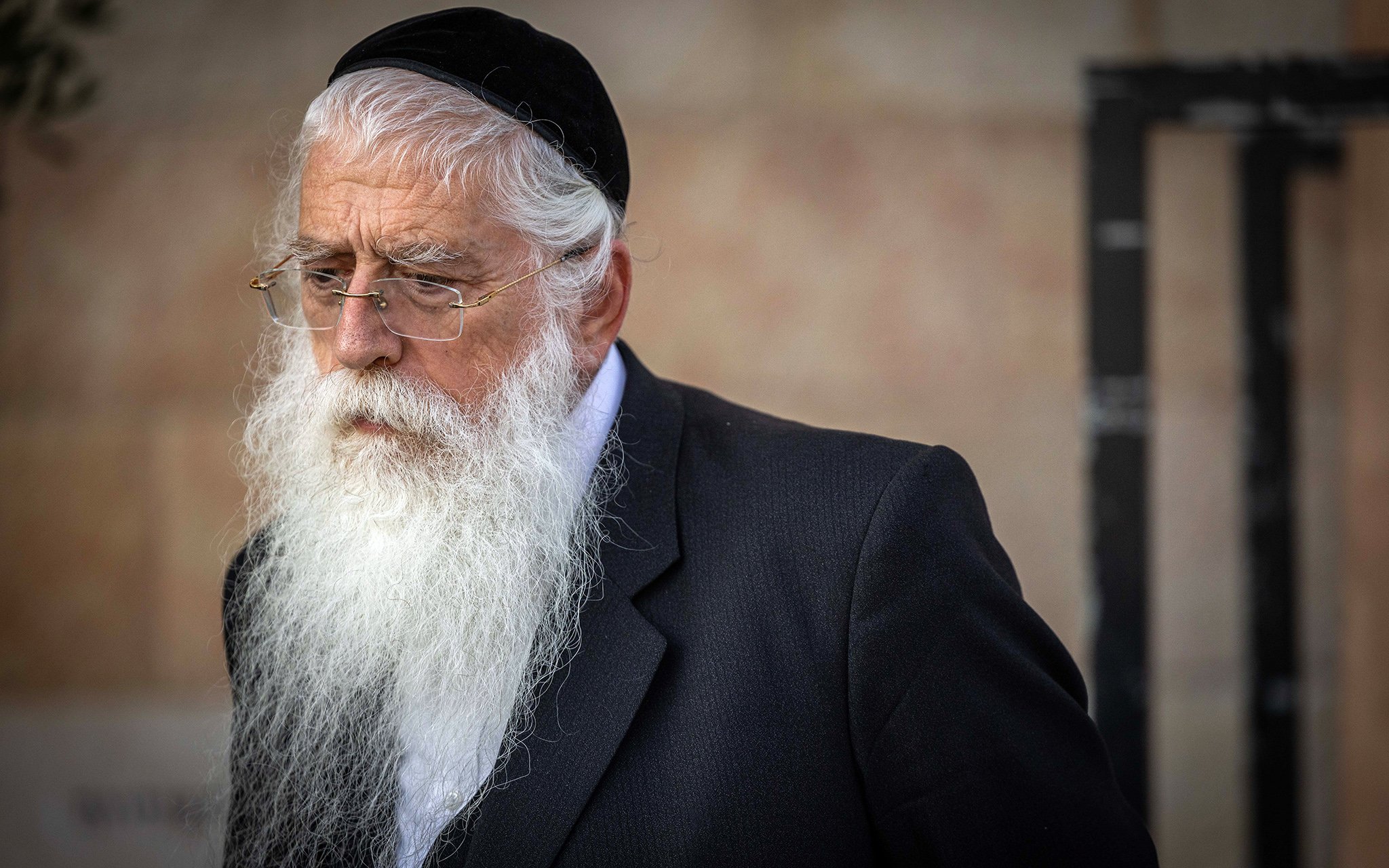
United Torah Judaism MK Meir Porush attends the Jerusalem Masters 2024 chess event, at Safra Square in Jerusalem, September 26, 2024. (Yonatan Sindel/Flash90)
The government has “no plan at the moment” to name a replacement for Jerusalem Affairs Minister Meir Porush, despite the fact that he resigned over two weeks ago when his ultra-Orthodox United Torah Judaism party bolted the coalition, a coalition source tells The Times of Israel.
“By law [Netanyahu] really should appoint someone, but I don’t think Porush is cool with any current Likud minister having it,” the source states. “This whole thing is a pretty big joke,” the source adds, saying UTJ is not really part of the opposition.
Earlier this month, UTJ quit the coalition after being presented with a copy of a proposed enlistment bill prepared by the Knesset Foreign Affairs and Defense Committee’s then-chairman, Yuli Edelstein, which it said violated agreements arrived at the month before regarding legislation on military draft exemptions. It was quickly followed by Shas, which, while quitting the government, has remained part of the coalition.
Politicians from UTJ were serving as minister for Jerusalem affairs and deputy minister for transportation when the party quit the government, while Shas held the health, interior, labor, welfare and religious services portfolios. Those have been handed to Likud ministers on an interim basis.
Porush’s Jerusalem and Jewish Tradition Ministry was one of 10 superfluous government ministries that the Finance Ministry reportedly recommended closing down in late 2023. It handles, among other things, annual pilgrimages to Uman, Ukraine, and Meron in northern Israel.
During his tenure as minister, Porush came under fire for stepping in to help convicted sex offender Rabbi Eliezer Berland to try beat a visa ban on entering Ukraine and arranging for his wife and three adult children to accompany him on a pilgrimage to Mount Meron last May, even as entry to the northern Israel holy site was restricted over security concerns.
A spokesman for Porush does not reply to a request for comment.
Canada-born MK blasts former home for move to recognize Palestinian state

Likud MK Dan Illouz speaks during a Knesset Economic Committee meeting in Jerusalem, on March 26, 2025. (Yonatan Sindel/Flash90)
Canada’s government has betrayed its principles by agreeing to recognize a Palestinian state, declares Canadian-born MK Dan Illouz (Likud).
“By endorsing recognition of a Palestinian state – less than two years after the October 7th massacre – you are rewarding the bloodiest antisemitic atrocity of our generation. You are handing political gains to those who butchered children in their beds and raped women in front of their families,” Illouz writes in an open letter to Canadian lawmakers in which he calls on them to “refuse to let Canada’s name be used to legitimize terror.”
Canadian-born MK @dillouz writes to his Canadian parliamentary counterparts, denounces pending recognition of a Palestinian state as "a historic betrayal." pic.twitter.com/wJyTlo17tc
— Sam Sokol (@SamuelSokol) July 31, 2025
Canadian Prime Minister Mark Carney announced on Wednesday that his country will recognize a Palestinian state at the United Nations General Assembly in September if the Palestinian Authority commits to “much-needed reforms.”
Calling recognition of a Palestinian state “a prize for terrorism,” Illouz, who heads the Knesset’s Israel-Canada Parliamentary Friendship Group, asserts that “if any other country had suffered what Israel suffered, no Western government would dare propose rewarding the perpetrators. But when it comes to Jews, suddenly the rules change.”
“This is not just a moral failure. It is a strategic one,” he continues. “This is not an Israeli issue. It is a civilizational one. And Canada – the Canada I grew up in – must decide which side of that fight it’s on. As head of the Israel – Canada Parliamentary Friendship Group, I say this with deep sorrow: your government’s move is not an act of friendship. It is a historic betrayal. One that will be remembered.”
Israel delivers food, other aid to Druze in southern Syria
Israel says it is delivering “urgent” humanitarian aid to the Druze community in the southern Syrian province of Sweida, following sectarian clashes in the region earlier this month.
Humanitarian Aid to Druze in Sweida Successfully Delivered
In light of the recent attacks against the Druze community in Sweida and the severe humanitarian situation in the area, the Ministry of Foreign Affairs, under the directive of Foreign Minister Gideon Sa’ar, is delivering… pic.twitter.com/lV2k0grvlp
— Israel Foreign Ministry (@IsraelMFA) July 31, 2025
The aid package includes NIS 2 million ($580,000) worth of food, medical supplies, and first aid kits for “areas directly impacted by the violent attacks,” according to the Foreign Ministry.
Israel’s Health Ministry previously delivered aid to the Druze on July 20. The Foreign Ministry says it also sent an aid package in March.
Trump: Fastest way to end Gaza suffering is for Hamas to surrender, release the hostages

US President Donald Trump speaks with the media at the Trump Turnberry Golf Courses, in Turnberry, southwest Scotland, on July 28, 2025. (Christopher Furlong / POOL / AFP)
US President Donald Trump says the Hamas terror group should surrender and release the 50 hostages it is holding in order to end hunger and other woes in Gaza.
“The fastest way to end the Humanitarian Crises in Gaza is for Hamas to SURRENDER AND RELEASE THE HOSTAGES!!!” he writes on his Truth Social platform.
The comment follows a string of posts about trade talks and Federal Reserve Chairman Jerome Powell.
It comes as his special envoy to the Mideast Steve Witkoff is scheduled to hold a sit-down with Prime Minister Benjamin Netanyahu on Gaza, including stalled hostage talks.
Trump, Witkoff and Netanyahu have all blamed the logjam on Hamas intransigence in the talks mediated by the US, Qatar and Egypt. Nonetheless, the US envoy is reportedly expected to press Netanyahu for concessions in hopes of putting negotiations back on track.
Netanyahu, Witkoff begin Jerusalem parley — PM’s office
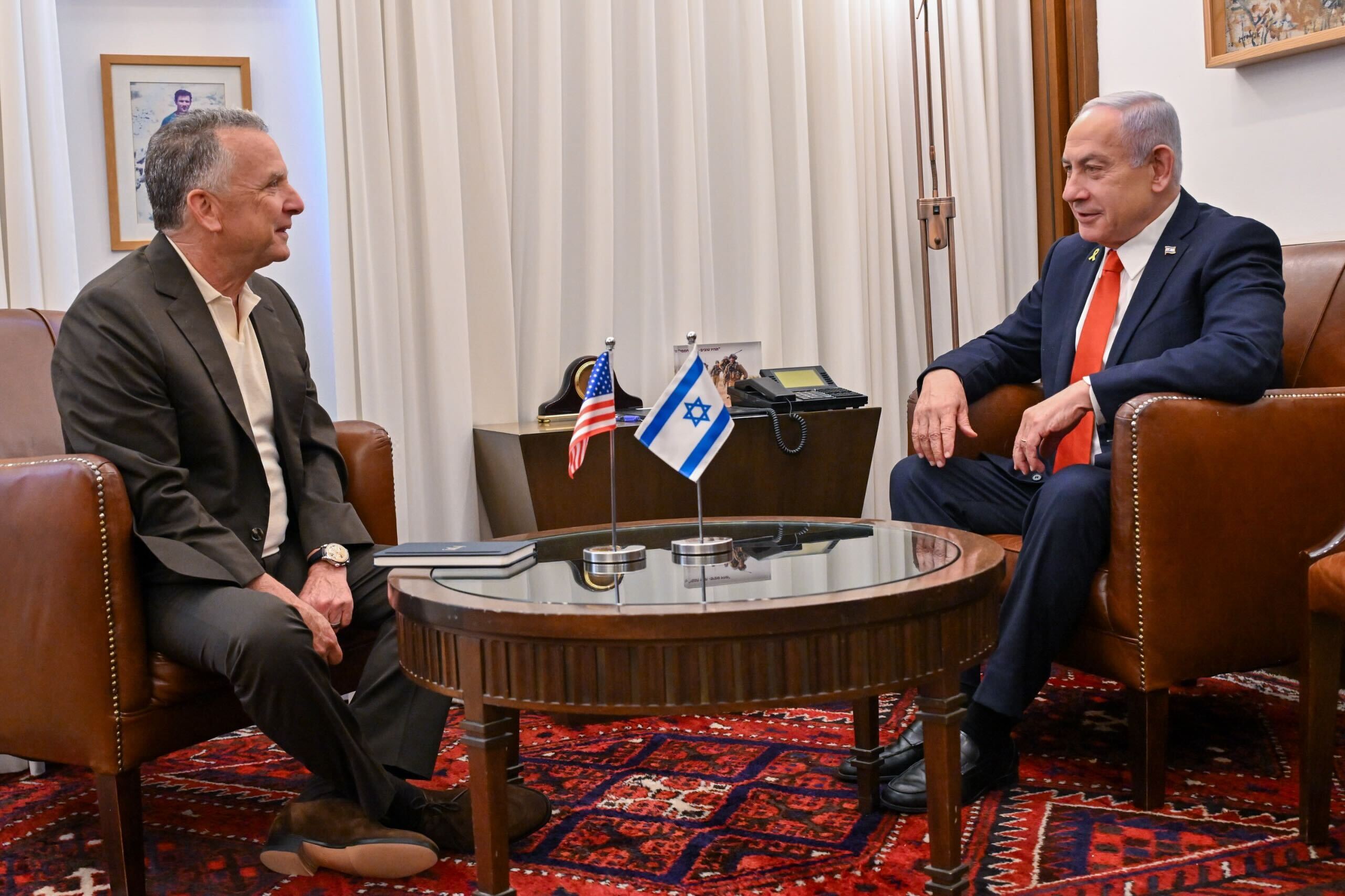
Prime Minister Benjamin Netanyahu, right, meets with US Special Envoy Steve Witkoff at his office in Jerusalem on July 31, 2025. (Kobi Gideon/GPO)
Prime Minister Benjamin Netanyahu is currently meeting with United States special envoy Steve Witkoff at the premier’s office in Jerusalem, the Prime Minister’s Office says.
The PMO publishes a pair of pictures of the two speaking, but does not add any further details on the meeting.
Germany going Nazi again, Ben Gvir says as country’s foreign minister heads to Israel
National Security Minister Itamar Ben Gvir accuses Germany of sliding back into Nazism after its foreign minister, Johann Wadephul, says that a recent UN conference on a two-state solution to the Israeli-Palestinian conflict showed that “Israel is finding itself increasingly in the minority.”
“80 years after the Holocaust, and Germany is returning to supporting Nazism,” tweets the far-right minister.
The comment comes as Wadephul is making his way to Jerusalem for talks with his counterpart Gideon Sa’ar and Prime Minister Benjamin Netanyahu, who are allied with Ben Gvir in the governing coalition.
Wadephul noted in a statement that “in view of the open threats of annexation by some in the Israeli government, a growing number of European countries are ready to recognize a state of Palestine without previous negotiations.”
Ben Gvir and members of his far right Otzma Yehudit party are among the staunchest supporters of West Bank annexation, though others in Netanyahu’s government also support the move.
Top ministers Levin, Katz declare time now ripe to annex West Bank
Justice Minister Yariv Levin and Defense Minister Israel Katz say that the current moment represents an opportunity to annex the West Bank, claiming that the groundwork for the explosively controversial move has already been laid.
“Ministers Katz and Levin have been working for many years to implement Israeli sovereignty in Judea and Samaria,” their offices say in a joint statement, using a biblical term for the West Bank. “At this very moment, there is a moment of opportunity that must not be missed.”
The statement does not specify the basis for the idea that now represents a unique opportunity for the move, which would likely ignite worldwide anger and further isolate Israel diplomatically and and economically. It comes after a wave of Western countries have announced plans to recognize a Palestinian state in the territory.
The statement is issued in response to a Channel 14 article claiming that neither Katz nor Levin had issued instructions to prepare for annexation, which the statement terms “false,” pointing to work done by the two, including as part of US President Donald Trump’s defunct 2020 Deal of the Century.
“This was expressed, among other things, in the work done by Minister Levin during President Trump’s first term, in which all the necessary things were prepared for the important move – from a proposal for resolutions to precise maps, and Defense Minister Katz led a series of unprecedented decisions to strengthen settlement and pave the way for Israeli sovereignty in Judea and Samaria,” the statement reads.
US sanctions Palestinian Authority, PLO officials
The United States is imposing sanctions on Palestinian Authority officials and members of the Palestine Liberation Organization, accusing the groups of undermining peace efforts, the State Department says in a statement.
The move prevents those targeted from receiving visas to travel to the United States, the statement says. It cites moves by the PA to seek redress through international bodies such as the ICC and World Court, its stipends to terror convicts and their families, and incitement, including in schools.
“It is in our national security interests to impose consequences and hold the PLO and PA accountable for not complying with their commitments and undermining the prospects for peace,” the statement reads.
French foreign minister charges GHF causing ‘bloodbath,’ must quit
French Foreign Minister Jean-Noel Barrot says the US- and Israel-backed Gaza Humanitarian Foundation has generated a “bloodbath” and must cease activity.
“I want to call for the cessation of the activities of the Gaza Humanitarian Foundation, the militarized distribution of humanitarian aid that has generated a bloodbath in distribution lines in Gaza, which is a scandal, which is shameful, and has to stop,” Barrot tells reporters after meeting his Cyprus counterpart in Nicosia.
Israel asks PA for autopsy results of Palestinian who died during settler attack in West Bank
Israeli authorities have requested that the Palestinian Authority provide the findings of the autopsy of a Palestinian man who died during an attack by extremist settlers in the West Bank town of Silwad overnight, a military official says.
According to the PA’s news agency WAFA, Khamis Abdul Latif Ayyad suffocated while trying to put out flames after a home in Silwad was set on fire.
The IDF says it received reports of the arson attack and dispatched troops to the scene; however, all the suspects had fled by the time the forces arrived. During scans in Silwad, the IDF reports that Palestinians hurled stones at the troops, who responded with riot dispersal means. The soldiers also located a burnt-out car and graffiti left behind by the Israeli assailants, the army says. Police have launched an investigation into the arson and vandalism.
A military official says the IDF is aware of the reports that a Palestinian man died as a result of smoke inhalation while trying to extinguish a blaze.
“As part of the investigation into the incident, a request was made to the Palestinian authorities to receive the autopsy findings immediately upon completion of the procedure,” the official adds.
Portugal to consider recognizing Palestinian state in September
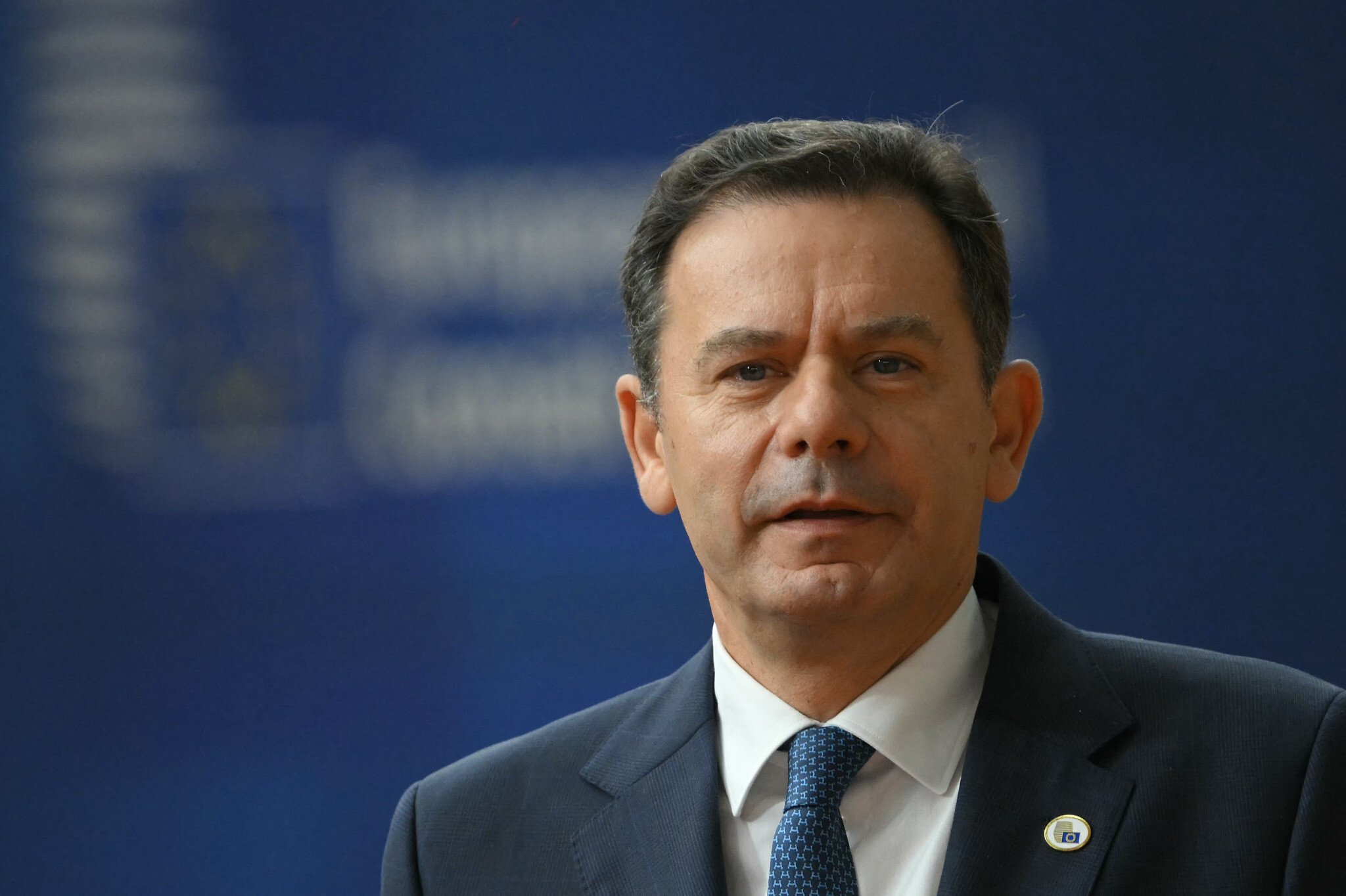
Portugal's Prime Minister Luis Montenegro arrives to attend the European Council in Brussels on June 26, 2025. EU leaders meet from June 26 to 27 to discuss geoeconomic challenges and the ongoing developments in Ukraine and the Middle East. (NICOLAS TUCAT / AFP)
The Portuguese government will consult the president and parliament on the question of recognizing the State of Palestine at the UN in September, Prime Minister Luis Montenegro’s office says.
Portugal “is considering recognition of the Palestinian state, as part of a procedure that could be concluded during the high-level week of the 80th United Nations General Assembly, to be held in New York in September,” the statement says.
Sweden jihadist jailed for life over Jordanian pilot burned alive
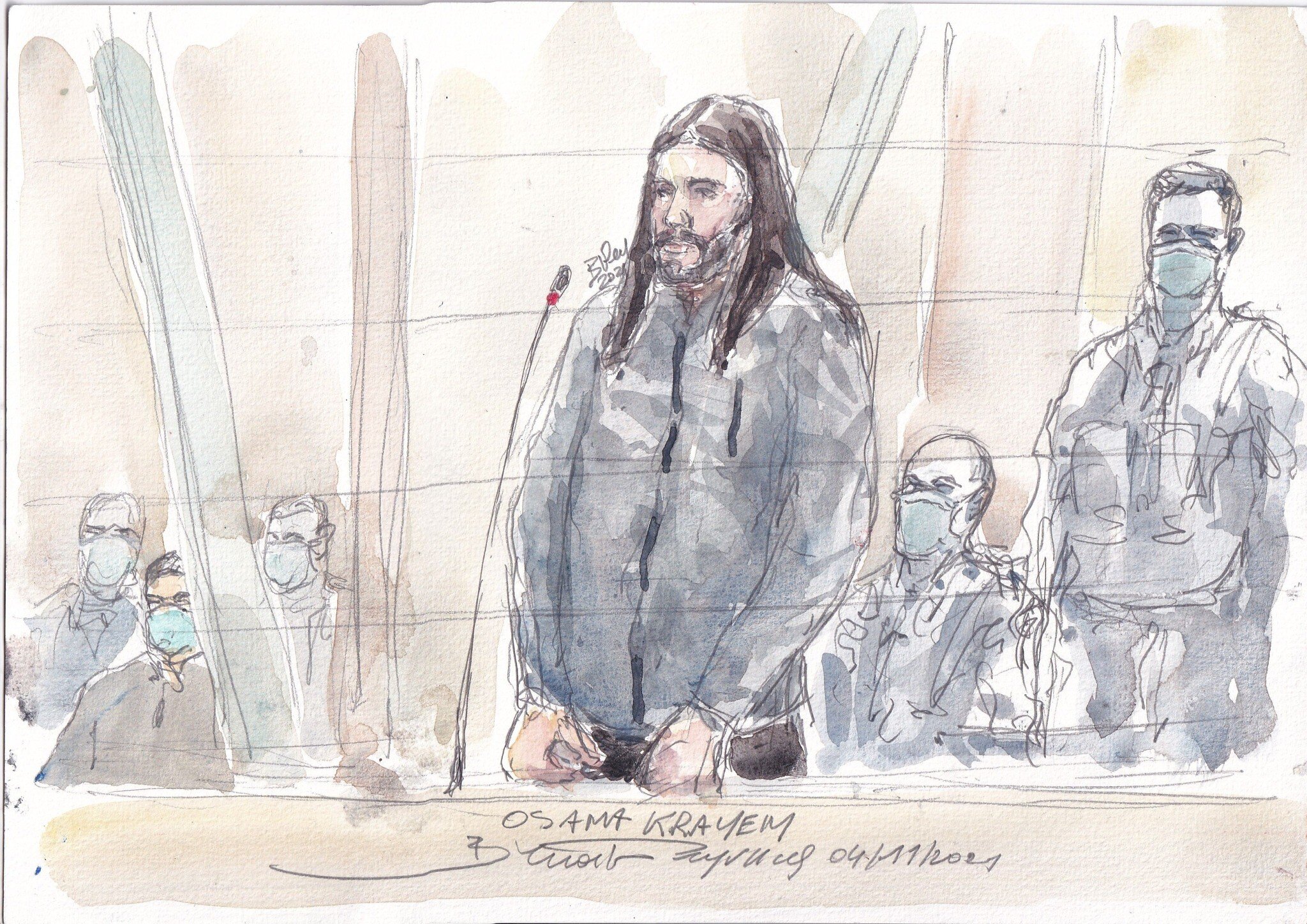
This court sketch made on November 4, 2021, shows Osama Krayem on trial for the November 13, 2015, Paris attacks, during the trial taking place in a temporary courtroom set up at the Palais de Justice of Paris. (Benoit PEYRUCQ / AFP)
A Stockholm court hands down a life term to Swedish jihadist Osama Krayem over the 2015 murder of a Jordanian pilot burned alive by the Islamic State group in Syria.
The Swedish court is the first to try a person over the infamous killing that sparked outrage around the world.
Judge Anna Liljenberg Gullesjo says “the investigation has shown that the defendant was at the execution site, uniformed and armed, and allowed himself to be filmed.”
Although video evidence showed that another man lit the fire, the judge says the “defendant’s actions contributed so significantly to the death of the victim that he should be considered a perpetrator.”
Krayem, who is serving long prison sentences for his role in the Paris and Brussels attacks in 2015 and 2016, was given a life sentence for “serious war crimes and terrorist crimes.”
On December 24, 2014, an aircraft belonging to the Royal Jordanian Air Force crashed in Syria. The pilot, Maaz al-Kassasbeh, was captured the same day by ISIS fighters near the central city of Raqqa and was burned alive in a cage sometime before February 3, 2015, when a slickly produced video of the gruesome killing was published.
Gullesjo says Krayem’s actions consisted of “guarding the victim both before and during the execution and taking him to the cage where he was set alight while still alive.”
IDF footage shows apparent Hamas attempt to ambush, kidnap soldiers
Footage circulating on social media shows an attempt by Hamas to carry out an attack on forces in southern Gaza’s Khan Younis yesterday, with an unusually large cell of at least 12 gunmen.
The military assesses that the operatives, armed with assault rifles and RPGs, sought to kidnap troops.
The videos, which are from leaked IDF aerial reconnaissance, show that the gunmen positioned themselves on the side of an IDF logistics road in Khan Younis and hid underneath blankets to ambush the Israeli forces.
Footage circulating on social media shows an attempt by Hamas to carry out an attack on forces in southern Gaza's Khan Younis yesterday, with an unusually large squad of at least 12 operatives.
The military assesses that the operatives, armed with assault rifles and RPGs, sought… pic.twitter.com/pTNMSZdzfd
— Emanuel (Mannie) Fabian (@manniefabian) July 31, 2025
The gunmen were spotted by troops of the Golani Brigade’s 13th Battalion using a drone, and they called in an Israeli Air Force Hermes 450 UAV to strike them. However, as the videos show, the gunmen fled back into a nearby tunnel before being struck.
As the gunmen withdrew, the IDF also identified a Hamas drone flying over the area, apparently to provide intel to the cell, according to a military probe.
The IDF is also investigating the leaked videos that have circulated online since yesterday.
24-year-old reservist from Netanya is latest serviceman to die by suicide
Roi Wasserstein, a 24-year-old reservist from Netanya who served in the IDF’s 401st Armored Brigade, died by suicide yesterday — amid growing scrutiny over the treatment of reservists exposed to battlefield trauma and whether they are adequately supported after their service ends.
Wasserstein had completed over 300 days of reserve duty since the start of the war, serving in the brigade’s medical evacuation unit, where he was repeatedly exposed to traumatic events, including evacuating wounded and fallen soldiers under fire.
מפרסם באישור המשפחה:
רועי וסרשטיין, לוחם מילואים בחטיבת השריון 401 – שם אתמול קץ לחייו לאחר שנחשף לזוועות במסגרת שירותו – אך צה״ל לא יכיר בו כחלל צה״ל
רועי, בן 24 מנתניה, ששירת במילואים בחוליית הפינוי הרפואית של חטיבה 401 – שירת במהלך המלחמה יותר מ-300 ימי מילואים.
במסגרת… pic.twitter.com/22ZgrMshhP— דורון קדוש | Doron Kadosh (@Doron_Kadosh) July 31, 2025
He reportedly completed his last round of reserve duty in late May. Because he was not under active reserve call-up at the time of his death, Hebrew outlets reported that the IDF has informed the family — through indirect channels — that he does not meet the criteria to be recognized as a military casualty and will therefore be buried in a civilian ceremony.
According to Ynet News, family members accused the Defense Ministry and the IDF of “disowning” Wasserstein after his death, asking, “Where is the shame?”
In response, Defense Minister Israel Katz says he has instructed the IDF and his office to provide full support to Wasserstein’s family — including assistance with funeral arrangements and military honors.
In a Facebook post, Wasserstein’s mother, Dina — a well-known community figure in Netanya — describes him as “a child full of light, humble, kindhearted, a quiet hero.”
She tells Ynet that “after October 7, he took part in retrieving bodies under fire. He saw horrific sights. He got out of a tank in the middle of an inferno to prevent soldiers from being abducted and evacuated soldiers with amputated limbs. It affected him deeply. Ever since he came home, it never left him.”
The Defense Ministry says officials from the IDF’s Manpower Directorate are in close contact with the family and are accompanying them through the process. Katz expresses his “deepest condolences” and says he embraces the family in their time of grief.
Ukraine’s Parliament approves law restoring independence of anti-graft watchdogs

Participants react at a protest against a law targeting anti-corruption institutions in front of the Ukrainian parliament in Kyiv, Ukraine, Thursday, July 31, 2025. (AP Photo/Evgeniy Maloletka)
Ukraine’s Parliament overwhelmingly approves a bill presented by President Volodymyr Zelensky that restores the independence of two of the country’s key anti-corruption watchdogs, reversing his contentious move last week that curbed their power and brought an outcry.
Last week’s measure by Zelensky to place the watchdogs under the oversight of the prosecutor-general prompted rebukes from Ukrainians, the European Union and international rights groups. It raised fears that the government could meddle in investigations and potentially shield its supporters from scrutiny.
Fighting entrenched corruption is crucial for Ukraine’s aspirations to join the EU and maintain access to billions of dollars of vital Western aid in the nearly 3½-year all-out war. It’s also an effort that enjoys broad public support.
Zelensky says he signed the bill into law less than two hours after its approval — an unusually speedy procedure for legislation.
“It guarantees normal, independent work for anti-corruption bodies and all law enforcement agencies in our state,” Zelensky says of the new law. “A truly productive day with real impact for the people.”
The backlash against Zelensky’s measures brought street protests across the country, the first major demonstrations since Russia’s full-scale invasion began on Feb. 24, 2022. Though the protests didn’t call for the president’s removal, the controversy threatened to undermine public trust in its leaders at a critical time.
Zelensky said his goal had been to speed up prolonged investigations, ensure more convictions and remove Russian meddling in investigations, which he didn’t detail. He said he had taken note of the protests and decided to present a new bill to Parliament underscoring that the prosecutor general and his deputies cannot give orders to anti-graft agencies or interfere in their work.
Starmer rejects ex-hostage’s criticism of move to potentially recognize Palestine
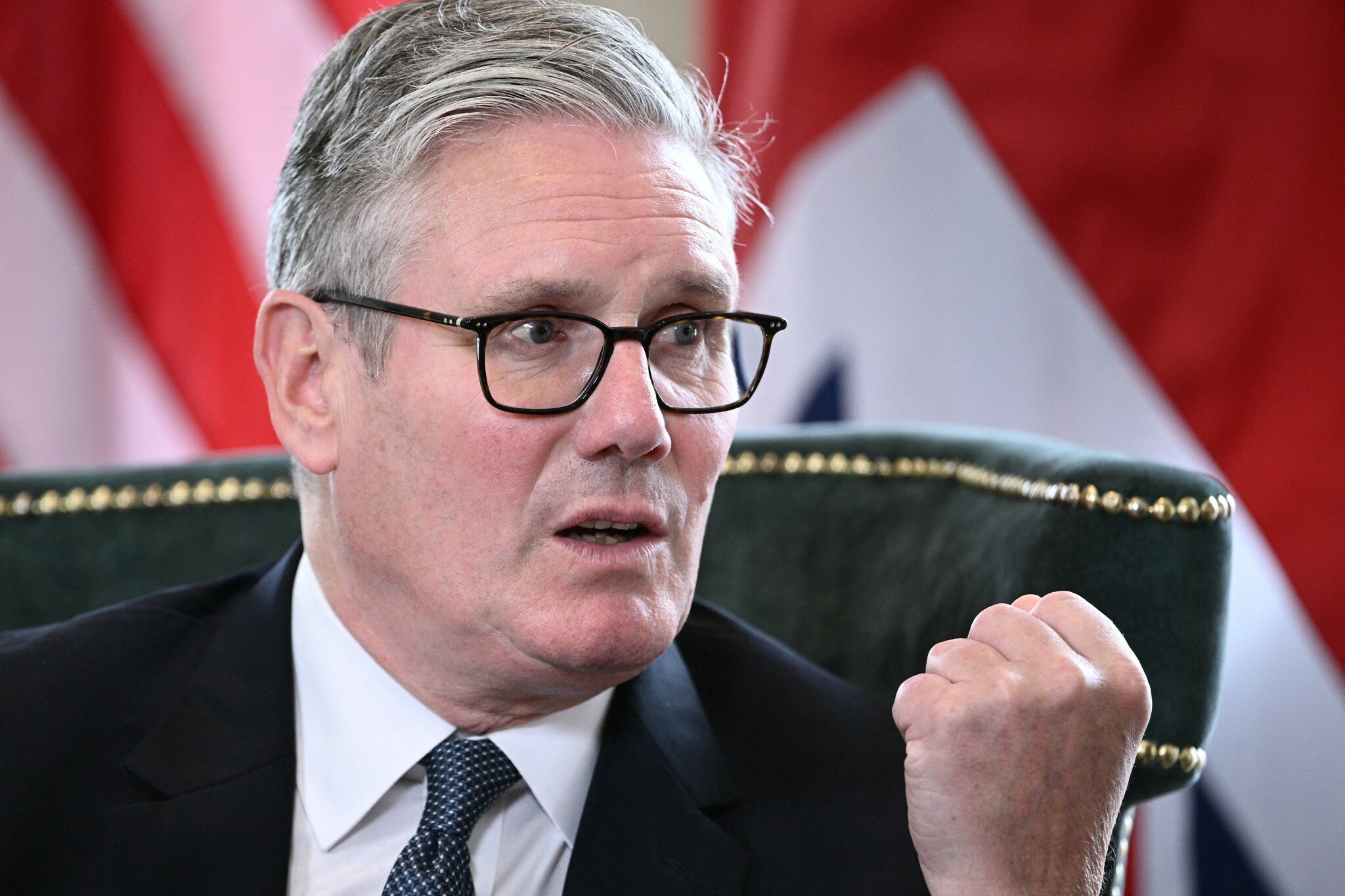
Britain's Prime Minister Keir Starmer speaks with the media during a bilateral meeting with US President Donald Trump at the Trump Turnberry Golf Courses, in Turnberry south west Scotland on July 28, 2025. (Brendan SMIALOWSKI / AFP)
After former hostage Emily Damari panned the UK’s plan to potentially recognize a Palestinian state in September if Israel does not reach a ceasefire with Hamas and improve the humanitarian situation in Gaza, British Prime Minister Keir Starmer says he “understands” what Damari endured — but adds that the issue of the hostages, to whose release the UK remains committed, won’t change Britain’s position.
“I’ve been absolutely clear and steadfast that we must have the remaining hostages released. That’s been our position throughout and I absolutely understand the unimaginable horror that Emily went through,” Starmer told ITV West Country, adding that he’s previously met with Damari, a dual British-Israeli citizen, and her mother.
“Alongside that, we do need to do everything we can to alleviate the humanitarian catastrophe in Gaza, where we are seeing the children and babies starving for want of aid which could be delivered,” he continues.
“That is why I’ve said unless things materially change on the ground — we’ll have to assess this in September — we will recognize Palestine before the United Nations General Assembly in September,” Starmer adds.
In a post on X addressed to Starmer following the UK’s announcement yesterday, Damari wrote: “As a dual British-Israeli citizen who survived 471 days in Hamas captivity, I am deeply saddened by your decision,” calling the move one that “risks rewarding terror” and teaches that “violence earns legitimacy.”
“This move does not advance peace — it risks rewarding terror. It sends a dangerous message: that violence earns legitimacy,” she said. “Recognition under these conditions emboldens extremists and undermines any hope for genuine peace. Shame on you.”
Sa’ar thanks Washington for sanctions on PA, says it ‘must pay a price for policies’
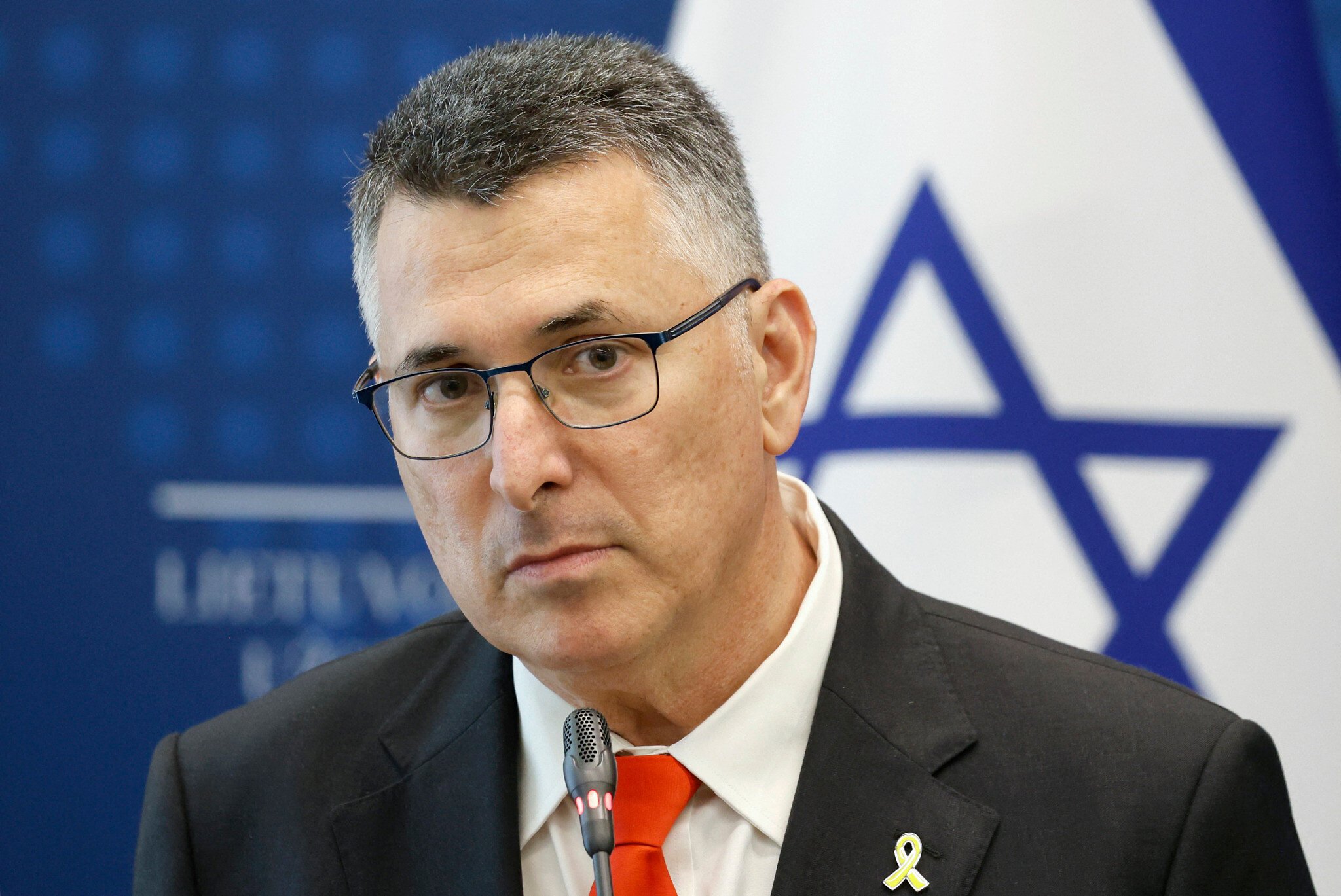
Foreign Minister Gideon Sa'ar looks on during a joint press conference with his Lithuanian counterpart at the Foreign Ministry in Vilnius on July 1, 2025. (Petras Malukas / AFP)
Foreign Minister Gideon Sa’ar commends the United States for its “moral clarity” in imposing sanctions on Palestinian Authority officials and members of the Palestine Liberation Organization.
“I thank [US] Secretary of State Marco Rubio and the US State Department for their moral clarity in imposing sanctions on members of the Palestinian Authority and PLO,” writes Sa’ar on X, saying the PA “must pay a price for its ongoing policy of paying terrorists and their families for carrying out attacks, and for its incitement against Israel in schools, textbooks, mosques, and the Palestinian media.”
In its statement explaining the decision, the US State Department cited moves by the PA to seek redress through international bodies such as the ICC and World Court, its stipends to terror convicts and their families, and incitement, including in schools.
In February, under US pressure, PA President Mahmoud Abbas signed a decree to end the so-called “pay-to-slay” policy, which provided stipends to convicted Palestinian terrorists and families of slain attackers. In April, he invited the Trump administration to verify that the change was being implemented. It remains unclear to what extent the move has been put into practice.
“This important action by [US] President [Donald] Trump and his administration also exposes the moral distortion of certain countries that rushed to recognize a virtual Palestinian state while turning a blind eye to the PA’s support for terror and incitement,” Sa’ar continues, referring to the growing list of Western nations announcing moves toward recognizing a Palestinian state later this year.
Reports of Israeli airstrikes in northeastern Lebanon
Lebanese media reports Israeli airstrikes in the Beqaa Valley area of northeastern Lebanon.
There is no immediate comment from the IDF.
????????????غارتان استهدفتا مرتفعات السلسلة الشرقية في البقاع pic.twitter.com/ToHBiu4J65
— bintjbeil.org (@bintjbeilnews) July 31, 2025
US and allies condemn threats by Iranian intelligence services
The US and a dozen allies condemn the “growing number of state threats” from Iranian intelligence services in their respective countries in a joint statement.
“We are united in our opposition to the attempts of Iranian intelligence services to kill, kidnap, and harass people in Europe and North America in clear violation of our sovereignty,” says the statement released by the governments of the United States, Britain, Albania, Austria, Belgium, Canada, Czech Republic, Denmark, Finland, France, Germany, Netherlands, Spain, and Sweden.
Ben Gvir says AG ‘undermining law and democracy’ in clash over promotion of policewoman
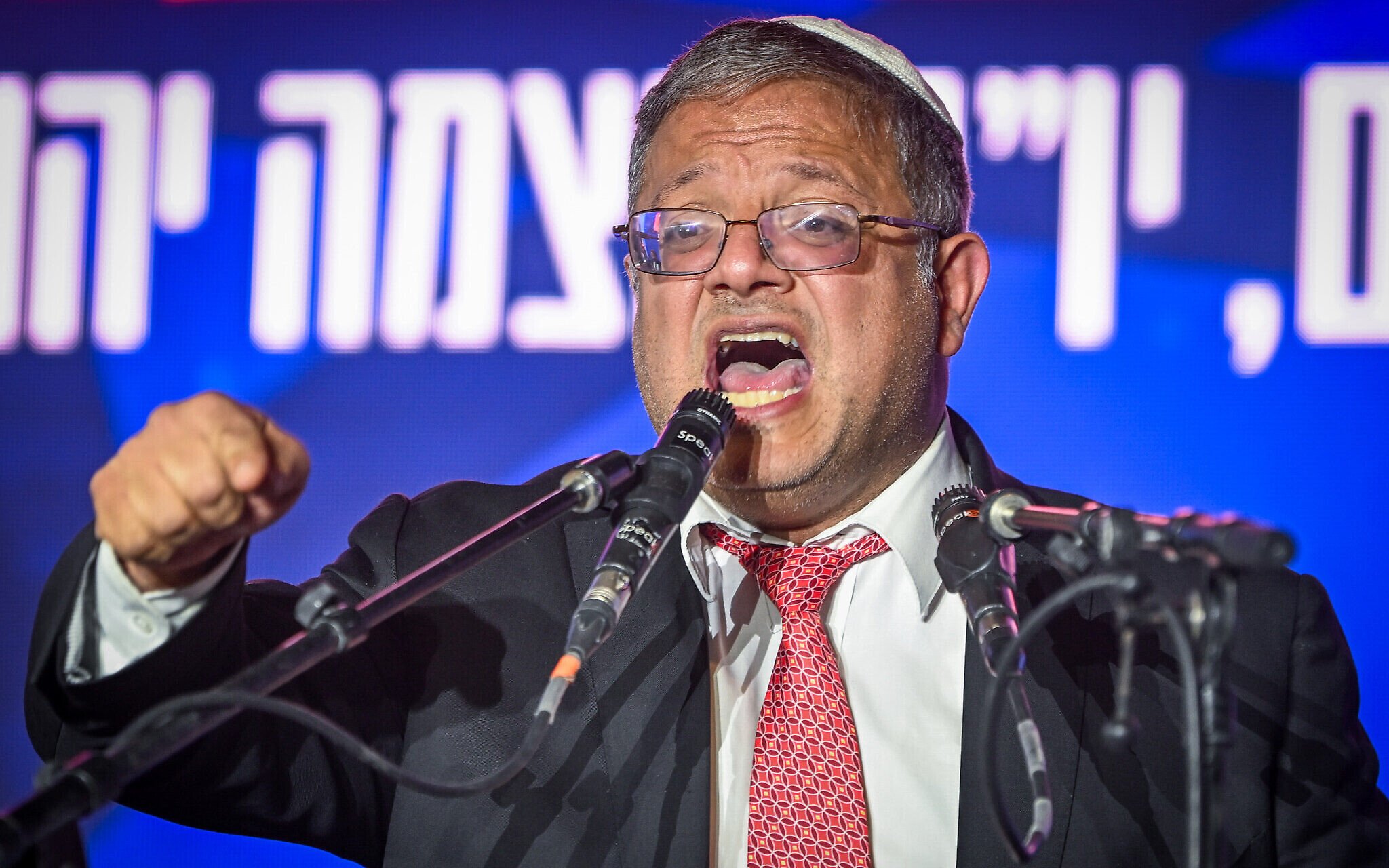
National Security Minister Itamar Ben Gvir speaks during a rally outside the Supreme Court in Jerusalem, June 5, 2025. (Arie Leib Abrams/Flash90)
National Security Minister Itamar Ben Gvir accuses Attorney General Gali Baharav-Miara of “undermining the law and democracy” after she demanded the politician stop blocking the promotion of a policewoman who testified in Netanyahu’s trial.
“I will not accept any outside interference by an attorney general who acts unlawfully and seeks to advance police appointments in the same scandalous and unlawful manner in which appointments are fixed up in the State Attorney’s Office,” he writes.
The far-right minister is responding to the attorney general’s letter addressed to him earlier today, in which she urged him to sign off on the promotion of Supt. Rinat Saban, saying “there is no reason to harm the officer who testified in the prime minister’s case.”
She said that Saban’s promotion is explicitly backed by Police Commissioner Danny Levy, who described the issues Ben Gvir raised regarding the police investigator as “unfounded.”
“These concerns were raised in an unusual manner in relation to this officer and were not raised in similar previous cases,” Baharav-Miara wrote. Ben Gvir, earlier this month sent a letter to several media outlets against Saban’s promotion to the rank of chief superintendent, alleging she suffered from “memory issues.”
In March, Saban testified against Netanyahu in court and previously investigated his advisers Jonatan Urich and Ofer Golan on suspicion they harassed Shlomo Filber, a state witness in Case 4000, the most serious of the three cases in the premier’s ongoing corruption trial.
In an unusual statement, the police came out in overt opposition to the minister, calling on outlets to remove supposedly defamatory statements about the officer.
The attorney general faces possible dismissal from her position by Prime Minister Benjamin Netanyahu’s coalition, amid friction between her and many members of the premier’s coalition.
IDF chief says will seek law to recognize reservists who died outside service as fallen soldiers
After the suicide of an off-duty reservist, IDF Chief of Staff Lt. Gen. Eyal Zamir is planning to look into the possibility of advancing legislation that would grant the military the authority to recognize reservists who died outside of their service as fallen soldiers.
The IDF says it “shares in the deep sorrow of the Wasserstein family over the tragic death” of Roi Wasserstein, a 24-year-old reservist combat medic who served with the 401st Armored Brigade during fighting in Gaza.
Wasserstein completed his last reserve duty in May and was not on duty when he died by suspected suicide yesterday.
“According to the law, an IDF fallen soldier is defined as one who died during regular or active reserve service, and therefore, he is not officially recognized as an IDF fallen soldier,” the military says, after notifying Wasserstein’s family that he does not meet the criteria to be recognized as a military casualty.
“However, due to the circumstances of the case, the chief of the staff has instructed an examination of the possibility of promoting legislation that would grant the IDF the authority to recognize, in exceptional cases, a reserve soldier who passed away outside of military service as an IDF fallen soldier, if a direct link is found between the death and military service,” the IDF says.
While the IDF is not able to directly advance laws, it can send representatives to relevant Knesset committees to present its agenda.
Wasserstein is set to be buried in a civilian ceremony. The military says that in light of his army service, “and in honor of his memory, the IDF offered the family that the funeral be held in the presence of his comrades from the brigade in which Roi served,” and a commander would also be present and lay a wreath.
Defense minister confirms IDF striking Hezbollah targets in Lebanon
Defense Minister Israel Katz confirms that the IDF is striking Hezbollah sites in Lebanon, saying a precision missile manufacturing facility in Lebanon’s eastern Beqaa Valley was targeted.
The site, Hezbollah’s largest weapons production plant, has been targeted several times by the IDF, including since the November ceasefire.
According to Katz, several other sites where Hezbollah was working to restore its capabilities were also targeted.
“Any attempt by the terrorist organization to restore, reestablish itself, or pose a threat will be met with uncompromising force,” Katz adds.
IDF confirms airstrikes on Hezbollah ‘strategic weapons’ sites in south Lebanon, Beqaa Valley
The IDF confirms completing a wave of airstrikes against Hezbollah’s “strategic weapons” manufacturing and storage infrastructure in southern Lebanon and in the eastern Beqaa Valley a short while ago.
The targets included a facility used to manufacture explosives and an underground site where Hezbollah built and stored precision-guided missiles, the army says.
The strikes were carried out after the IDF says it had identified efforts by Hezbollah to restore the sites. The facility in the Beqaa Valley has been targeted by the IDF several times before.
Hezbollah’s activities “constitute a violation of the understandings between Israel and Lebanon,” the IDF adds.
Aircraft from Arab nations airdrop food packages in Gaza
Aircraft from the United Arab Emirates, Jordan, and Egypt airdropped 43 aid packages containing food in the northern and southern Gaza Strip in the last few hours, the Israeli military says.
The IDF says the airdrops were carried out “in accordance with the directives from the political echelon and as part of the cooperation between Israel, the UAE, Jordan, and Egypt.”
The airdrops are part of a “series of actions aimed at improving the humanitarian response in the Gaza Strip,” the military says.
“The IDF will continue to work in order to improve the humanitarian response in the Gaza Strip, along with the international community, while refuting the false claims of deliberate starvation in Gaza,” it adds.
Israel gave Hamas its red lines on aid, prisoners, perimeter — report
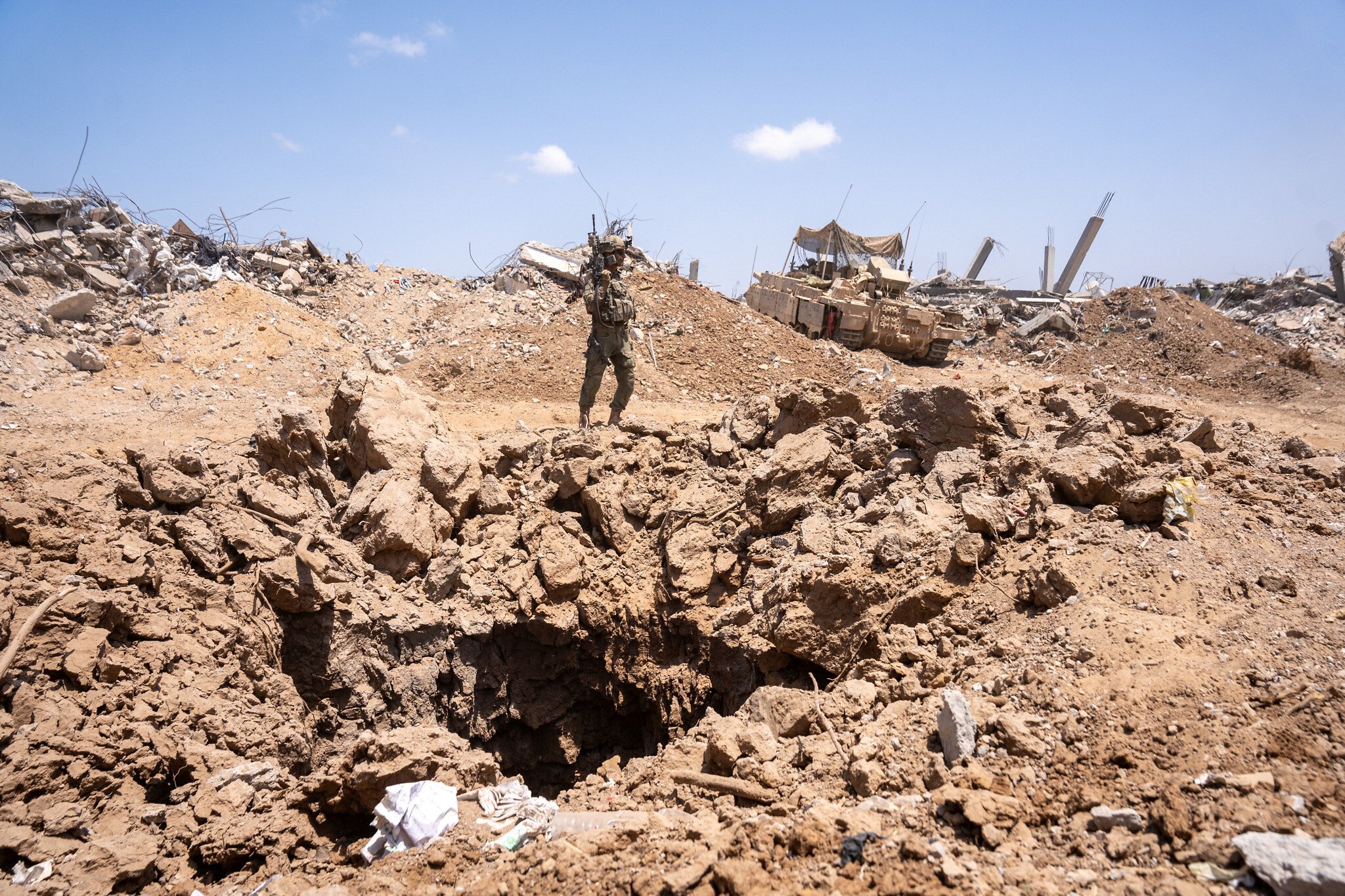
IDF troops of the Givati Brigade stand over a tunnel shaft in northern Gaza's Beit Hanoun, July 30, 2025. (Emanuel Fabian/Times of Israel)
Channel 12 reports on Israel’s alleged red lines in Gaza ceasefire negotiations:
Israel agrees to 500 trucks of aid to enter daily in a potential truce, but insists that the highly controversial US- and Israel-backed Gaza Humanitarian Foundation must continue to be the platform for distribution, as it believes this limits Hamas’s ability to hoard aid.
Terrorists from Hamas’s elite Nukhba forces will not be freed in exchange for hostages.
Israeli forces will relocate to a perimeter 800 meters from the border, inside Gaza. At some points, the perimeter will stand at 1,200 meters.
The network reports that with a deal seeming less likely in recent days, Israel is reviewing the possibility of moving to operate in areas it has avoided so far, where it believes hostages are being held. This would endanger the hostages’ lives.
Israeli officials tell outlets chances for ceasefire-hostage deal appear ‘slim’
Anonymous Israeli officials cited by Hebrew media say chances for a ceasefire and hostage-release deal with Hamas now appear “slim,” and that negotiations are not taking place or expected to restart soon.
An unnamed official tells Channel 12 that Hamas is “unwilling to negotiate.”
“There are currently no ongoing negotiations or expectations for renewed talks. We are moving toward the next steps, which are expected to include a military operation,” the Maariv news outlet cites an official as saying.
The remarks follow US Special Envoy Steve Witkoff’s meeting with Prime Minister Benjamin Netanyahu this afternoon to try and resolve the logjam in talks.
Trump said to suspect Netanyahu prolonging Gaza war for political gain
US President Donald Trump speaks with the media at the Trump Turnberry Golf Courses, in Turnberry, southwest Scotland, on July 28, 2025. (Christopher Furlong / POOL / AFP)
US President Donald Trump increasingly believes Prime Minister Benjamin Netanyahu is prolonging the war in Gaza for political considerations and is undermining efforts to reach a ceasefire, The Atlantic reports, citing two unnamed administration officials.
At the same time, the officials doubt Trump will take any severe steps against Netanyahu.
A White House official tells the publication that “there is no significant rupture” between the two and “allies can sometimes disagree, even in a very real way.”
The Atlantic says Netanyahu’s positions are frustrating Trump’s hopes of stabilizing the region and encouraging trade and business deals.
US officials say part of the reason for US envoy Steve Witkoff’s current visit to Israel is to develop an independent assessment of Israel’s efforts to supply aid to Gaza, with Trump voicing growing displeasure over reports of a hunger crisis.
At the same time, one source tells the paper that Trump still chiefly blames Hamas for the failure to reach a truce deal.
IDF to form panel of experts to review treatment of discharged soldiers who died by suicide

Dado Bar Kalifa promoted to the rank of major general during a ceremony at the IDF HQ in Tel Aviv, October 8, 2024.(Photo by Israel Defense Forces)
The chief of the IDF’s Personnel Directorate, Maj. Gen. Dado Bar Kalifa, has ordered the establishment of a panel of experts to “examine the response provided to discharged soldiers and reservists who are not on active duty and who ended their lives following their military service.”
The military says the committee will be headed by former Personnel Directorate chief Maj. Gen. (res.) Moti Almoz, and will include IDF medical and mental health professionals, legal advisors, casualty officers, and Defense Ministry representatives.
“The committee will examine systemic, moral, and socio-national aspects related to the challenges faced by IDF veterans after their discharge, including issues of recognition and support for servicemembers, as well as the legal implications of recognizing their cases,” the IDF says.
The military says the committee is intended to “ensure a thorough, responsible, sensitive, and equitable examination of the support given to servicemembers throughout and after their military service.”
The committee’s findings will be presented by Bar Kalifa to Defense Minister Israel Katz and IDF Chief of Staff Lt. Gen. Eyal Zamir for approval, the army adds.
During the ongoing war, the military has seen a rise in suicides among soldiers and reservists. In several cases, the IDF has not recognized off-duty reservists who died by suicide outside of duty as fallen soldiers.
Witkoff, Huckabee to tour Gaza food distribution sites Friday as US plans to ramp up aid
United States Special Envoy to the Middle East, Steve Witkoff, looks on as unseen US President Donald Trump meets with unseen Israeli Prime Minister Benjamin Netanyahu at the Blue Room of the White House in Washington, DC, on July 7, 2025. (ANDREW CABALLERO-REYNOLDS / AFP)
US Special Envoy Steve Witkoff and US Ambassador to Israel Mike Huckabee will enter Gaza on Friday in order to tour food distribution sites ahead of the rollout of a new US plan for getting aid into the Strip, the White House announces.
Witkoff and Huckabee held a “very productive” meeting with Prime Minister Benjamin Netanyahu and other senior Israeli officials on the topic of getting aid into Gaza, White House press secretary Karoline Leavitt says during a press briefing.
The two senior US officials will “inspect the current distribution sites [to] secure a plan to deliver more food and meet with local Gazans to hear firsthand about this dire situation on the ground,” Leavitt says.
Immediately after their visit, Witkoff and Huckabee will brief US President Donald Trump “to approve a final plan for food and aid distribution,” the White House press secretary says, adding that more details will be provided once the plan is approved.
Trump announced on Monday that new food centers would be established in Gaza to alleviate the hunger crisis. He provided few details on the matter, other than saying that there would be no fences at the sites so that Palestinians wouldn’t be blocked from accessing food.
On Tuesday, he said that Israel would be responsible for managing the sites — something that the IDF has been reluctant to do, fearing that it would put troops in danger.
It wasn’t clear whether Trump was referring to the controversial Gaza Humanitarian Foundation, which Israel has contracted to run food distribution sites for the past two months, as it tries to box Hamas out of the process.
Sa’ar tells German FM Hamas uninterested in deal as world ‘rewards it with prizes and gifts’
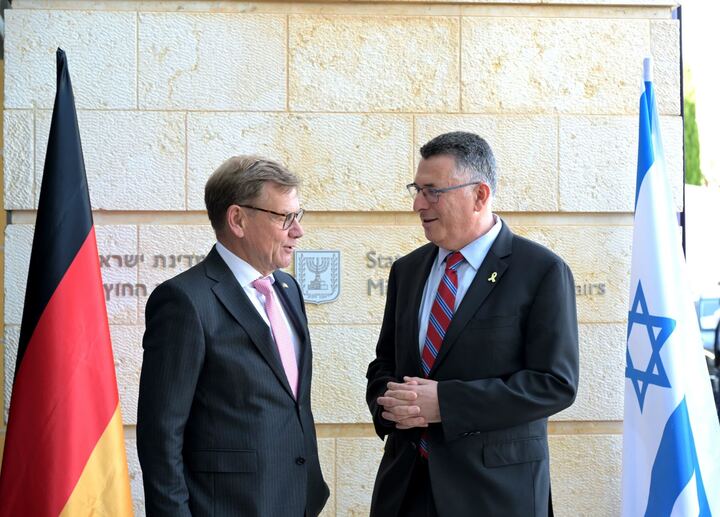
German Foreign Minister Johann Wadephul (L) poses for a photo with his Israeli counterpart Gideon Sa'ar ahead of a meeting at the Foreign Ministry in Jerusalem, on July 31, 2025. (Shlomi Amsalem/GPO)
Foreign Minister Gideon Sa’ar told his German counterpart Johann Wadephul at a Jerusalem meeting today that Hamas “is not interested” in reaching a ceasefire and hostage-release deal, and that the terror group’s hardened stance is being bolstered by global moves to recognize a Palestinian state.
Addressing the stalled negotiations for a truce, Sa’ar told Wadephul that Hamas “is not interested in reaching a deal,” according to a readout of the meeting from Sa’ar’s office.
“Hamas is holding the hostages, refusing to disarm, and is entrenched in its rejectionist stance toward a hostage deal because it sees the international community rewarding it with prizes and gifts,” Sa’ar’s office says in the readout, referring to the recent wave of Western nations announcing moves toward unilateral recognition of a Palestinian state.
The two ministers held a private discussion followed by an expanded meeting with representatives from both sides, according to the readout.
Sa’ar also emphasized Israel’s opposition to recognizing a Palestinian state, telling Wadephul that “We don’t call these areas ‘the West Bank,’ we call them ‘Judea and Samaria,'” referring to the Biblical term for the territory.
“We believe that Jews have the right to live in the heart of their historic homeland — including in Judea and Samaria,” Sa’ar told his counterpart, while also accusing the Palestinian Authority of inciting hatred against Israel through its education system and media activities, and of providing financial support to terrorists.
“If the PA were to gain control over the borders and airspace,” Sa’ar cautioned, “we would find ourselves flooded with Iranian weapons inside Israel. That will not happen.”
Sa’ar also referred to “illegal Palestinian construction in Area C,” saying that turning a blind eye to it is “hypocrisy.”
Palestinians living in towns and villages in Area C, which is under full Israeli civil and military control and makes up 60% of the West Bank, can rarely receive building permits. As a result, the construction they do in the area is often done illegally. Organizations behind the settlement movement reject these constructions, seeing them as part of an effort to take full control of the area.
A Palestinian state cannot be established “for the simple reason that Israel cannot compromise on its security,” Sa’ar concluded, according to his office.
Official: Israel, US now aligning on comprehensive Gaza plan, including release of all hostages, not partial ceasefire
As negotiations with Hamas stall, Israel and the United States are now aligned on aiming for a comprehensive framework in place of a partial ceasefire and hostage-release deal, an unnamed senior Israeli official tells Hebrew media outlets.
“There is an emerging understanding between Israel and the United States that, in light of Hamas’s refusal, we must shift from a framework for the release of some of the hostages to a framework for the release of all the hostages, the disarmament of Hamas, and the demilitarization of the Gaza Strip,” the official is quoted as saying.
“There will be no more partial deals,” they add.
“At the same time,” the source is quoted as saying, “Israel and the US will work to increase the humanitarian aid, while continuing the fighting in Gaza.”
“There is a breakdown in contacts. Hamas has cut off communication,” the official adds. “There is no one to talk to on the other side. This is also [US special envoy] Witkoff’s understanding.”
The official also notes that Jerusalem and Washington will work to increase humanitarian aid while continuing the fighting in Gaza.
Hamas tells mediators it won’t resume ceasefire talks until hunger crisis addressed
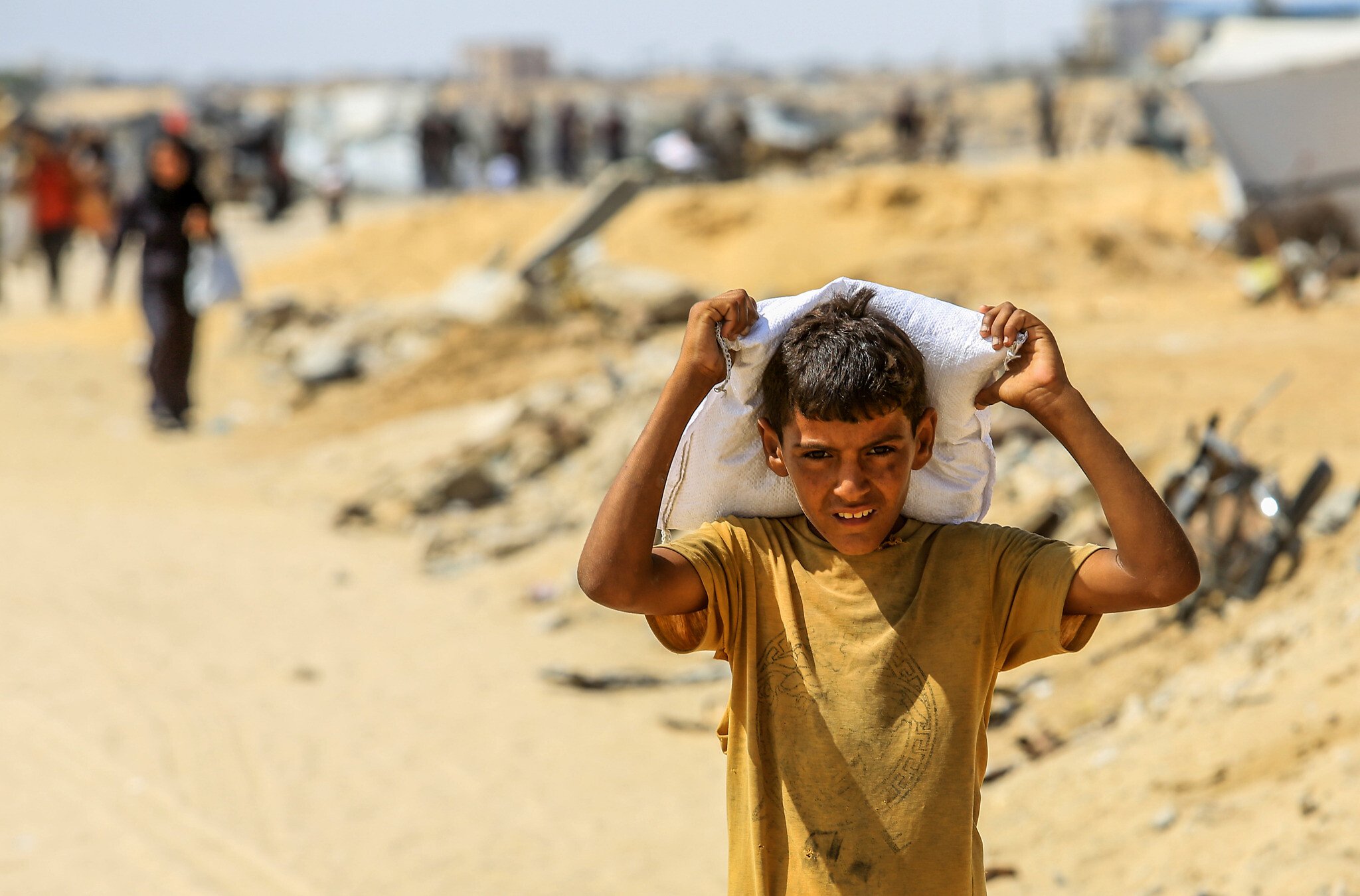
Palestinians carry food supplies they received from the US aid center in Rafah, in the southern Gaza Strip, July 30, 2025. (Photo by Abed Rahim Khatib/Flash90)
Hamas negotiators in Doha have told mediators that they are uninterested in resuming ceasefire negotiations until the hunger crisis in Gaza subsides, an Arab diplomat and a second source involved in mediation efforts tell The Times of Israel.
Tensions are also at a peak level between Hamas and Arab negotiating countries, Egypt and Qatar. Hamas’s lead negotiator Khalil al-Hayya accused Egypt last week of complicity in the humanitarian crisis, infuriating Cairo. The terror group is also angry at Qatar for signing onto a declaration at the UN earlier this week that called for Hamas to disarm and step down from power, the two sources say.
Earlier this week, Israel presented mediators with its response to the amendments requested by Hamas to the latest ceasefire proposal. The Hamas response angered Israel and the US, which subsequently pulled its negotiators from Doha.
In its latest response, Israel rebuffed Hamas’s demand that the IDF withdraw from population centers along the southern Gaza border.
Netanyahu meets visiting German foreign minister
Prime Minister Benjamin Netanyahu met this evening in his Jerusalem office with German Foreign Minister Johann Wadephul, the Prime Minister’s Office says in a statement.
The PMO provides no further details about the meeting, which follows an earlier meeting between Wadephul and Foreign Minister Gideon Sa’ar at the Foreign Ministry.
Pictures show Sa’ar and Israeli ambassador to Germany Ron Prosor participating in the meeting.
Sa’ar ‘strongly rejects’ Ben Gvir’s accusation Germany supporting Palestinian ‘Nazism’
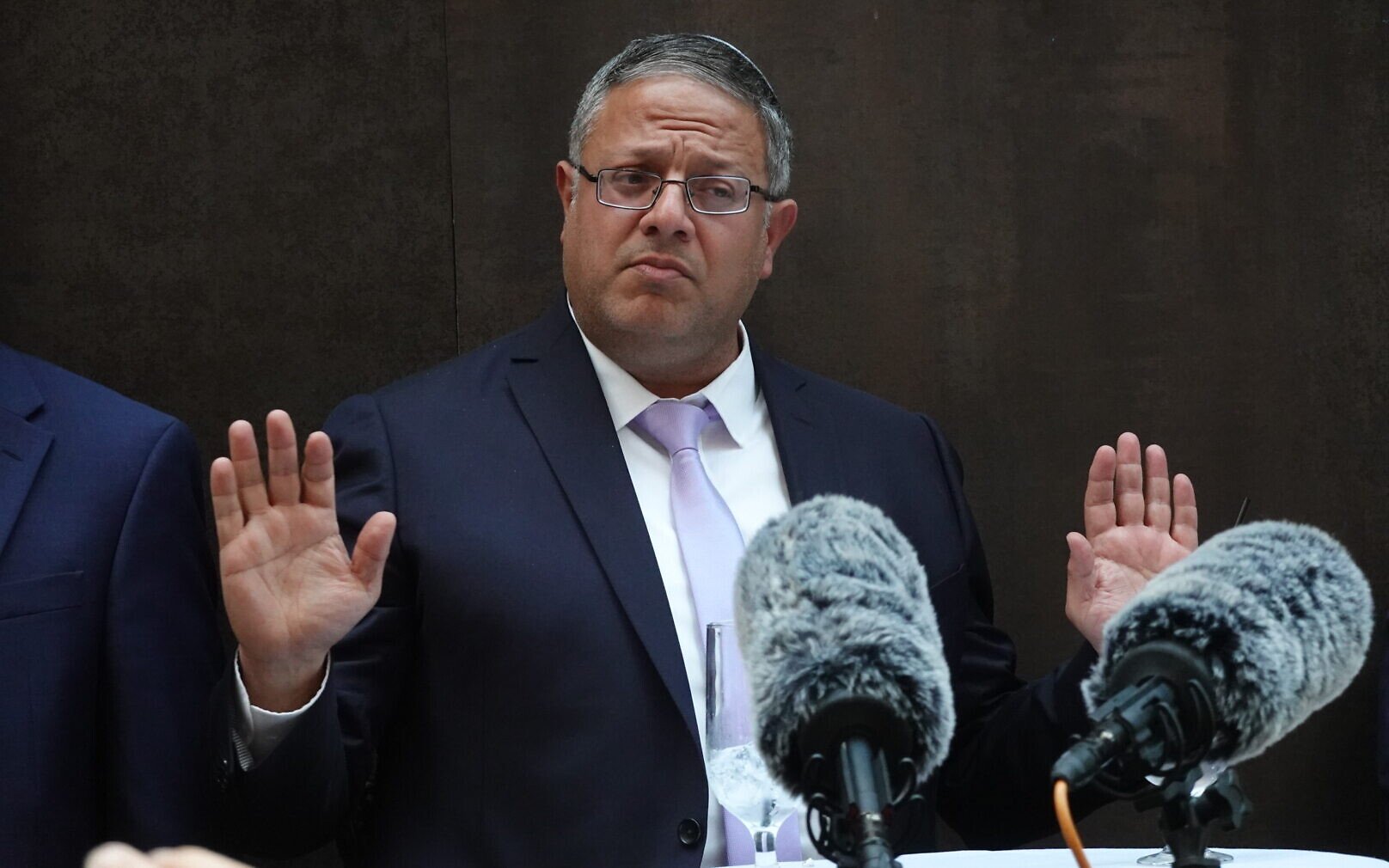
National Security Minister Itamar Ben Gvir at a speaking event in New York City during his visit to the United States, April 24, 2025. (Luke Tress/Times of Israel)
Foreign Minister Gideon Sa’ar says he “strongly rejects” National Security Minister Itamar Ben Gvir’s earlier remarks accusing Germany of supporting Nazism in response to comments by Foreign Minister Johann Wadephul that Berlin may consider unilaterally recognizing a Palestinian state.
In a Hebrew-language post on X, Sa’ar calls Ben Gvir’s comments “unnecessary and harmful.”
“Germany is a friendly country, and Foreign Minister Wadephul is a friend of Israel. This does not change even when there are disagreements between us,” adds Sa’ar, who met with Wadephul in Jerusalem this evening.
Hundreds in Tel Aviv demand end to war: ‘It’s a duty to refuse’
About 1,000 people gather at Tel Aviv’s Habima Square for an anti-war protest organized by an Israeli-Palestinian coalition of peace activists and human rights groups.
Speakers also assail Israel’s actions in the West Bank and the release of a settler accused of having shot dead Palestinian activist Odeh Hathaleen this week, even as Hathaleen’s relatives remain in prison.
In a rare occurrence for a Tel Aviv protest of this size, one of the speakers at the demonstration, actor Yossi Zabari, explicitly accuses Israel of genocide — “the word that frightens us more than the deed itself,” he says.
Protesters hoist pictures of emaciated Gazan children and Israeli hostages. A large screen on stage reads, in Hebrew and Arabic, “Enough with the killing, enough with the starvation, enough with the abandonment.”
“Right now in Gaza, there is a little girl hungry for food and a little boy thirsty for water,” says Rula Daoud, a co-leader of the binational socialist group Standing Together. “I don’t know how much energy the boy and girl have left in their bodies to shout, but I know I can shout for them.”
She calls for a joint Jewish-Arab struggle “to sabotage life here until the government breaks.”
כיכר הבימה מלא עד אפס מקום בעשרות אלפי מפגינים נגד ההערבה המוות וההפקרה.@omdimbeyachad pic.twitter.com/RWhjIaaAIX
— suf patishi???? (@suf_patishi) July 31, 2025
“We must not think that it’s not our responsibility and that we have nothing to do, because it’s possible to refuse, and it’s a duty to refuse to serve this war,” she says, as the crowd chants: “Refuse.”
Activist Ghadir Hani, who introduces herself, to applause, as “an Arab-Palestinian citizen of Israel,” says in her speech that starting Sunday, dozens of peace groups will set up a “struggle tent” on nearby Dizengoff Square, “from which actions of disruption and incessant struggle will go out.”
“We won’t stop until the war of annihilation is over and the government of death is out of here,” she says.
Hani also plays a video address to the demonstration by a man she introduces as “Rami, a resident of the Gaza Strip, whose family was displaced from its home and is struggling with hunger.”
Rami says he follows anti-war protests in Israel from afar, and expresses appreciation for protests that exhibit pictures of children killed by Israel.
“It shows we feel each other’s pain,” he says.
At least one arrested as some Tel Aviv protesters become unruly
At least one person has been arrested as police ordered protesters leaving an anti-war demonstration in Habima Square to clear off Ben Tziyon Boulevard, where they began marching toward the central King George Street.
Protesters sat down and lit a fire on King George. Police shoved some of them to the ground.
Elderly woman shot dead in the northern Arab city of Arraba
An elderly woman was shot dead in the northern Arab city of Arraba tonight, police and paramedics say.
Medics found the 88-year-old victim lying unconscious in a house yard with several bullet wounds. They took her to a nearby medical center in critical condition, but she soon succumbed to her injuries.
The unnamed victim was not the shooting’s intended target, Ynet reports. The assailant had reportedly been aiming for cars parked nearby, but instead hit her.
Police have opened an investigation into the circumstances of the shooting. They have not yet arrested any suspects.
German FM says Israel in danger of becoming diplomatically isolated
In Jerusalem, German Foreign Minister Johann Wadephul says Israel is in danger of becoming diplomatically isolated amid growing international outrage over the humanitarian situation in Gaza, and that Berlin is trying to prevent that.
“Israel must always find friends, partners, and supporters in the international community. And that is currently in danger in this situation. And if there is one country that has a responsibility to prevent this, then in my view it is Germany,” Wadephul tells reporters.
Wadephul held meetings with Prime Minister Benjamin Netanyahu and Foreign Minister Gideon Sa’ar after landing in Israel this afternoon, and will travel to the West Bank tomorrow for additional discussions on the Gaza humanitarian situation amid widespread international moves toward recognizing a Palestinian state.
Smotrich to PM: If you miss chance to apply sovereignty to Judea, Samaria and Gaza, history won’t forgive you

Finance Minister and Religious Zionism head Bezalel Smotrich leads a faction meeting at the Knesset in Jerusalem, May 5, 2025. (Yonatan Sindel/Flash90)
At a right-wing conference organized by the settlement Yesha Council, Finance Minister Bezalel Smotrich addresses the prime minister: “If you miss the historic opportunity to apply Israeli sovereignty over Judea and Samaria and Gaza, and to reunite the land, the people and our hearts — history will not forgive you.”
On the stalled talks with Hamas, he adds: “There is a limit to how much we can humiliate our national dignity and beg these Nazis for a deal. How much more can we compromise and let [Hamas] mock us?
“I state here clearly: There will no longer be negotiations with Hamas over a partial deal. The only acceptable deal is their complete surrender, the unconditional return of all our hostages, disarmament, demilitarization of Gaza, exile of Hamas leadership, and allowing those who wish to leave Gaza to do so.”
PIJ releases video of hostage Rom Braslavski; ‘They broke him,’ family says

Hostage Rom Braslavski, in a still from a propaganda video released by Palestinian Islamic Jihad, July 31, 2025. (Hostages and Missing Families Forum)
The Palestinian Islamic Jihad terror group has put out a video of hostage Rom Braslavski, saying it is from before it claims it lost contact with his captors earlier this month.
The family has asked not to publish the video itself, but approves a still photo from it. It shows Braslavski looking pale and thin, lying on the ground in an unknown location in Gaza.
In a statement, the Braslavski family says: “We are deeply shaken. People talk a lot about what is happening in Gaza, about hunger, and I want to ask everyone who spoke about hunger: Did you see our Rom? He is not receiving food, and he is not receiving medicine. He has simply been forgotten there. Six minutes of video — that is all it took for Rom to break on camera. But Rom has been there for 664 days.
“They managed to break Rom. Even the strongest person has a breaking point. Rom is an example of all the hostages. They must all be brought home now.”
They demand “an immediate meeting with security officials… a meeting with the political and military leadership — from the head of Military Intelligence to the defense minister to the prime minister. We don’t understand what they’re doing all day at Knesset committees. Talking? Debating? Rom has been there for almost two years, and no one has even called to update us.
We ask that Ambassador Witkoff see this video. And we make an urgent plea to President Trump: Bring our son home.”
PIJ has made statements and claims in the past that have not always proven reliable. Israel has accused the group, like Hamas, of conducting psychological warfare. PIJ released a video of Braslavski in April, likely scripted by his captors, in which he said he was experiencing “hell” and displayed signs of illness.
In EU first, Slovenia bans weapons trade with Israel; Israeli official: A meaningless move
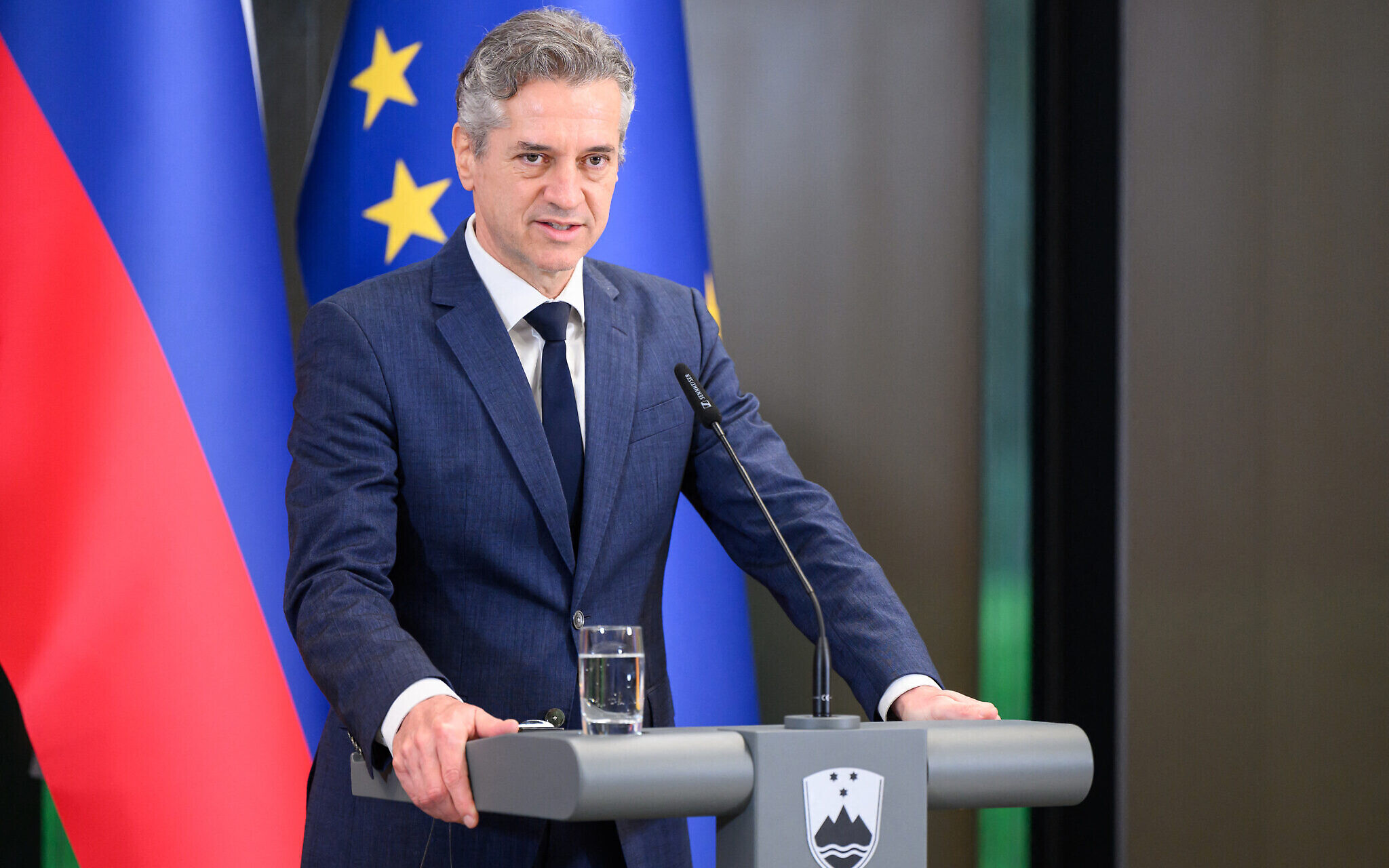
Slovenian Prime Minister Robert Golob addresses a joint press conference with Germany's chancellor after their meeting in Brdo Estate, near Kranj, Slovenia, on March 26, 2024. (Jure Makovec/AFP)
Slovenia says it will ban all weapons trade with Israel over the war in Gaza, in what it says is a first by an EU nation.
Slovenia’s government has frequently criticized Israel over the conflict, and last year moved to recognize a Palestinian state as part of efforts to end the fighting in Gaza as soon as possible.
“Slovenia is the first European country to ban the import, export and transit of weapons to and from Israel,” the government says in a statement. It says it is moving ahead “independently” because the bloc is “unable to adopt concrete measures… due to internal disagreements and disunity.”
In response, an unnamed Israeli official tells Ynet: “There is no defense procurement in Slovenia. We don’t buy so much as a pin from them. They simply decided on an embargo for the sake of the media, because they can, but it’s completely meaningless.”
The Slovenian statement says that amid the devastating war in Gaza, where “people… are dying because humanitarian aid is systematically denied them,” it is the “duty of every responsible state to take action, even if it means taking a step ahead of others.”
It adds that the government has not issued any permits for the export of military weapons and equipment to Israel since October 2023 because of the conflict.
Early in July, Slovenia — also in an EU first — banned two far-right Israeli ministers from entering the country. It declared both Israelis “persona non grata,” accusing them of inciting “extreme violence and serious violations of the human rights of Palestinians” with “their genocidal statements.”
In June 2024, Slovenia’s parliament passed a decree recognizing Palestinian statehood, following in the steps of Ireland, Norway and Spain, in moves partly fueled by condemnation of Israel’s offensive in Gaza after the October 7, 2023, Hamas attacks on Israel.
Israel intensifies warning against UAE travel, evacuates embassy amid fears of attack
An aerial view taken on January 1, 2022 from a passenger plane shows a general view of the Gulf Emirate of Dubai with the capital of the United Arab Emirates, Abu Dhabi, in the background. (Marina Passos / AFP)
The National Security Council is intensifying an existing warning for Israelis against travel to the United Arab Emirates.
“This comes amid growing indications that terrorist organizations (including Iranian-affiliated groups, Hamas, Hezbollah and global Jihad) are stepping up efforts to harm Israelis,” it says in a statement.
Concurrently, the Israeli embassy in Abu Dhabi will evacuate most of its workers from the facility, and the remaining staff are under strict security guidelines.
“It is believed there is increased motivation for revenge” following Israel’s war with Iran, “in addition to rising anti-Israel incitement and pro-Palestinian sentiment,” the NSC says. “In light of this, the NSC emphasizes the potential for terrorist attacks against Israeli and Jewish targets in the UAE, particularly around Jewish holidays and Sabbaths.”
2 more Palestinians die from malnutrition in Gaza — Hamas-run Gaza health ministry
Two more Palestinians have died over the past day due to complications from malnutrition, the Hamas-run Gaza health ministry announces.
The pair brings the total figure of hunger-related deaths to 159 since the start of the war, with 90 of them being children, the ministry says.
The figures have not be verified.
On Sunday, the World Health Organization said that 63 of the hunger deaths had taken place in July alone.


read more: