

Paving the way, but where?
A ruling allowing the state to take private Palestinian land for roads is either a milestone or a harbinger of things to come, and papers look at what jobs are open to whom
 Add ToI as a Preferred Source on Google
Joshua Davidovich is The Times of Israel's Deputy Editor
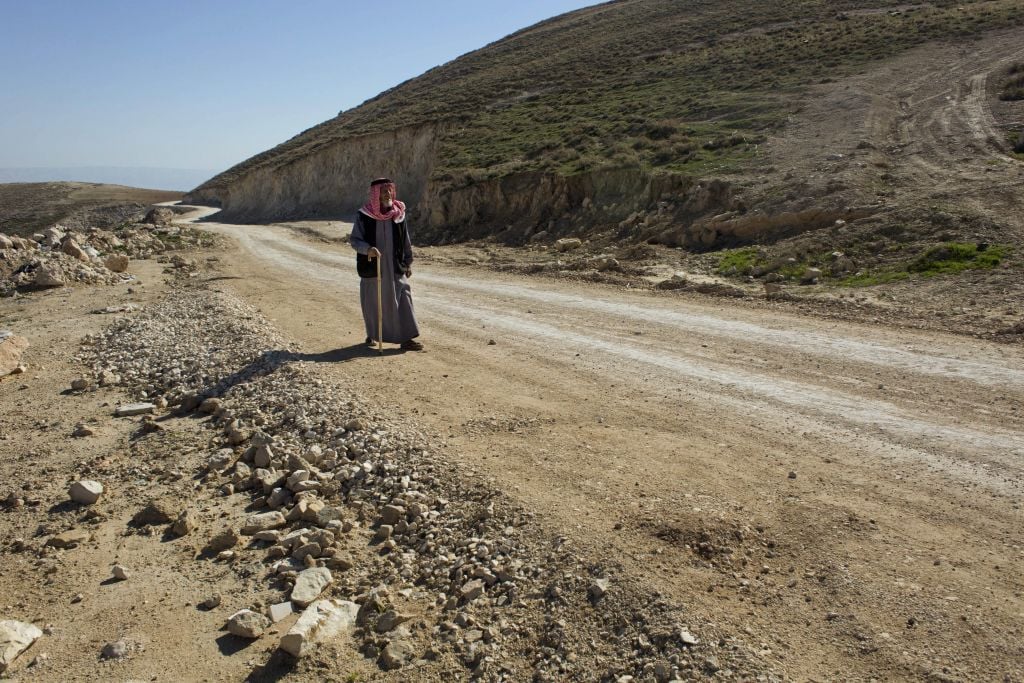
The attorney general on Wednesday okayed the state taking private Palestinian land in the West Bank to pave roads to settlements. Whether or not that fact is to be heralded or disparaged depends largely on whether one reads Haaretz or Israel Hayom on Thursday morning.
Haaretz leads off with the news, reporting that after Supreme Court Justice Salim Joubran ruled that roads for settlers benefited the local population (i.e. settlers), Justice Minister Ayelet Shaked asked Attorney General Avichai Mandelblit to lay out the state’s interpretation of the ruling.
“The attorney general’s legal opinion was issued at the request of Shaked and is connected to a request to legalize an access path to the illegal Jewish outpost of Harsha, located near Ramallah in the West Bank. A portion of the path sits on privately owned Palestinian land, and the absence of legal access to Harsha is the main reason that the outpost had not yet been authorized,” it reports.
While much of the reporting is pretty strait-laced, the paper also quotes both supporters and critics of the ruling.
“A decision allowing the theft of land is dangerous,” one lawyer is quoted saying. “We hope this opinion is not a harbinger of the attorney general folding on his stance against the [outpost] regularization bill.”
The themes of land theft and the idea that settlers can also be victims of seemingly capricious West Bank policy comes through in the paper’s lead editorial as well. While not directly related to the ruling, the column attacks the World Zionist Organization’s Settlement Division, which controls much West Bank building, for overstepping its bounds and misleading even Israeli settlers.
“When necessary the agency, which is funded by the state, does not even hesitate to deceive settlers in the pursuit of its sacred goal: putting up more buildings in the settlements,” the editorial reads. “The published investigative reports show that it is clearly exceeding its mandate. The division is not making do with the lands the state allocates it, but illegally takes lands that don’t belong to it as enforcement agencies look on helplessly.”
In Israel Hayom, though, the decision on paving new roads is covered in only glowing terms, and the story is even coupled with a report that the Knesset is set to remove restrictions on settlers evacuated from northern West Bank settlements over a decade ago returning to their former hilltops.

“Many of the law’s backers see this as a first step on a long road that will end with the reestablishment of the four settlements cleared out in the [2005] evacuation: Homesh, Sa-Nur, Ganim and Kadim,” the paper reports.
The attorney general’s decision is music to the ears of columnist Haim Shine, who calls it a “milestone for settling our birthright.”
Shine appears to praise the decision since it allows land to be taken “legally.”
He writes: “In Judea and Samaria there are wonderful settlements and hundreds of thousands of Jews deserve to travel on the roads used by our forefathers. Redeeming the land can’t be done by harming private property of Palestinian Arabs that live in the West Bank. The commandment of returning to the land by settling it needs to be done through legal means… There is enough state land to fill the whole West Bank with Jews.”
In a related matter, Yedioth Ahronoth, which does not cover the Mandelblit ruling, does devote several pages to reporting on revealed minutes from 1967, as the government tried to decide what to do with its newly won lands in the West Bank, and the people living in them.
In one telling passage, Defense Minister Moshe Dayan says he’s against a Palestinian state, but advises against making that known publicly.
“Our strength in a negotiation is to say that there is a possibility of a Palestinian state. It’s possible that a deal is possible, but if we say from the outset that we don’t want one, we prevent ourselves from having maneuverability,” he’s quoted saying.
Papers also look at what job openings, or lack thereof, in the Israeli military. Israel Hayom leads off its pages with the news that Brig. Gen. Ofer Winter, who used to sneak military info to Education Minister Naftali Bennett, has been told by IDF chief Gadi Eisenkot he won’t be made the military attache to Prime Minister Benjamin Netanyahu. However, the paper reports, Netanyahu is dragging his feet on who will get the post.

“Eizenkot told Winter in no uncertain terms that he is not a candidate and he should plan on remaining in his position as GOC Central Command. Formally, the prime minister cannot request a certain person to be his military attache, but he can choose between candidates chosen by the chief of staff,” the paper reports. “However, in the past Netanyahu has asked to meet with additional officers before choosing one, and he could do this again, even though the list before him includes senior brigadier generals who are respected in the army. The IDF is waiting for Netanyahu to choose since it’s holding up candidates for other promotions.”
At least Winter had a shot, thanks to his gender. Yedioth highlights an uptick in women serving in combat — 2,700 in 2017, compared to just 547 in 2012. But in a column for the paper, one woman in the mixed-gender Caracal unit bemoans the fact that women are still not trusted with many jobs, and writes that it’s time they be given an expanded role in defending the country.

“I’ve learned that every woman in combat needs to be careful of two threats: scorn and outmoded opinions. Sometimes it seems that these are even more dangerous than operations in the field,” Inbal Rechtman-Shiloh writes. “The IDF has always kept its male dominated hierarchy but now the time has come to break another glass ceiling, to open your minds and to pave the way for women who are capable of defending the country’s borders with determination and professionalism.”
Haaretz puts a report on its front page about former prime minister Ehud Barak possibly seeking a political comeback. Barak tells Channel 2 news he would consider starting a new party and that he could do a better job than Netanyahu. As for the man occupying his old seat as the head of Labor, Haaretz op-ed columnist Uri Misgav flings flack at Avi Gabbay for trying to shame the left over a lack of “Jewishness,” which he doesn’t feel should be an issue for anyone to bring up.
“In any other place and at any other time it would be seen as racism and anti-Semitism. Once it used to be the sole domain of the Orthodox rabbinate and the Interior Ministry…The floodgates have since opened, and anyone with a microphone or keyboard is drafting decisive theories about who’s a Jew. Avi Gabbay didn’t invent anything, at most he brought a prevalent trend to the realm of the grotesque,” he writes.
“We’re dealing with a national mental illness. From right and left, from top to bottom, the preoccupation of Jews with their Jewishness is simply obsessive… The sad conclusion is that the Israeli project has failed. The Declaration of Independence’s statement of intentions has gone bankrupt. Instead of a modern state with a sold, confident sense of citizenship, we’ve returned to the ghetto. A shtetl with nuclear submarines and a national cyber headquarters.”










The Times of Israel Community.