

Pixelate or perish: 7 things to know for November 23
A rare plea from the censor unfogs a PR battle with Hamas, and it’s unclear if the terror group or military will end up succeeding, or even what’s actually at stake
 Add ToI as a Preferred Source on Google
Joshua Davidovich is The Times of Israel's Deputy Editor
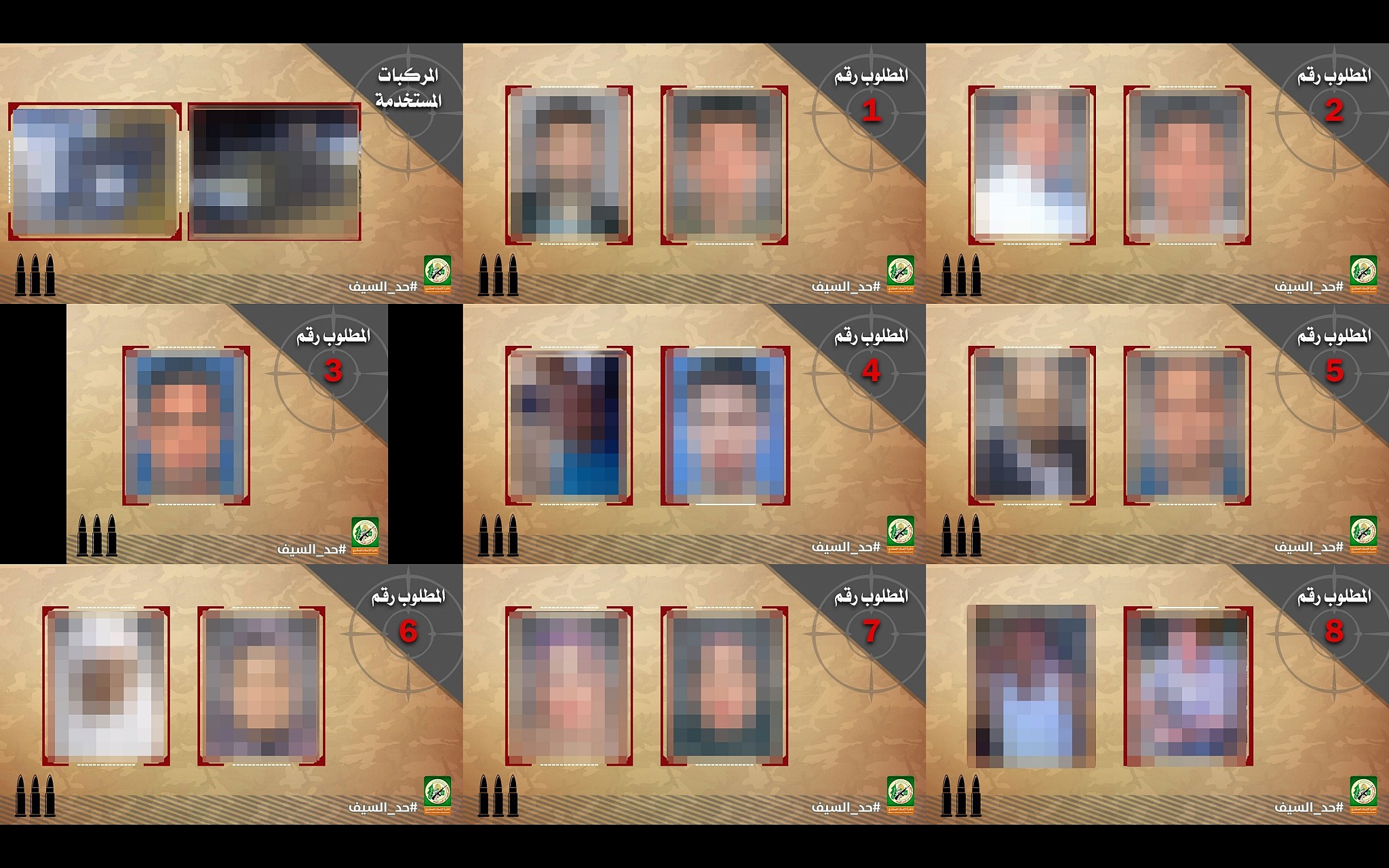
1. Blurred lines: Israel isn’t taking any chances with information getting out about whatever secret operation went awry in Gaza. On Thursday, after Hamas published pictures and other information of people it says were involved with the operation, the military censor — among the most opaque institutions in a country full of opaque institutions — made the rare step of issuing a public call for Israelis not to share any information they have about the raid, even if they think it benign.
- “Hamas is working now to interpret and understand the event that occurred within Gaza on November 11, and every piece of information, even if it is considered by the publisher as harmless, is liable to endanger human lives and damage the security of the state,” the censor said.
- The statement is a sign that the censor realizes it can no longer control the flow of information like it used to, with the pictures of eight people Hamas says were involved in the November 11 raid and of the two cars allegedly used by the Israeli special forces soldiers freely available online.
- While the censor doesn’t have the ability to enforce itself on Whatsapp groups, Twitter and the like, news outlets are bound by a special agreement to abide by censorship rules, which means that news sites and newspapers are filled with blurred out pictures.
- While in the past the use of such displays have been used as a protest against overbearing censorship — like in 2010 when newspaper published articles with blacked out text or snide notes telling readers to go elsewhere for news about Anat Kamm’s arrest — in this case the blurred pictures appear to simply be a way of telling the story.
2. Spin terrorists: The release of the information and Israel’s attempts to put a lid on them are part of a propaganda battle being waged between the two.
- In Haaretz, Amos Harel writes that Hamas is trying to crowdsource information and pull a Dhahi Khalfan — the Dubai police chief who blew the cover of the alleged Mossad spies who carried out a 2010 hit on a Hamas agent, giving Israel a black eye.
- “Hamas is trying to achieve two things by publishing the pictures: To impose its narrative, in which it defeated the IDF in the incident, and to derive an operational advantage by exposing Israeli methods and perhaps “burning” the identity of the fighters,” he writes.
- Yedioth’s Alex Fishman says that even though he can’t talk about all the things that Hamas is doing to try and win the propaganda war, he can still be impressed by it: “Hamas planned well for this PR campaign. In general, in recent confrontations Hamas has shown an impressive mastery of media methods.”
- But in Israel Hayom, which doesn’t even publish the blurred pictures, Yoav Limor praises the censor for battling Hamas’s “psychological warfare.”
- “It’s not clear how successful the attempt [to quash the info] is, but there’s no question as to the clear and definite connection to state security — even if some see it as controversial,” he writes.
3. Keeping the lid on: Despite that, the Ynet news site reports that the IDF doesn’t think the pictures went viral on social media or Whatsapp.
- Indeed, tweets with the pictures published by some popular Palestinian accounts garner only a handful of likes and retweets.
- For the foreign press, the censor warning garners as much attention — if not more — than Hamas’s publication of the pictures.
- On Twitter, journalist and analyst Yoni Ben Menashe notes that Hamas is using fictitious accounts to scan twitter and see what Israelis are posting about their pictures and how it compares to photos published in Israel on Facebook, but will have a hard time making headway because the press is obeying the censor.
- Nonetheless, Yedioth’s Ronen Bergman, who regularly writes about spycraft, seems to think the censor wants to keep the info secret not to protect secret agents, but save face. Similar attempts in the past have only brought more attention, he says.
- “There was a disaster in Gaza, both for Col. Mem and his family and the IDF. No attempt to stop Hamas info from getting out will lessen the catastrophe. The horses long ago bolted and there’s no point in even trying to close the door,” he writes.
4. A tragedy comes to light, 36 years later: A sign of how the censor used to work effectively is on display with the publication of a deadly incident that has remained under cover for over 36 years.
- After petitioning the high court, Channel 10 was finally allowed on Thursday to report that Israel mistakenly torpedoed a ship carrying refugees and others from Lebanon in 1982, killing 25 people.
- Thanks to the passage of time, the disastrous affair barely makes a blip, overshadowed in the press by a tweet from the IDF wishing Lebanon a happy Independence Day and urging it to throw off the yoke of Hezbollah and Iran.
Happy Independence Day to the people of #Lebanon, our neighbors to the north! We hope you will soon be free of Iranian imperialism and #Hezbollah’s terrorism in your country. pic.twitter.com/VDpvUYbRdG
— Israel Defense Forces (@IDF) November 22, 2018
5. Troubling times: Israel’s ties with Saudi Arabia are also totally under wraps, but US president Donald Trump shed a tiny bit of light Thursday, commenting that “Israel would be in big trouble without Saudi Arabia.”
- “The fact is that Saudi Arabia is tremendously helpful in the Middle East, if we didn’t have Saudi Arabia we wouldn’t have a big base, we wouldn’t have any reason probably…” he added, trailing off to who knows where.
- According to Haaretz’s Chemi Shalev, Mohammed Bin Salman might be in big trouble if it weren’t for Israel.
- “Netanyahu and his aides, led by US Ambassador to Israel Ron Dermer, have been working around the clock to protect Trump and to prevent his administration from ‘throwing out the prince with the bath water,’ as Dermer put it. Netanyahu has volunteered to serve as Trump’s human shield to protect him from widespread demands by both Democrats and Republicans to punish the crown prince and his kingdom for the Khashoggi assassination,” he writes.
6. Voting with their stomachs: The thin governing coalition of 61 is apparently bringing lots of attention to the eating habits of Knesset members.
- A day after Netanyahu sent out a video of him ordering fish and pasta from the Knesset cafeteria for some reason, Yedioth’s Oded Shalom writes about the Likud MK Amir Ohana grabbing some shnitzel, Thai stir fry, rice and corn, and green beans in the Knesset caf.
- But just when he sat down, according to Shalom, Tzipi Hotovely announced there would be a vote on recognizing the Armenian genocide, which to Ohana was not quite as important as his lunch.
- “Just as he loaded the rice on his fork, the faction vote coordinator Danit Amitai stood over him, and told him to get up and run to the plenum. ‘I’m eating,’ Ohana begged, but Amitai did not relent. ‘We can’t lose to them today, we have to show them we can win votes.’ Ohana tried again to appeal to her heart, ‘I’m in the middle of my snack.’”
- For those keeping score at home, the coalition, Ohana included, managed to successfully protect Israel from recognizing the Armenian genocide, thus ensuring the country’s continued stellar ties with Turkey. (That’s sarcasm.)
7. Speaking of Turkey: Israel may not have much of a Thanksgiving tradition (most Israelis think of it as a Christian holiday), but Black Friday is very much happening at malls and stores across the country.
- Papers, radio stations and any place an ad can fit are filled Friday with notices for “deals,” allowing Israelis to be just as consumerist as Americans.
- “Every time I hear or see a Black Friday ad, I feel like maybe too much of America has crept into our society. We already have pre-Rosh Hashanah and pre-Passover sales, since they have also become gift-giving occasions. But Black Friday? It’s just not Israel,” writes JTA’s Marcy Oster.
- Given the fact that Black Friday in America marks the start of the Christmas shopping season, and in Israel there is no Hannukah gift-giving tradition, doesn’t that make Black Friday even more of a Christian holiday than Thanksgiving?



The Times of Israel Community.