

PM on Shabbat construction controversy: Highway can’t be closed midweek
In row over building of pedestrian bridge over major Tel Aviv artery, transportation minister claims he has Netanyahu’s full support, blames mayor for politicizing issue
 Add ToI as a Preferred Source on Google
Prime Minister Benjamin Netanyahu weighed in on the controversy over canceled building work planned for a bridge over a Tel Aviv highway that had been due to take place on Saturdays, telling reporters Thursday that the work could not be carried out during the week.
“I don’t think it is reasonable to close a main transportation artery like the Ayalon in the middle of the week,” he said at Ben Gurion airport prior to his departure on a trip to Lithuania. “I think that this is clear and will also be taken into account.”
The prime minister was responding to Transportation Minister Israel Katz’s announcement that he would delay construction on a pedestrian bridge by six months following a controversy about the work taking place on Shabbat, the Jewish day of rest, amid protests from ultra-Orthodox lawmakers.
Sources close to Prime Minister Benjamin Netanyahu ramped up criticism of Katz on Thursday morning, telling Army Radio, “Minister Katz’s mistakes are starting to become irritating.”
“How can it be that there is a request for work on Shabbat and the Transportation Ministry does not see it will be explosive?” the source said.
In response Katz, a member of the ruling Likud party, told the radio station that Netanyahu had given his support to the decision.
The minister refrained from responding to the criticism from Netanyahu’s office, instead hitting out at Tel Aviv Mayor Ron Huldai who had accused him of bowing to ultra-Orthodox pressure.
Huldai accused the government of turning Israel into a theocracy by canceling work on the bridge during Shabbat.

The Tel Aviv mayor is running for reelection in the October 30 municipal elections, so he “made this into a political issue,” Katz said, “which will harm hundreds of thousands of drivers who travel every weekend.”
Katz, who is also intelligence minister, stressed that the Jerusalem Chords Bridge and bridges throughout the world were built at night without ever closing the road completely, and the same could be done in Tel Aviv. He also clarified that the approval for the work was made by the Industry, Trade and Labor Ministry, not his Transportation Ministry, but that he had the responsibility to make policy decisions.
This echoed his statement on Wednesday night when he said, “It’s true this began with the protest of the ultra-Orthodox but today I looked into things and I can say unequivocally that I’m not going to approve carrying out work during the weekend or the middle of the week,” he said, adding that unlike Huldai he has “national considerations.”
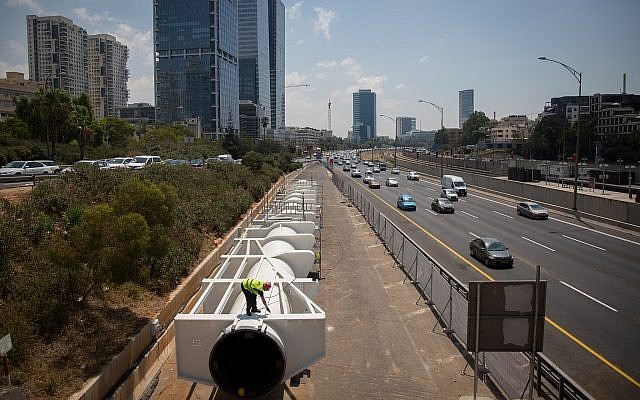
The construction of the Yehudit Bridge, which will necessitate shutting parts of Tel Aviv’s busy Ayalon freeway, had been slated to take place over six consecutive weekends, starting at sundown Friday and lasting 24 hours each time.
The work, which will require one direction of the highway to be shut down while massive steel support girders are hoisted into place, had been slated to coincide with Shabbat to minimize the impact on commuters.
However, ultra-Orthodox lawmakers in the government protested it as a violation of a coalition agreement to refrain from infrastructure work on the day of rest, which begins at sundown Friday.
Katz insisted he ordered the construction freeze because he was unhappy with the highway being closed to traffic, but opposition lawmakers and others accused him of knowing about the planned work all along and only halting the work because of ultra-Orthodox threats.

In the past, ultra-Orthodox coalition members have also worked to block railway work from being carried out on Shabbat, causing disruptions to services when it was moved to workdays instead.
The Yehudit span will link an area with several office towers, including Google Israel’s office, that sits on the eastern side of the Ayalon freeway, which essentially cuts it off from the rest of the city center to the west of the highway.
When completed, the bridge will be 110 meters long (360 feet), 18 meters high, and 11 meters wide. It will have a pedestrian and a bicycle lane separated by a central area featuring benches.
Construction will require steel beams weighing a total of 1,000 tons to be lifted into place, Channel 10 reported Wednesday.
The now-canceled plan had scheduled the first work session for August 31. On each occasion the highway was to be closed in one direction starting 6 p.m. Friday for 24 hours.
Stuart Winer contributed to this report.










The Times of Israel Community.