Israeli pop singer Kobi Peretz (C) and his wife arrive for a hearing at the Tel Aviv District Court on June 28, 2017. (Yonatan Sindel/Flash90)
Mizrahi pop singer Kobi Peretz was released from prison Sunday, after serving nine months of 18-month sentence for tax evasion.
Peretz spent the weekend at home with his family, but returned to Ma’asiyahu Prison in Ramle Sunday morning to complete the necessary paperwork.
Peretz was convicted in May 2016 by the Tel Aviv Magistrate’s Court of tax evasion amounting to NIS 5.8 million ($1.5 million). He was indicted on tax fraud charges for hiding millions of shekels in income between 2005 and 2009, submitting false income information, and making threats against his agent, who turned state’s witness against him in 2012.
Throughout his trial, Peretz maintained his innocence, and claimed that his agent misled him.
Following an appeal, his two-year sentence was reduced to 18 months.
Get The Times of Israel's Daily Editionby email and never miss our top stories
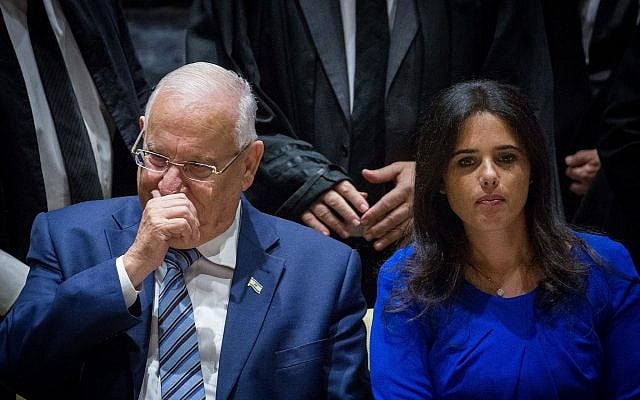
President Reuven Rivlin, left, and Justice Minister Justice Ayelet Shaked during a ceremony at the President’s Residence in Jerusalem, on October 26, 2017. (Miriam Alster/Flash90)
In May, President Reuven Rivlin cut his sentence by half, one of several special commutations he granted to prisoners on the occasion of Israel’s 70th anniversary year. Earlier in 2018, Rivlin and Justice Minister Ayelet Shaked announced that as part of the framework of the national celebrations, the president would pardon or commute the sentences of a number of nonviolent prisoners who had shown remorse for their crimes.
Rivlin rejected Peretz’s first request for clemency last year, telling the singer that his office was not the place to hear legal appeals but rather to show “acts of charity” in “isolated and exceptional cases.”
According to reports in Hebrew-language media, Shaked convinced Rivlin to include Peretz among his Independence Day pardons.
Advertisement
Help us report truthfully on social media
As a multimedia journalist, my job is to take the quality, fact-based journalism produced by The Times of Israel newsroom and make it accessible across every platform — from Instagram posts to podcasts to short-form videos.
This is how many, especially young people, consume news these days. But misinformation is rampant on social media. Our team at ToI produces accurate, responsible short-form reporting on Israel and the Jewish world.
If you believe in the importance of factual social media journalism, please consider joining our reader support group, The Times of Israel Community. Your financial support is essential to sustain responsible multimedia reporting.
We’re really pleased that you’ve read X Times of Israel articles in the past month.
That’s why we started the Times of Israel - to provide discerning readers like you with must-read coverage of Israel and the Jewish world.
So now we have a request. Unlike other news outlets, we haven’t put up a paywall. But as the journalism we do is costly, we invite readers for whom The Times of Israel has become important to help support our work by joining The Times of Israel Community.
For as little as $6 a month you can help support our quality journalism while enjoying The Times of Israel AD-FREE, as well as accessing exclusive content available only to Times of Israel Community members.
Thank you, David Horovitz, Founding Editor of The Times of Israel


 Add ToI as a Preferred Source on Google