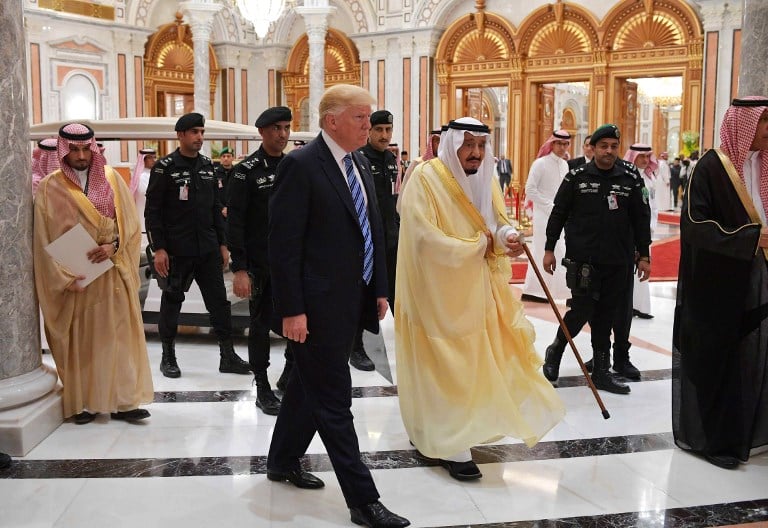
US President Donald Trump (C-L) and Saudi Arabia's King Salman bin Abdulaziz al-Saud (C-R) arrive for the Arabic Islamic American Summit at the King Abdulaziz Conference Center in Riyadh on May 21, 2017. (AFP Photo/Mandel Ngan)
RIYADH, Saudi Arabia — Saudi King Salman on Monday described US President Donald Trump’s visit to the Muslim kingdom in the Gulf as a “turning point” in relations between the two countries.
Trump on Monday concluded his landmark visit to Saudi Arabia, which he chose for his first foreign trip since taking office in January, during which the allies announced arms deals and investments worth hundreds of billions of dollars.
“This is a turning point in relations between the two countries,” Salman told his council of ministers, according to state news agency SPA.
He said relations between the two countries will advance from a partnership to the “level of strengthening consultations, cooperation and coordination on all fronts.”
The king also praised an “historic agreement” between Gulf monarchies and Washington “to take firm measures to target the financing of terrorism” and the setting up of a Riyadh-based center for this task, SPA said.
Get The Times of Israel's Daily Editionby email and never miss our top stories
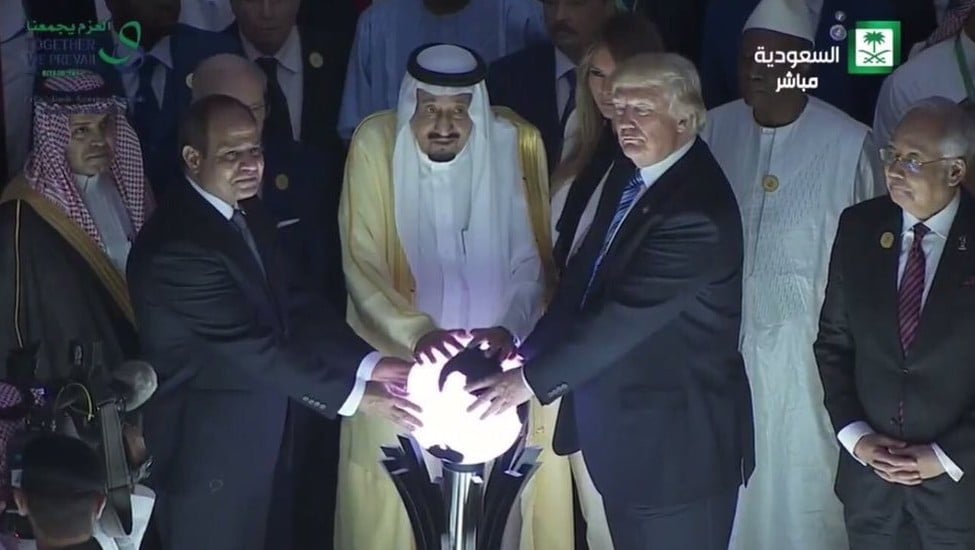
US President Donald Trump, Saudi King Salman and Egyptian President Abdel-Fatah al-Sissi touching a glowing globe to launch the opening of an anti-extremism center in Riyadh on May 21, 2017. (Screenshot)
The ministers also hailed the launch of the Global Center for Combating Extremist Ideology in Riyadh on Sunday.
Dubbed “Etital,” Arabic for moderation, the center “embodies the kingdom’s great efforts and its ongoing fight against terrorism,” SPA reported.
In his first foreign speech, Trump on Sunday urged Muslim leaders to take a stand against violence committed in the name of religion, describing the struggle against extremism as a “battle between good and evil.”
Advertisement
Help us report truthfully on social media
As a multimedia journalist, my job is to take the quality, fact-based journalism produced by The Times of Israel newsroom and make it accessible across every platform — from Instagram posts to podcasts to short-form videos.
This is how many, especially young people, consume news these days. But misinformation is rampant on social media. Our team at ToI produces accurate, responsible short-form reporting on Israel and the Jewish world.
If you believe in the importance of factual social media journalism, please consider joining our reader support group, The Times of Israel Community. Your financial support is essential to sustain responsible multimedia reporting.
We’re really pleased that you’ve read X Times of Israel articles in the past month.
That’s why we started the Times of Israel - to provide discerning readers like you with must-read coverage of Israel and the Jewish world.
So now we have a request. Unlike other news outlets, we haven’t put up a paywall. But as the journalism we do is costly, we invite readers for whom The Times of Israel has become important to help support our work by joining The Times of Israel Community.
For as little as $6 a month you can help support our quality journalism while enjoying The Times of Israel AD-FREE, as well as accessing exclusive content available only to Times of Israel Community members.
Thank you, David Horovitz, Founding Editor of The Times of Israel


 Add ToI as a Preferred Source on Google