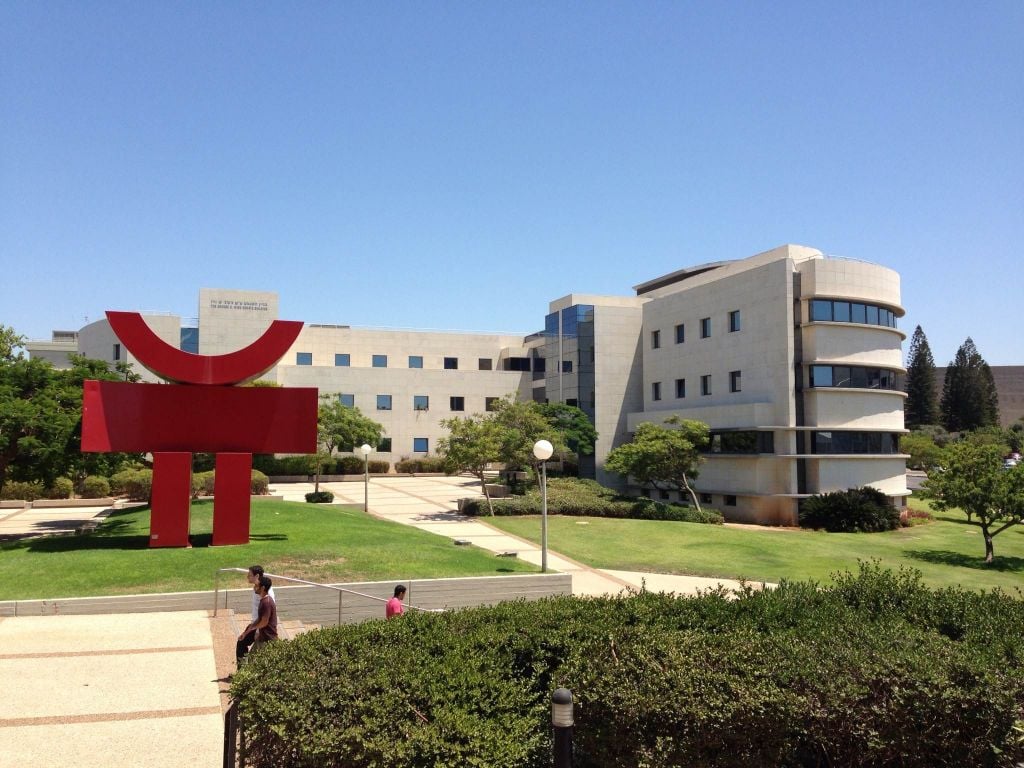
Illustrative photo of the Tel Aviv University campus. (Andrew Tobin/JTA)
Tel Aviv University scientists will collaborate with their counterparts at Stanford University and the University of California, Berkeley on research in medical and information technology.
The initiative is being funded with a five-year, $10 million grant from the Koret Foundation, which funds Bay Area organizations and initiatives, and works to support the US-Israel relationship.
The multidisciplinary research will take place in the fields of bioinformatics, computational biology, and smart cities and digital living.
Joseph Klafter, president of Tel Aviv University, is in California this week to sign memorandums of understanding with the two universities.
The Koret Program for Bioinformatics and Computational Biology will be run jointly by the Edmond J. Safra Center for Bioinformatics at TAU and the Center of Computational Biology at Berkeley. The program is expected to develop computational tools that integrate patient genetic, genomic and other data for medical purposes.
Sign up for the Tech Israel Dailyand never miss Israel's top tech stories
The University of California, Berkeley. (Charlie Nguyen/ Flickr, CC BY 2.0/via JTA)
The program will award joint research grants to groups at both institutions, hold annual joint workshops and seminars, operate a visiting-scientist program, and facilitate a joint summer research program.
The Koret Program for Smart Cities and Digital Living will fund joint research at TAU and Stanford.
Advertisement
Help us report truthfully on social media
As a multimedia journalist, my job is to take the quality, fact-based journalism produced by The Times of Israel newsroom and make it accessible across every platform — from Instagram posts to podcasts to short-form videos.
This is how many, especially young people, consume news these days. But misinformation is rampant on social media. Our team at ToI produces accurate, responsible short-form reporting on Israel and the Jewish world.
If you believe in the importance of factual social media journalism, please consider joining our reader support group, The Times of Israel Community. Your financial support is essential to sustain responsible multimedia reporting.
We’re really pleased that you’ve read X Times of Israel articles in the past month.
That’s why we started the Times of Israel - to provide discerning readers like you with must-read coverage of Israel and the Jewish world.
So now we have a request. Unlike other news outlets, we haven’t put up a paywall. But as the journalism we do is costly, we invite readers for whom The Times of Israel has become important to help support our work by joining The Times of Israel Community.
For as little as $6 a month you can help support our quality journalism while enjoying The Times of Israel AD-FREE, as well as accessing exclusive content available only to Times of Israel Community members.
Thank you, David Horovitz, Founding Editor of The Times of Israel


 Add ToI as a Preferred Source on Google