

The coming storm: 8 things to know for December 14
Thursday’s deadly attack in the West Bank underlines warnings about the flammability of the West Bank, but responses don’t come without controversy
 Add ToI as a Preferred Source on Google
Joshua Davidovich is The Times of Israel's Deputy Editor
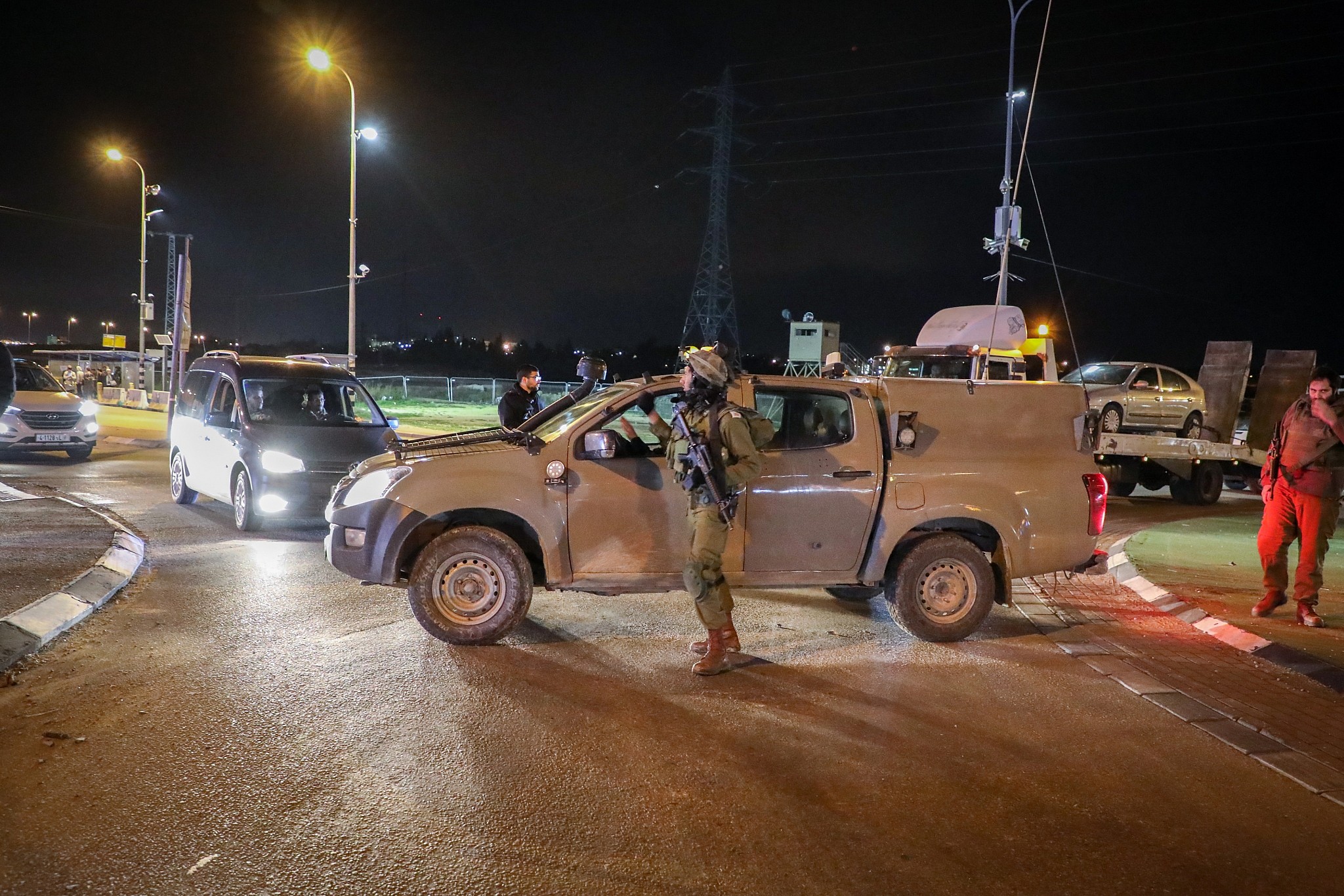
1. Headed for an explosion? Is Israel on the cusp of another inexorable slide into violence with the Palestinians, this time in the West Bank? That’s the question on many people’s minds the day after a shooting near Ramallah left two soldiers dead and another fighting for his life.
- Unlike the 2015 so-called lone-wolf intifada, there is a sense (likely filtering from the IDF down to the loyal army of military correspondents) that what is happening in the West Bank is different. Top down rather than grassroots, and the work of cells rather than solitary assailants operating on impulse. That’s thanks to an army assessment that thinks there may be a connection between the group who carried out the attack outside the Ofra settlement and those involved with the shooting attack outside the Givat Asaf outpost.
- Analyst Yossi Yehoshua in Yedioth Ahronoth calls the “wave” (his word), “the realization of warnings from the military to government, which alerted them over fears of an increase in violence if the political stalemate with the Palestinians continues.”
- (Such a warning is a near-constant fixture of army assessments, often because it’s true, but also because nobody wants to be the officer who said everything is swell right before a fresh outbreak of violence.)
- “It’s hard to be surprised by the wave of terror this week in the West Bank,” Israel Hayom’s Yoav Limor writes. “Anyone who has followed the statistics over the last months has seen a clear trend: attempts to carry out attacks were on a constant upswing, and only operations by the Shin Bet and IDF have prevented a mass of casualties until now.”
- Haaretz’s Amos Harel notes that an officer giving a briefing Thursday appeared uncharacteristically shaken, giving the impression that the West Bank is facing another wave of violence.
- “The ability to stop this trend in the coming days, before it spreads, depends mainly on the forces in the field – on whether a wave of copy-cat attacks will translate into another success for terror,” he writes.
2. Collective punishment on the table: During the last wave of violence, Defense Minister Moshe Ya’alon (and later Avigdor Liberman) was praised for making efforts to keep collective punishment against the Palestinians to a minimum. It seems however that Defense Minister Benjamin Netanyahu may be taking a different tack, with the army already making the rare move of putting up a cordon around Ramallah, the seat of the Palestinian government.
- In 2015, most attackers were captured or killed on the spot. That has not been the case this time around, with the terrorist who carried out the Givat Asaf attack getting away, and reportedly making off with the gun of one of the victims.
- “The army is determined at this point to stop the wave of terror and find the terrorist, even at the price of hurting Palestinians daily lives,” Amir Bohbot writes in Walla, describing large traffic jams around the West Bank thanks to the cordon around Ramallah and checkpoints set up in other spots.
- The biggest loser, according to Bohbot, is the Palestinian Authority, which is watching the army hem it in while Hamas gets to brag about successes against the occupation. “The PA got hit doubly this week,” he quotes an officer telling him.
- In Yedioth, Nahum Barnea writes that there are arguments both for and against collective punishment. While noting that only oppressive regimes such as colonialists or genocidal leaders have seen any success from punishing a population as a whole (and even that is limited), making sure that innocent Palestinians are not harmed has also not been proven as a salve against popular uprisings, such as the First Intifada, which occurred at a time of relative prosperity in the West Bank and Gaza.
- “In general, the decision has been made on the basis of politics, not security,” he writes. With the defense minister doubling as the prime minister and likely soon to enter a fight for his political life, one can see where this is leading.
3. Build, baby, build: Another response has been for the government to increase building in the West Bank as a form of punishment (never mind that the fact that Israel uses settlement building as a punitive measure says clearly what it thinks of the enterprise).
- On Thursday, Attorney General Avichai Mandelblit officially approved the use of a legal tactic that will allow for the de-facto legalization of roughly 2,000 illegally built Israeli homes throughout the West Bank.
- The move came after Netanyahu vowed to increase building as a response to the attacks, saying in a statement that beffudled many that he would “legalize thousands of homes in communities in Judea and Samaria that were built in good faith and which have yet to be legalized, some for decades.”
- There’s more too. Haaretz reports that, “On Sunday, the Ministerial Committee for Legislation is expected to discuss a bill to legalize a series of outposts and settlements. The proposal seeks to supply settlements whose status has yet to be confirmed with services that would prevent their demolition until they receive official status.”
- But there’s also some confusion: “It is not clear what the full implications of the bill would be. Most established outposts are already connected to water and electricity, largely via nearby settlements. The authorities refer to such outposts as recognized localities; budgets from both ministries and West Bank regional councils are transferred to them on an ongoing basis,” the paper reports.
4. Pressure builds: A sign of the political pressure Netanyahu is under because of the attacks was on display Thursday night, as some one thousand right-wingers rallied outside his residence in Jerusalem and called for his resignation.
- Samaria Regional Council head Yossi Dagan told the crowd that he wasn’t seeking resignation, but action: “I call on Netanyahu to wake up! The people elected you to head a national government, but this government is behaving like the Barak government at the beginning of the Second Intifada,” Dagan said, referring to former prime minister Ehud Barak, on whose watch the uprising erupted in 2000. “We hope to see you crush the terrorist authority.”
- At the same time, settlers near Givat Asaf and elsewhere in the West Bank rioted and hurled rocks at Palestinian cars as they raged over the attacks.
5. Settlements as strategic bases: In Israel Hayom, Gershon Hacohen, a former high-ranking military officer, writes that there is a strategic importance as well to approving more building as a response to security challenges.
- “Without wide swaths of Jewish settlement, as there is in the West Bank today, the IDF would have a hard time maintaining a presence in the area and doing its job effectively,” he writes, pointing to the role Jewish settlement ringing Nablus played for soldiers taking part in 2002’s Operation Defensive Shield. “Where there are Israeli settlements near Nablus, they are used by Israeli forces as a protected launching point for repeated operations within Nablus. The IDF works to protect settlers, but mostly its operations there are to protect the coastal areas and the Tel Aviv region.”
- Not all settler leaders are enamored with the idea of building being tied to terror, as ToI’s Jacob Magid explained in September.
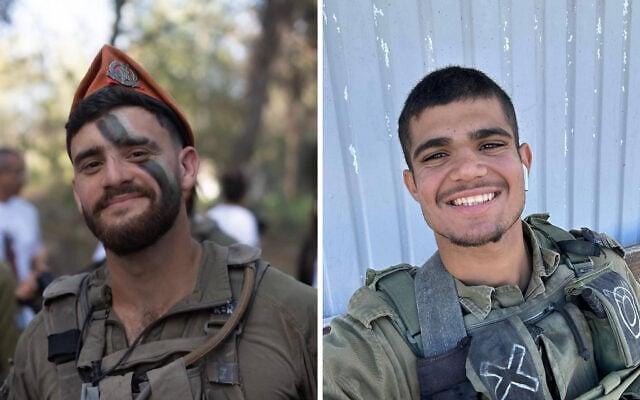
6. Soldiers remembered and rumors debunked: The two soldiers killed in Thursday were named as Yovel Mor-Yosef, 20, and Yosef Cohen, 19, both from the Netzach Yehuda brigade made up of more religious soldiers.
- Some reports Thursday indicated that Cohen, from an ultra-Orthodox background, had been disowned by his family for enlisting, and they had already mourned him (some ultra-religious families will sit shiva for a family member who leaves the fold).
- However, Haaretz reports that in fact his step-father, who heads a yeshiva that encourages work alongside Torah study, encouraged him to join the army, and his mother eventually accepted his choice as well.
- “These rumors are unspeakably evil and low,” mother Adele Cohen is quoted as saying, regarding the reports that the family had already mourned him. “I don’t know if I can forgive anyone for that. It never happened. I’m amazed at how brazen people can be, lying and inventing things that give people a bad name. I don’t know how anyone could devise such a thing.”
- Mor-Yosef, meanwhile, is praised for insisting on volunteering for combat duty the morning he was killed.
- “He spoke with his father this morning and Yovel said that he was supposed to go home after being on duty all night, but volunteered to switch with other people so they could rest,” his uncle tells Hadashot news. “This was ordained from heaven.”
7. ‘Noah didn’t stop telling his story’: Buried among all the security news Thursday was the death of Noah Klieger, 92, a sports journalist, editor, historian and Holocaust survivor who was well-known in Israel as a chronicler of the horrors of that period and the struggles afterward.
- Yedioth, which employed Klieger since the 1950s as an editor and columnist (he continued to write until recently) runs a series of appreciations, including from President Reuven Rivlin, Netanyahu, former IDF chief Benny Gantz and others.
- “Thanks to him, and a few others like him, the Shoah remains an institution in Israel and around the world. Every speech he gave in every place raised the memory of the Holocaust,” Eitan Haber, a Yedioth columnist, writes in one obituary.
- The paper also runs a full translation of a speech that Klieger gave to the UN last year that drew wide attention (or as wide attention as speeches at the UN about the Holocaust go).
- While Klieger was well known in Israel, he is nearly unknown in the English-speaking world. By coincidence, just last month, Harper’s Magazine happened to run a profile of Klieger which had been translated from German and is worth a read to get a sense of who the man was.
- “Noah’s the driven man who never gave up, who was never able to stop talking about Auschwitz, who swore to himself seventy years ago: If I get out of here alive the world must know, because then all this won’t have been in vain. He continues to confront his memories today, despite the fact that so many of his fellow survivors chose never to talk about their experience again, never to relate the horrors—not even to their children,” Marco Lauer writes.
8. Losing the memory-keepers: Together with Elie Wiesel and Aharon Appelfeld, Klieger marks the third writer whose life was marked by perpetuating the memory of the Holocaust to die in the last two years, underlining the intensive efforts to make sure survivors are heard as time runs out.
- The Associated Press reports that another loss Thursday was Alter Wiener, 92, who recently appeared before lawmakers to press for mandatory curriculum about the Holocaust and genocide in Oregon, where he lived.
- Wiener was killed while crossing a street near his home, according to the AP.
- “He spoke to thousands of Oregonians about his experiences, making nearly 1,000 appearances at schools, libraries, churches, conferences and charitable events,” the agency notes.





The Times of Israel Community.