

There would have been (more) blood
Papers take some liberties in reporting on how bad things may have gotten in Barcelona and are divided on the meaning of Steve Bannon’s ouster
 Add ToI as a Preferred Source on Google
Joshua Davidovich is The Times of Israel's Deputy Editor
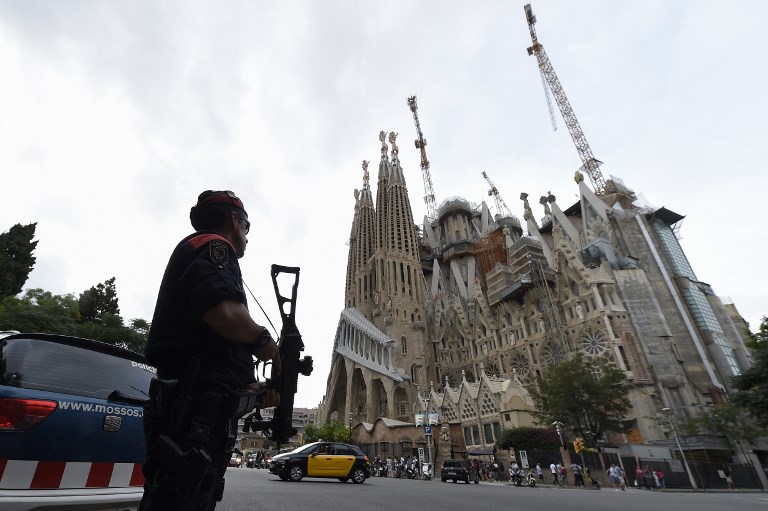
It’s not as if the twin car-ramming attacks in Spain on Thursday and Friday — in which 14 were killed and over 10 injured — were anything less than horrible, but Israeli papers on Sunday morning are of one mind in fixating on how much worse some say it could have been, with all three major Hebrew print outlets focusing on what investigators say was a plot to detonate gas canisters in central Barcelona.
Both tabloids take some liberties in playing a macabre game of what if — call it “if it could have bled it led” — with Yedioth Ahronoth and Israel Hayom naming Barcelona’s La Sagrada Familia church as the intended target of some 105 gas canisters packed into three vans.
While police believe the plotters did intend to blow up gas canisters in the heart of Barcelona before a “work accident” saw all their efforts go up in flames, the naming of the target and the high number of canisters seem to have come straight from European tabloids playing fast and loose with the suspicions.
Both are reported as fact, though, with Yedioth putting the famed cathedral on its front page alongside the headline “IS planned to blow up the symbol of Barcelona” and Israel Hayom putting the 105 canisters on its front under a headline reporting that there could have been “MASS KILLINGS,” as if the van barreling down Las Ramblas Boulevard didn’t bring with it MASS KILLINGS.
“It’s hard to believe, but the terrible scene could have been much worse,” Yedioth Ahronoth’s correspondents in Spain write. “Some 48 hours after the disaster, the terrorists’ real plan is becoming clear: A triple car bomb attack in different parts of the district, including the famous Sagrada Familia, one of the most-well known icons of Barcelona.”
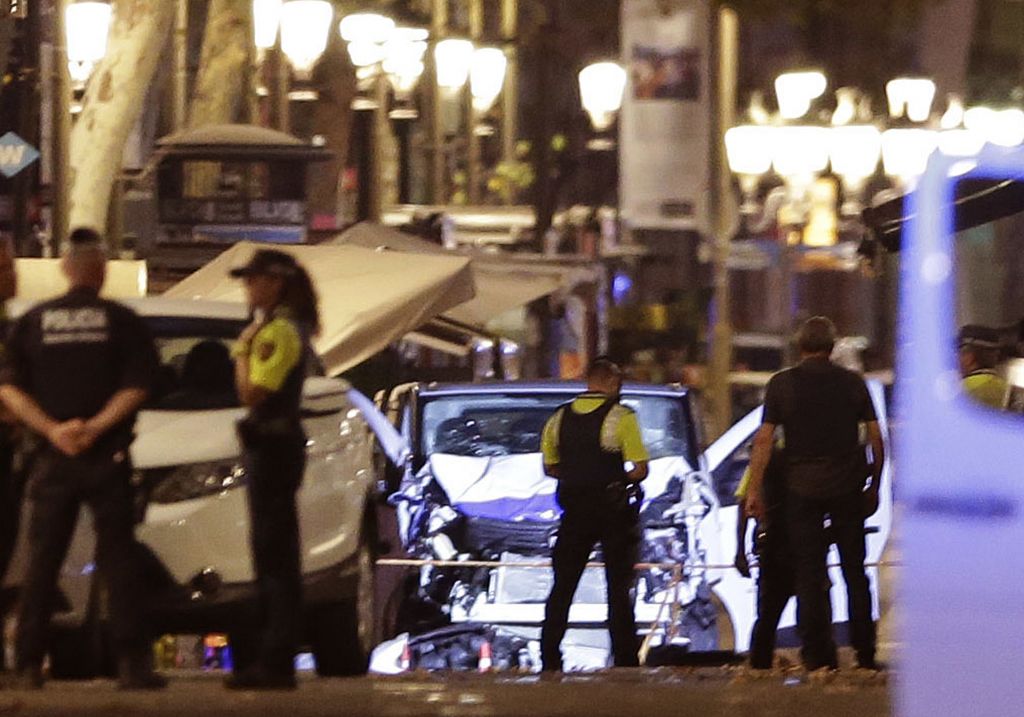
Meanwhile Israel Hayom’s Danielle Rut-Albari, dispatched to Alcanar, reports that police found 105 gas canisters in a house there. Doing some first-hand reporting, she quotes a neighbor saying they thought something might have been up.
“I’m shocked to find that our vacation home is in the neighborhood of a terror cell,” the neighbor is quoted saying. “A few days ago, we saw some hombres going back and forth on scooters, and it seemed strange since they were not familiar.”
Haaretz also leads off with what might have been, but while reporter Yaniv Kubovich — also dispatched to Barcelona and Alcanar — reports that the cathedral was a target (adding in the qualifier “according to reports”), he goes with the more accepted number of 12 gas canisters found.
Kubovich also quotes a neighbor, possibly the same one, talking about a bunch of young men from the house trying to ride motorcycles, and notes that police, despite investing much intelligence into counterterror efforts since the 2005 Madrid train bombings, say that lone wolves present a new problem.
“Sometimes we can’t deal with all the cases and all the information coming in. We have 400 people on the radar we’ve received information about. There are names we get from nearby countries like Morocco. We are investing great deal in quality intelligence so we can be much more focused,” he quotes a policeman saying.
In Israel Hayom, though, a columnist named Sal Amargi notes that Barcelona was a natural target and says when it comes to security, Spain is not Israel.
“The desire to reconquer Andalusia is a constant fixture of jihadi forums. In addition, Barcelona is an easy and safe hop from Africa to Europe. Exploiting the values of tolerance and total freedom, the Salafi terrorists found an opportunity … to hit Las Ramblas isn’t only to hit the heart of Barcelona, but also the hearts of 35 countries whose citizens were killed or injured,” he writes. “Now more security forces will be dispatched, but the approach toward security matters, like open borders, immigrants and human rights, will not change fundamentally. I don’t know if that’s good or bad. I do know that every time I return to the city I love most I am surprised anew when I see there are no guards at the entrances to malls or train stations. The same surprise I had when I got to Israel and to my surprise a person I know told me I had to open my bag for him in order to go into the mall.”
Finding the balance between liberty and security also forms the heart of a column in Yedioth by Yoav Frumer, who writes that when push comes to shove in times of crisis, liberty usually loses out.
“You can’t live in a democracy without security. It hasn’t ever happened and won’t ever happen. And so sometimes there are existential crises of democracies, where the citizens are forced to choose between the two and give up on one. The Europeans are quickly heading to that point of no return,” he writes. “Europe is not there yet but it is taking giant steps toward it. If the attacks on the Continent continue or even get worse, even these most enlightened citizens, those that taught the world about liberty, equality and fraternity, could quickly forget them.”
Some say the same process is underway in the United States, even without Islamic terror but instead thanks to internal struggles with the ghosts of a racist past. The firing of White House adviser Steve Bannon, a leader of the alt-right, would certainly have been top news if not for Barcelona, and it garners much ink in all three papers, though they have somewhat different takes.
Yedioth puts Bannon’s firing into the context of general disarray in a White House that has never really known array, pointing out how many other top staffers have been fired in just a few months.

“It’s already not a coincidence or series of coincidences but a trend that testifies to the problematic status of [US President Donald] Trump’s inner circle: After his national security adviser, spokesman and chief of staff, over the weekend it was the turn of top adviser Steve Bannon to pack his things and leave the Oval office for a last time,” the paper’s lede reads.
To Israel Hayom, which has pointedly avoided criticizing Trump and mostly ignored coverage of white supremacists and his milquetoast response to them, the turnover is totally normal and there is nothing to see here (with the paper even burying the firing on page 13).
“There is nothing out of the ordinary, but just another expression of the well-rooted heritage of American politics,” Avraham Ben-Tzvi writes, though he has to go back to Jimmy Carter firing some cabinet members and Dwight Eisenhower letting his labor secretary go after only seven months to try and prove his point.
Haaretz’s Chemi Shalev, no fan of Trump or Bannon, doesn’t celebrate the move but rather finds another reason to lash the president, writing that the move will alienate the one group that has stuck with him and could also make things even worse for Jews.
“Bannon’s fans, those that have made Breitbart News so popular, will feel betrayed and hell hath no fury like radical right-wingers who feel scorned, and worse, that they’ve been played. Some of them will turn on Trump directly, others will direct their rage at the ‘globalists’ who will now be portrayed as having taken over the White House,” he writes. “This is bad news for Jews, because the latent anti-Semites on the right will now be able to openly point fingers at Kushner and Ivanka Trump as well as Treasury Secretary Steven Mnuchin and Trump’s main economic adviser Gary Cohn. They’ll just recite these names over and over again, and everyone will get the message.”








The Times of Israel Community.