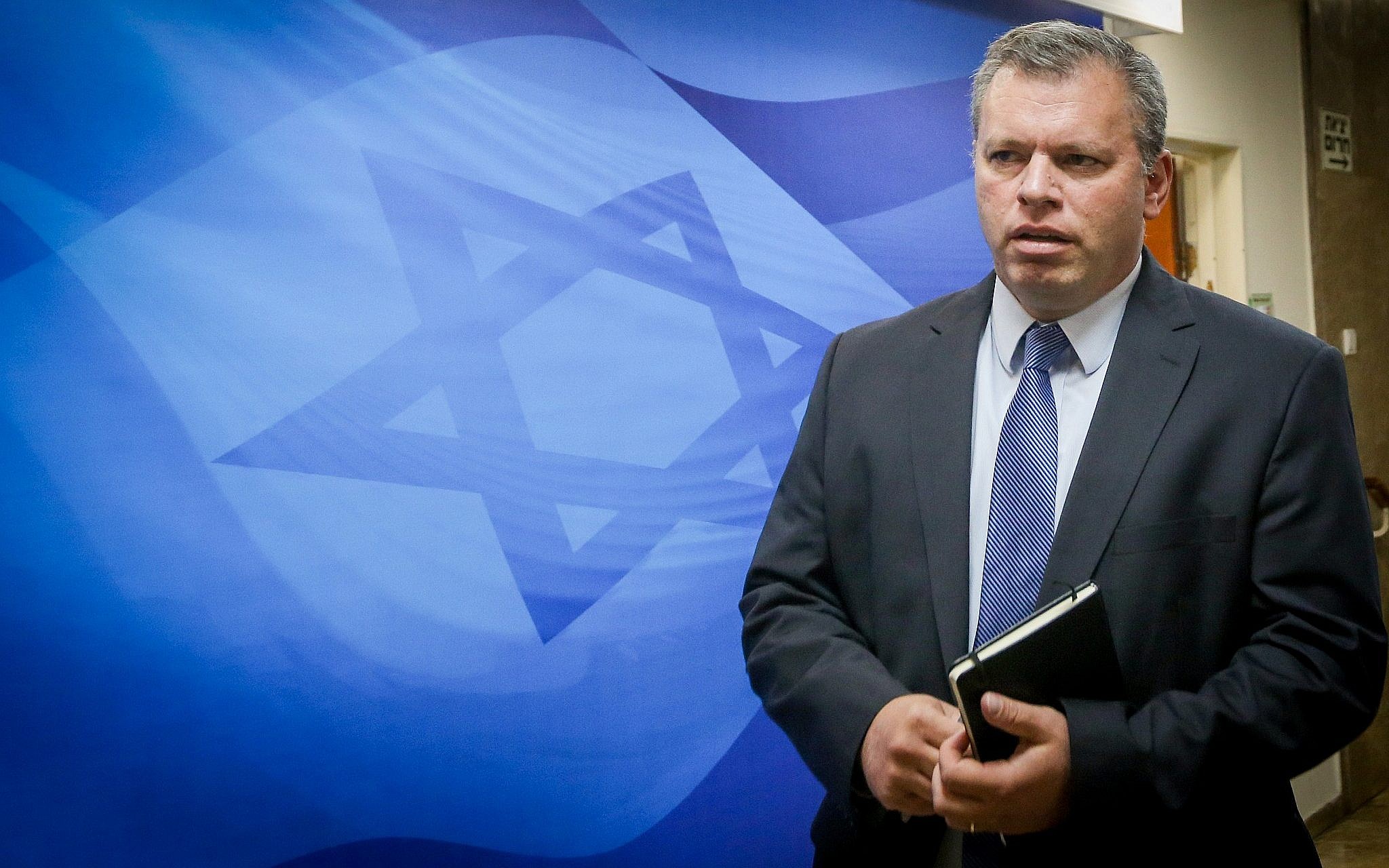
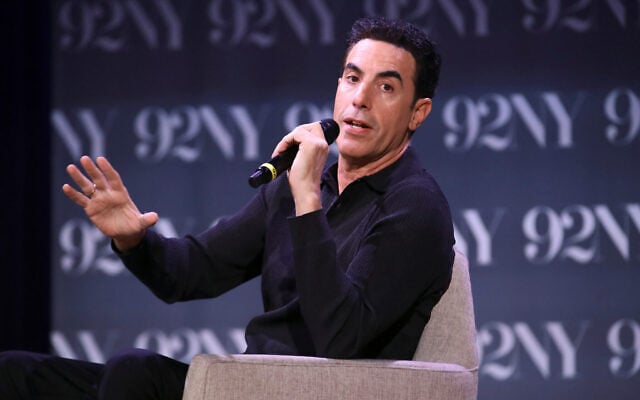
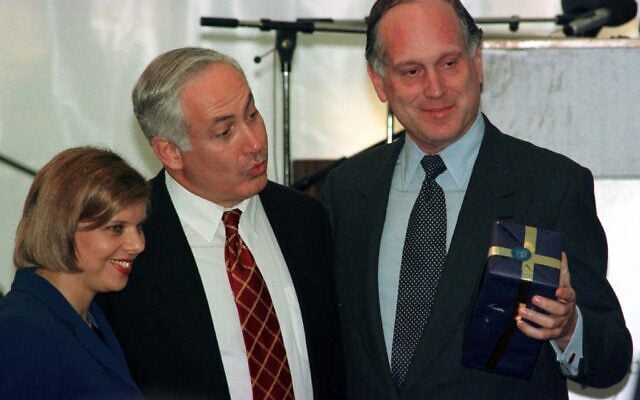
Eli Groner, director-general of the Prime Minister's Office, arrives to the weekly cabinet meeting at the PMO in Jerusalem on September 3, 2017. (Marc Israel Sellem/ Pool/ Flash90)
Eli Groner, director general of the Prime Minister’s Office, will step down after serving more than three years in the position, the PMO announced Monday.
Prime Minister Benjamin Netanyahu asked Eli Groner, who took up the position in May 2015, to stay on until the end of the current Knesset session to complete a reform in business licensing before officially stepping down later this summer.
“I thank Eli Groner for his dedicated work in advancing issues of great importance in the fields of economics and society,” said Netanyahu.
No replacement for Groner, 47, has been named.
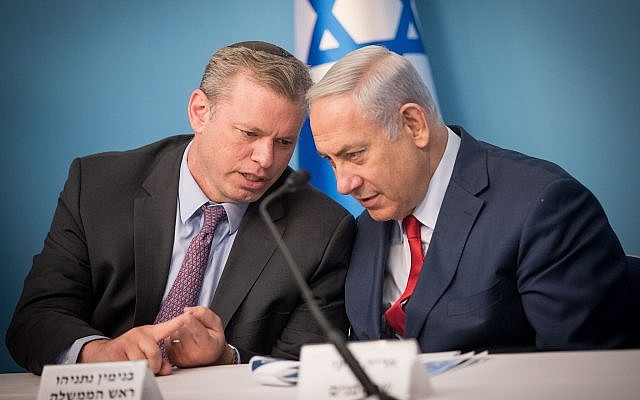
Prime Minister Benjamin Netanyahu (R) and Eli Groner, director-general of the Prime Minister’s Office, at a press conference announcing a new reform for small businesses at the PMO in Jerusalem, on December 3, 2017. (Yonatan Sindel/Flash90)
The PMO credited Groner with leading reforms to cut regulation and lower the cost of living, as well helping to formulate and obtain approval for a host of other initiatives.
Get The Times of Israel's Daily Editionby email and never miss our top stories
Before taking the position, Groner served as Israel’s minister for economic affairs at the Israeli Embassy in Washington, a position that saw him responsible for advancing Israeli economic interests with the US Treasury, the American Department of Energy, and other government agencies.
Groner previously served as a senior adviser to the chairman of Tnuva, and before that spent six years at the McKinsey & Company consulting firm.
Groner served as a paratrooper in the Israeli military and received a citation for outstanding performance and exemplary leadership. He served as a reserve soldier in the Second Lebanon War in 2006.
Advertisement
American-born, Groner renounced his US citizenship before taking up the embassy post in 2011.
Help us report truthfully on social media
As a multimedia journalist, my job is to take the quality, fact-based journalism produced by The Times of Israel newsroom and make it accessible across every platform — from Instagram posts to podcasts to short-form videos.
This is how many, especially young people, consume news these days. But misinformation is rampant on social media. Our team at ToI produces accurate, responsible short-form reporting on Israel and the Jewish world.
If you believe in the importance of factual social media journalism, please consider joining our reader support group, The Times of Israel Community. Your financial support is essential to sustain responsible multimedia reporting.
We’re really pleased that you’ve read X Times of Israel articles in the past month.
That’s why we started the Times of Israel - to provide discerning readers like you with must-read coverage of Israel and the Jewish world.
So now we have a request. Unlike other news outlets, we haven’t put up a paywall. But as the journalism we do is costly, we invite readers for whom The Times of Israel has become important to help support our work by joining The Times of Israel Community.
For as little as $6 a month you can help support our quality journalism while enjoying The Times of Israel AD-FREE, as well as accessing exclusive content available only to Times of Israel Community members.
Thank you, David Horovitz, Founding Editor of The Times of Israel


 Add ToI as a Preferred Source on Google