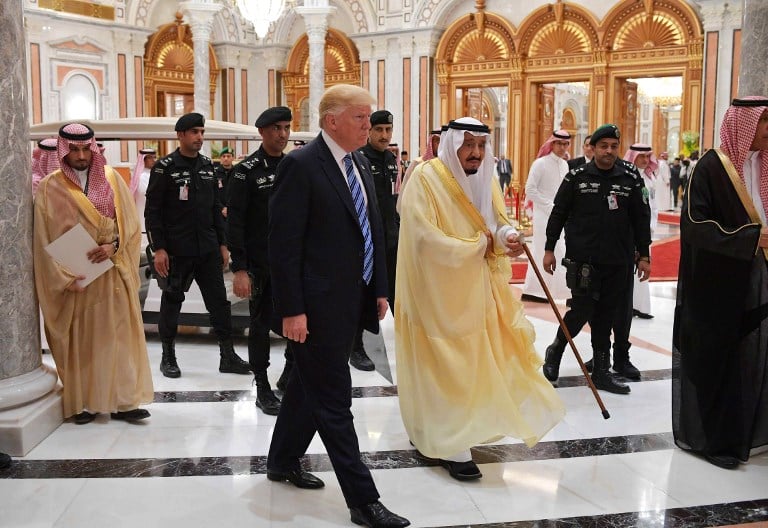
US President Donald Trump (C-L) and Saudi Arabia's King Salman bin Abdulaziz al-Saud (C-R) arrive for the Arabic Islamic American Summit at the King Abdulaziz Conference Center in Riyadh on May 21, 2017 (AFP PHOTO / MANDEL NGAN)
DUBAI, United Arab Emirates — US President Donald Trump said Tuesday night that Saudi Arabia’s king “might not be there for two weeks” without US military support, as he sought to pressure the close American ally over rising oil prices.
Speaking at a campaign rally in Mississippi, Trump said: “I love the king, King Salman, but I said, ‘King, we’re protecting you. You might not be there for two weeks without us. You have to pay for your military, you have to pay.'”
Trump didn’t elaborate on when he spoke to the king.
Trump and King Salman last shared a reported telephone call on Saturday, discussing global crude oil prices amid the American leader’s call for OPEC to bring down energy prices.
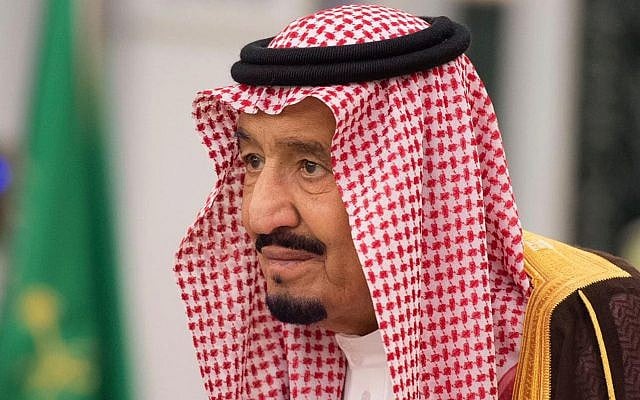
In this photo provided by the Saudi Press Agency, King Salman attends a swearing in ceremony in Riyadh, Saudi Arabia, on November 6, 2017. (Saudi Press Agency, via AP)
The state-run Saudi Press Agency reported the call, saying “the efforts to maintain supplies to ensure the stability of the oil market and ensure the growth of the global economy” were discussed by the two leaders.
Get The Times of Israel's Daily Editionby email and never miss our top stories
US officials acknowledged the call at the time, but offered no details.
Trump, facing political pressure at home, has been calling on OPEC and allies like Saudi Arabia to boost their production to lower global crude oil prices.
Benchmark Brent crude oil is near $85 a barrel — a four-year high — and analysts say it could reach $100 as US sanctions on Iran resume in November. US gasoline prices are up ahead of November midterm elections.
Advertisement
Times of Israel staff contributed to this report.
Help us report truthfully on social media
As a multimedia journalist, my job is to take the quality, fact-based journalism produced by The Times of Israel newsroom and make it accessible across every platform — from Instagram posts to podcasts to short-form videos.
This is how many, especially young people, consume news these days. But misinformation is rampant on social media. Our team at ToI produces accurate, responsible short-form reporting on Israel and the Jewish world.
If you believe in the importance of factual social media journalism, please consider joining our reader support group, The Times of Israel Community. Your financial support is essential to sustain responsible multimedia reporting.
We’re really pleased that you’ve read X Times of Israel articles in the past month.
That’s why we started the Times of Israel - to provide discerning readers like you with must-read coverage of Israel and the Jewish world.
So now we have a request. Unlike other news outlets, we haven’t put up a paywall. But as the journalism we do is costly, we invite readers for whom The Times of Israel has become important to help support our work by joining The Times of Israel Community.
For as little as $6 a month you can help support our quality journalism while enjoying The Times of Israel AD-FREE, as well as accessing exclusive content available only to Times of Israel Community members.
Thank you, David Horovitz, Founding Editor of The Times of Israel


 Add ToI as a Preferred Source on Google