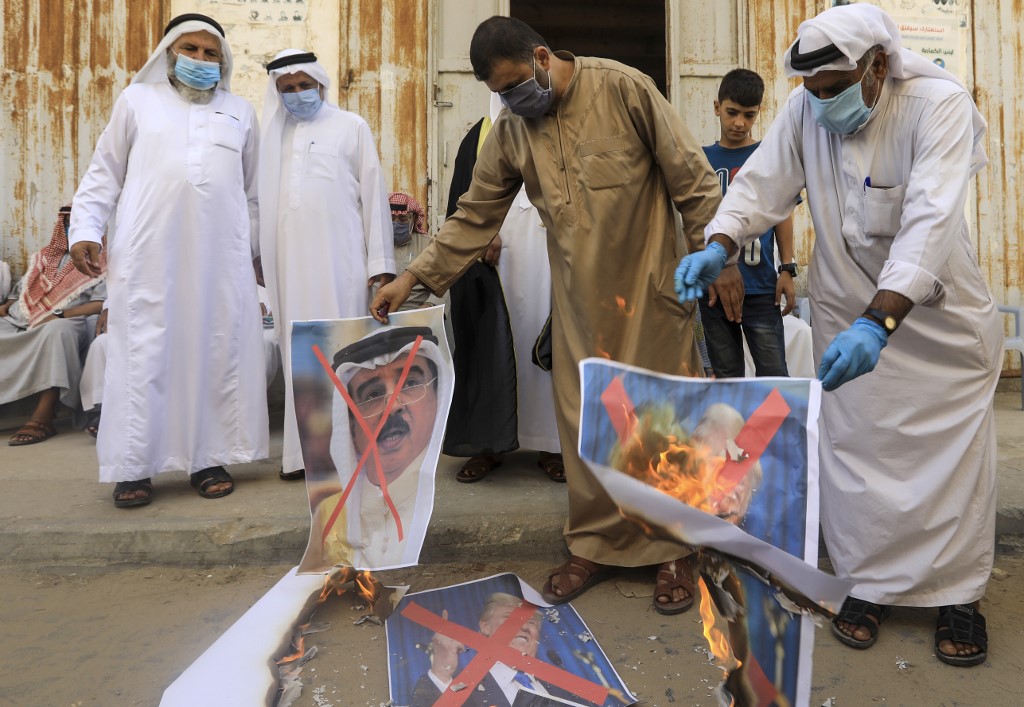
Palestinian men burn the exed-out portraits of the Bahraini king, US president and Israeli premier during a protest in Deir al-Balah, in the central Gaza Strip, on September 12, 2020. (MAHMUD HAMS / AFP)
MANAMA, Bahrain — The United States Embassy in Bahrain on Monday warned American citizens in the Gulf kingdom of the “need for caution,” days after Manama signed a US-backed deal with Israel.
“The Embassy encourages all US citizens to review their personal security plans, remain aware of their surroundings, including local events, and maintain a high level of vigilance,” an embassy statement read.
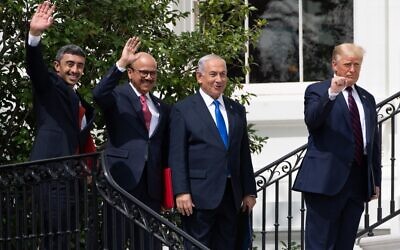
Bahrain and the United Arab Emirates last week signed deals to normalize ties with Israel at the White House, breaking with decades of Arab consensus that there would be no relations with the Jewish state until it had made peace with the Palestinians.
Small sporadic protests took place in Bahrain on Friday against the deals, a rare display of dissent in the oil-rich island nation.
Since 2011, protests have been extremely rare in the kingdom and are met harshly by security forces.
Get The Times of Israel's Daily Editionby email and never miss our top stories
(L-R) UAE Foreign Minister Abdullah bin Zayed Al-Nahyan, Bahrain Foreign Minister Abdullatif al-Zayani, Israeli Prime Minister Benjamin Netanyahu, and US President Donald Trump, wave on the South Lawn of the White House after they participated in the signing of the Abraham Accords where the countries of Bahrain and the United Arab Emirates recognize Israel, in Washington, DC, September 15, 2020. (SAUL LOEB / AFP)
The embassy encouraged citizens to “keep a low profile” and to “avoid crowds and demonstrations.”
Bahrain is a key US ally in the Gulf and hosts the headquarters of the US Fifth Fleet.
Bahrain’s King, Sheikh Hamad bin Issa Al-Khalifa, said on Monday that the deal with Israel was “not directed against anyone,” state media reported.
Advertisement
Sunni-ruled Bahrain has faced unrest among its large Shiite community, which it has consistently blamed on Iran.
Both Manama and Dubai share with Israel a vehemently anti-Iran foreign policy stance and Tehran has slammed the normalization moves.
Help us report truthfully on social media
As a multimedia journalist, my job is to take the quality, fact-based journalism produced by The Times of Israel newsroom and make it accessible across every platform — from Instagram posts to podcasts to short-form videos.
This is how many, especially young people, consume news these days. But misinformation is rampant on social media. Our team at ToI produces accurate, responsible short-form reporting on Israel and the Jewish world.
If you believe in the importance of factual social media journalism, please consider joining our reader support group, The Times of Israel Community. Your financial support is essential to sustain responsible multimedia reporting.
We’re really pleased that you’ve read X Times of Israel articles in the past month.
That’s why we started the Times of Israel - to provide discerning readers like you with must-read coverage of Israel and the Jewish world.
So now we have a request. Unlike other news outlets, we haven’t put up a paywall. But as the journalism we do is costly, we invite readers for whom The Times of Israel has become important to help support our work by joining The Times of Israel Community.
For as little as $6 a month you can help support our quality journalism while enjoying The Times of Israel AD-FREE, as well as accessing exclusive content available only to Times of Israel Community members.
Thank you, David Horovitz, Founding Editor of The Times of Israel


 Add ToI as a Preferred Source on Google