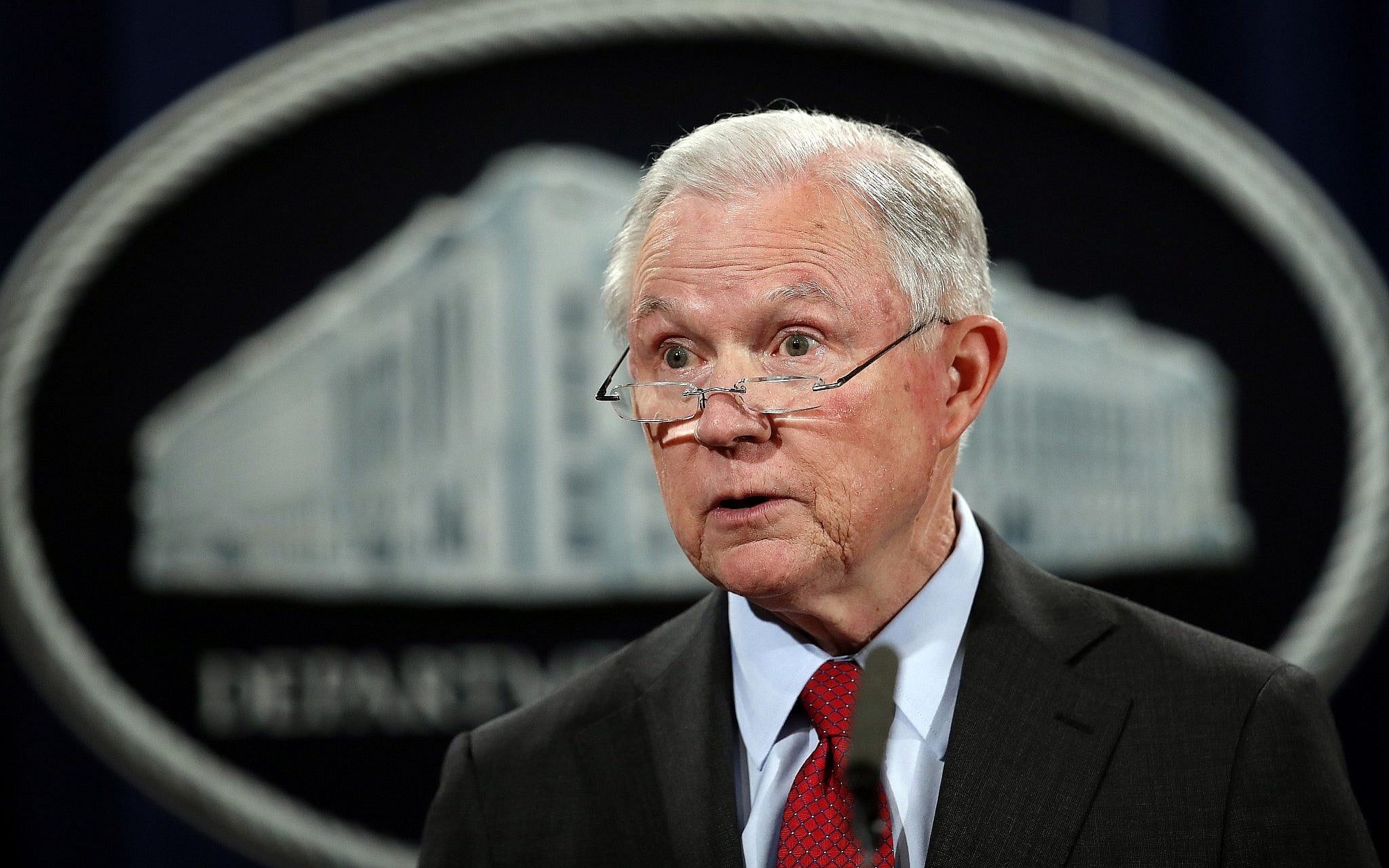
United States Attorney General Jeff Sessions during a news conference at the Justice Department in Washington, December 15, 2017. (AP Photo/Carolyn Kaster, File)
WASHINGTON — A suspect has been charged with five federal crimes in connection with more than a dozen suspicious packages sent in a US mail bombing spree, Attorney General Jeff Sessions said Friday.
The charges include interstate transportation of an explosive, mailing of explosives, threats against former presidents and threatening interstate communications, Sessions told a news conference.
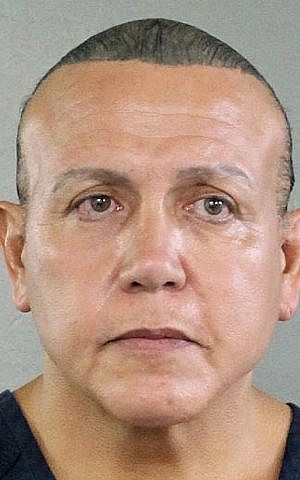
FBI chief Christopher Wray confirmed the suspect is 56-year-old Florida resident Cesar Sayoc.
If put on trial and convicted, the suspect faces up to 48 years in prison, according to a spokeswoman for the Department of Justice.
In this undated photo released by the Broward County Sheriff’s office, mail bomb suspect Cesar Sayoc is seen in a booking photo in Miami. (Broward County Sheriff’s Office via AP)
Thirteen improved explosive devices were sent to different individuals in the mail bombing spree, including PVC pipe, a small clock, a battery and wiring, Wray said.
Get The Times of Israel's Daily Editionby email and never miss our top stories
He said it was “too early” to publicly identify a motive for the bombing spree, while also warning there “may be” further packages.
“It’s too early at this stage for us to be discussing motivation in this particular case,” Wray said. “We’re concerned about people committing acts of violence under any motivation.”
According to pictures posted on social media and broadcast by US television, a van impounded in Florida in connection with the suspect, Cesar Sayoc, was covered in stickers denouncing Democrats and supportive of Donald Trump.
Advertisement
The targets of the bombing spree were all prominent Trump critics.
Help us report truthfully on social media
As a multimedia journalist, my job is to take the quality, fact-based journalism produced by The Times of Israel newsroom and make it accessible across every platform — from Instagram posts to podcasts to short-form videos.
This is how many, especially young people, consume news these days. But misinformation is rampant on social media. Our team at ToI produces accurate, responsible short-form reporting on Israel and the Jewish world.
If you believe in the importance of factual social media journalism, please consider joining our reader support group, The Times of Israel Community. Your financial support is essential to sustain responsible multimedia reporting.
We’re really pleased that you’ve read X Times of Israel articles in the past month.
That’s why we started the Times of Israel - to provide discerning readers like you with must-read coverage of Israel and the Jewish world.
So now we have a request. Unlike other news outlets, we haven’t put up a paywall. But as the journalism we do is costly, we invite readers for whom The Times of Israel has become important to help support our work by joining The Times of Israel Community.
For as little as $6 a month you can help support our quality journalism while enjoying The Times of Israel AD-FREE, as well as accessing exclusive content available only to Times of Israel Community members.
Thank you, David Horovitz, Founding Editor of The Times of Israel


 Add ToI as a Preferred Source on Google