

Dealing with the devil
Papers seem unsure about how seriously to take threatening words: If they come from Iran, they’re a big deal, but from an Israeli hostage negotiator, they can be easily dimissed
 Add ToI as a Preferred Source on Google
Joshua Davidovich is The Times of Israel's Deputy Editor
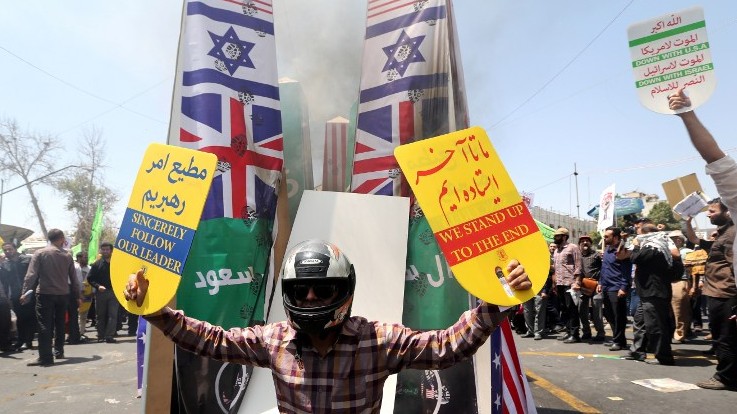
The ability of Iran to speak with two voices – negotiating a nuclear deal with global powers while denouncing and threatening America – has the Israeli press in a dour mood Sunday morning.
But while all three major papers take note of the confluence of hard-line Quds Day rhetoric in Tehran and ongoing nuclear talks in Vienna, some more angrily that other, all three are short on any original reporting or analysis of the line running from Tehran to Vienna.
Haaretz, which offers the most sober take, reports that remarks by Supreme Leader Ali Khamenei may actually be his way of signaling support for the emerging nuclear deal, with claims that he will continue to fight the US meant to soothe hardliners worried that the pact will mean Tehran is getting too comfortable with Washington.
Not everybody is convinced.
Yedioth Ahronoth comes right out and calls the weekend’s moves a “double game by Iran,” writing that Khamenei “continued to attack the US as if there were no talks.”
The most interesting thing in Israel Hayom is the discovery that one need only transpose two letters in Hebrew to switch between “negotiating” and “hating,” which it does to create a neat-o headline.
Beyond that, the tabloid devotes space in two separate stories to the opinions of two right-wing ideologues, as if their opinions have any newsworthy policy implications, or the fact that they are criticizing US President Barack Obama is out of the ordinary.
The first story lays out criticism of the White House by Weekly Standard writer Lee Smith, who says the US caving to Iran was already prewritten as far back as 2013, when Obama failed to act against Syria’s Bashar Assad. Even back in 2009, Smith claims, according to the paper, Obama tried to cozy up to Tehran. A second piece describes in painful detail a new ad by black horse Republican presidential candidate Mike Huckabee, which plays on the old “Daisy” mushroom ad by Barry Goldwater, only replacing the Soviets with the Iranians. How clever.
“In the Huckabee ad, there is a realistic message, ‘A threat on Israel is a threat on the US,’ written, and then it continues ‘support Israel, stop a nuclear Iran,’” the paper reports breathlessly.
The lowdown on Lotan
Much coverage is also devoted to the captivity of two Israelis in Gaza, and the government’s handling of the affair, which seems to be the real focus of news reports. While Friday’s paper was filled with criticism of the government and sympathy for the captives, Sunday’s papers see a sea change, with commentators coming to negotiator Lior Lotan’s defense and calling on the country to hold firm to the recommendations of the Shamgar commission, which advises against releasing prisoners in exchange for captives.
Yedioth Ahronoth reports that Lotan offered to resign after a tape of him emerged apparently threatening the Mengistu family, whose son wandered into Gaza and hasn’t been heard from since.
Unlike on Friday, when the paper dripped with contempt for Lotan, on Sunday, commentator Yoaz Hendel has the negotiator’s back, and goes so far as to describe Avraham Mengistu as someone with a death wish.
“Lotan is one of the good ones, even after he was recorded drowning in his own words,” he writes. “I know the military tone and that kind of talking well, even I use it sometimes in the most inappropriate places – it’s part of the Israeli way – for better or worse. Lotan apologized and it’s good he did. That’s it. Done. He’s done enough good things in his life for captives and those who disappeared that we shouldn’t need a serious conversation about him quitting over one mistake. There are those who wish to turn this affair into an ethnic matter and say that Lotan’s tone proves it. That’s stupidity. The story of Mengistu is the story of a poor family with a lost son who crossed the border into Gaza of his own volition. If you want, a man who decided to end his own life over mental health issues.”
Israel Hayom reports on efforts by Prime Minister Benjamin Netanyahu to do cleanup duty, rushing to visit the family and assure them the country is working to get their son home. The paper reports, though, that Netanyahu warned them that the lifting of the gag order on the case will raise the price Hamas demands for their son.
The paper’s Dan Margalit also takes the side of the government, writing that there’s no reason anybody should have expected Netanyahu to embark on such intensive damage control.
“There’s no country in the world where the prime minister would rush to the family of a civilian who decided to cross the border of his own accord and go to the enemy; and there’s no country in the world where he would force his envoy to stand shamed in front of the cameras and admit wrongdoing,” Margalit writes, saying that he would have resigned from the voluntary position were he in Lotan’s place.
In Haaretz, Amos Harel also comes to Lotan’s defense, writing that his biggest blunder – besides his regrettable words – was believing the Mengistus when they said they weren’t recording him. They had nothing to lose, he writes, calling the lawmakers who hopped on the affair to see who could criticize him the most “terrible.”
Lotan, on the other hand, is a true professional, he says.
“If a soldier close to me had been captured by Hamas, I’d be happy if Lotan were there to devote the same determination and courage he displayed in trying to save [Nachshon] Wachsman, or when he headed the force that abducted Mustafa Dirani in Lebanon as part of the effort to trace Ron Arad. If a relative of mine crossed the border to Gaza, I’d want Lotan’s vast experience to work for him, despite his impropriety,” he writes. “Many mistakes have been made in the Mengistu affair.… But that does not justify swinging in the opposite direction and freeing masses of Hamas terrorists in exchange for Mengistu and the missing Bedouin youngster. It is a humanitarian issue that needs intelligent handling, not ranting and raving at the expense of family tragedies.”








The Times of Israel Community.