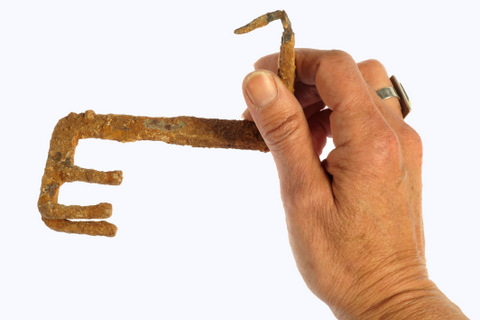
An iron key used to open a 2,000-year-old door, found in an ancient quarry in Jerusalem (photo credit: Clara Amit/Courtesy of the Israel Antiquities Authority)
Archaeologists working in Jerusalem have discovered a 2,000-year-old stone quarry, along with an iron key and masonry tools dating to the same period, the Israel Antiquities Authority announced Wednesday.
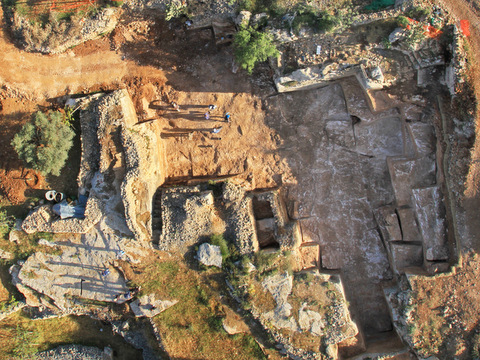
The large quarry adjacent to the modern-day neighborhood of Ramat Shlomo dates to the first century CE and would have been active around the time of the Second Temple in Jerusalem, archaeologists say.
Some of the stones cut from the rock were more than two yards long. They were likely transported downhill, on an ancient road discovered nearby, to the walled city to the south, where they would have been used in the construction of monumental buildings.
The quarry, seen here from above, is located adjacent to the north Jerusalem neighborhood of Ramat Shlomo (photo credit: Skyview/Courtesy of the Israel Antiquities Authority)
Also unearthed at the site was an iron key.
“The key that was found, and which was probably used to open a door some 2,000 years ago, is curved and has teeth. What was it doing there? We can only surmise that it might have fallen from the pocket of one of the quarrymen,” archaeologist Irina Zilberbod, the excavation director, said in the statement from the Antiquities Authority.
Get The Times of Israel's Daily Editionby email and never miss our top stories
The excavators also found pickaxes and metal wedges used to sever the cut stones from the surrounding rock.
The excavation is a salvage dig meant to allow the construction of a new road.
Ramat Shlomo, an ultra-Orthodox neighborhood, was built in a part of the West Bank annexed to the Jerusalem municipality after the 1967 war.
Advertisement
Help us report truthfully on social media
As a multimedia journalist, my job is to take the quality, fact-based journalism produced by The Times of Israel newsroom and make it accessible across every platform — from Instagram posts to podcasts to short-form videos.
This is how many, especially young people, consume news these days. But misinformation is rampant on social media. Our team at ToI produces accurate, responsible short-form reporting on Israel and the Jewish world.
If you believe in the importance of factual social media journalism, please consider joining our reader support group, The Times of Israel Community. Your financial support is essential to sustain responsible multimedia reporting.
We’re really pleased that you’ve read X Times of Israel articles in the past month.
That’s why we started the Times of Israel - to provide discerning readers like you with must-read coverage of Israel and the Jewish world.
So now we have a request. Unlike other news outlets, we haven’t put up a paywall. But as the journalism we do is costly, we invite readers for whom The Times of Israel has become important to help support our work by joining The Times of Israel Community.
For as little as $6 a month you can help support our quality journalism while enjoying The Times of Israel AD-FREE, as well as accessing exclusive content available only to Times of Israel Community members.
Thank you, David Horovitz, Founding Editor of The Times of Israel