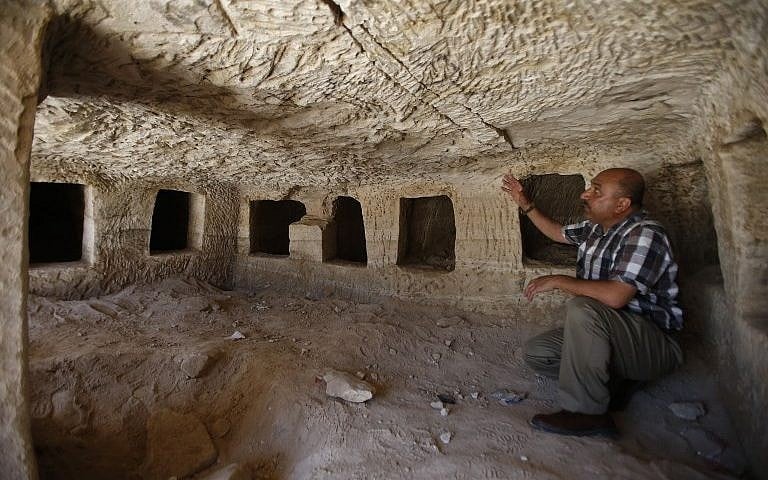
Taleb Jubran, director of the department of tourism and antiquities in Hebron, points to an ancient burial site from the Roman-era which was discovered during construction of a new road in the southern West Bank village of Idna on August 16, 2018. (AFP Photo/Hazem Bader)
IDNA, West Bank — A set of Roman-era tombs dating back some 2,000 years have been discovered near the West Bank city of Hebron during road works, an official said Thursday.
The cemetery dating to the first century AD, when the region was under Roman rule, was found in the Palestinian village of Idna in the southern West Bank around two weeks ago.
It was discovered during road work in mountainous terrain in the area, said Taleb Jubran, director of the department of tourism and antiquities in Hebron.
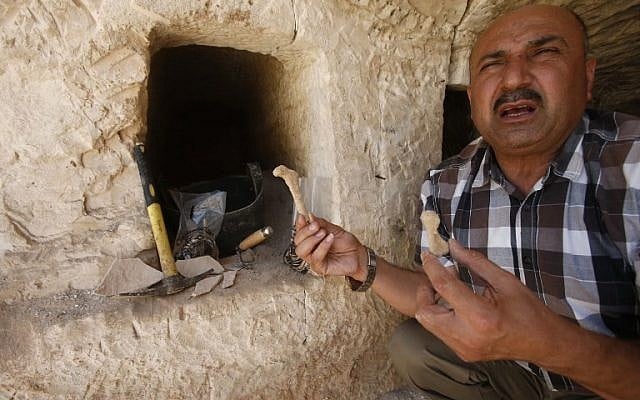
Bones, pottery and some 32 tombs set into stone were found. It was clear to archaeologists that artifacts had been stolen from the site before it was officially discovered, said Jubran.
“This discovery is very important for us to study it and to preserve it,” Jubran said.
Get The Times of Israel's Daily Editionby email and never miss our top stories
Taleb Jubran, director of the department of tourism and antiquities in Hebron, shows pieces of bones and pottery found in an ancient burial site from the Roman-era which was discovered during construction of a new road in the southern West Bank village of Idna on August 16, 2018. (AFP Photo/Hazem Bader)
The tombs were set out over a space of some 50 meters.
Officials also hoped to turn the site into a tourist attraction, while further study of it would continue to turn up details of what was found and its importance, he said.
A large number of remains from the Roman era can be found and visited in Israel and the West Bank as well as the region as a whole.
Advertisement
We can't do this work alone.
The war with Iran has been draining for all of us in Israel. But when I heard about a high casualty incident – ballistic missile impacts in Arad and Dimona that left nearly 200 people wounded – I drank a cup of coffee, packed a bag, and headed south.
There, I spoke with Shilgit, the head of an after-school program for underprivileged youth. Standing outside her destroyed center, Shilgit said it was a miracle that no children were hurt and spoke about the community coming together in the hours since.
As a Times of Israel reporter, I’m committed to telling stories of resilience like Shilgit’s. But my colleagues and I can't do this alone. If you value work like this,please consider joining our reader support group, The Times of Israel Community. Your financial support is essential to keep real human reporting like this going.
We’re really pleased that you’ve read X Times of Israel articles in the past month.
That’s why we started the Times of Israel - to provide discerning readers like you with must-read coverage of Israel and the Jewish world.
So now we have a request. Unlike other news outlets, we haven’t put up a paywall. But as the journalism we do is costly, we invite readers for whom The Times of Israel has become important to help support our work by joining The Times of Israel Community.
For as little as $6 a month you can help support our quality journalism while enjoying The Times of Israel AD-FREE, as well as accessing exclusive content available only to Times of Israel Community members.
Thank you, David Horovitz, Founding Editor of The Times of Israel