

Assad talks of unity while protesters die outside his palace
Damascus violence, Iranian ships arrive and Egypt’s would-be presidents set out their agendas
 Add ToI as a Preferred Source on Google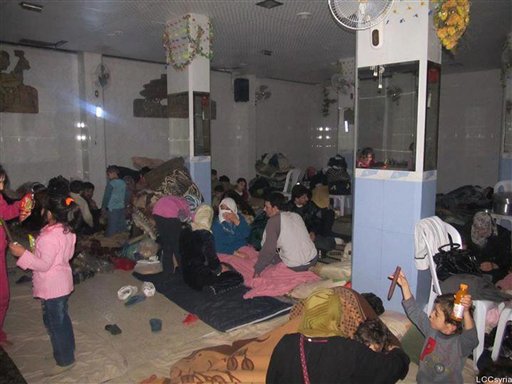
The pan-Arab Saudi publication A-Sharq Al-Awsat focuses on the weekend’s round of protests in Syria: “Roughly 30,000 protesters gathered in front of the Syrian presidential palace calling for the toppling of the Assad regime,” it notes.
During the demonstrations, Syrian security forces clashed with the protesters, leading to the death of three members of the Syrian opposition, it says. Other reports have indicated that 20 or more people were killed in Saturday’s violence, in Damascus and beyond.
Bashar Assad’s response to the recent clashes is also highlighted: “Syrian unity is possible” said the president, “but it must happen after the restoration of peace and security to the Syrian people.” The Syrian demonstrators are evidently still less-than-convinced; the mass protests in front of the palace continue.
Arrival of two Iranian ships to Tartus naval base
Qatar’s Al-Jazeera highlights the arrival of two Iranian ships – “an equipment ship and a destroyer” — at the Tartus naval base in Syria. Tartus is a Russian-leased base – one of Russia’s last in the region after the fall of Col. Qaddafi and its base in Lybia.
The Iranian captain of the destroyer conveyed to Al-Jazeera that “the Iranian ships arrived at the Tartus base due to recent events in Syria” and that “the ships bring forth a message of peace to the countries of the region.”
Having said that, the captain added that “the ships’ presence in the region does serve to showcase Iran’s military force, due to the recent talks of either an Israeli or American attack.”
Planning for Egyptian elections
Al-Ahram, Egypt’s leading publication, covers the nomination process for the Egyptian presidency – a process that was recently initiated.
One of the nominees is the former president of the Arab League, Amr Moussa. The paper lays out Moussa’s platform, which includes “reconciliation between the military council and the protesters” – a prospect which seems somewhat far-fetched as of now.
Another nominee is Hamdeen Sabahi, leader of the Egyptian Dignity Party and head of the Department for Future Research in Asyut University. Sabahi sets out his vision: “The first thing needed in Egypt is a clear constitution which will lay out Egypt’s governmental foundation – a firm standing on the values of equality, respect, and freedom and a complete rejection of any sort of discrimination.”
These principles seem to represent a critique from Sabahi against the temporary military government, since many of the major grievances over the military government have a lot to do with these fundamental constitutional matters.
The article repeatedly highlights concern about the timing of the upcoming election: “In order for any presidential stability, Egypt must first draft a new constitution which will lay out presidential term limits. Without such guidelines, Egypt will always run the risk of falling into the same dangerous path of the Mubarak presidency.”
Mubarak to be transported to a prison hospital
On its second page, Al-Ahram reports former president Hosni Mubarak’s upcoming transfer to Tura Prison’s hospital. The medical staff of the National Health Center have been “working tirelessly to compile a report that will include all the necessary preparation – medical and logistical – to ensure a smooth and safe transition of the former president.”
The compilation of this report has been anything but smooth, as the publication reports that “the chiefs of medicine charged with preparing the report have received numerous death threats urging them to issue a report that will state that the former president ought not be moved.”
The fate of the former president is still evidently a very charged issue; he apparently still has many avid supporters along with the many vitriolic dissenters throughout the Egyptian public.
Religion tensions rise over Israeli bid to hold Temple Mount prayer service
Kul-Al-Arab, the Nazareth-based weekly, carries reactions to a recent initiative by several Israeli politicians to hold a prayer service at the Temple Mount, conditionally sanctioned by the Supreme Court.
The paper features some of the inflammatory rhetoric from both sides, including the response from the Al-Aqsa Institute, the administrative authority for the mosque: “[The Supreme Court’s decision on the issue] is yet another Israeli attempt to infringe upon the Muslim authority in Al-Aqsa; the Supreme Court does not hold authority over Al-Aqsa, and the decision to grant Jews the right to enter and pray there is a deliberate provocation.”
The Al-Aqsa Institute was responding to the initiative by Likud hawk Moshe Feiglin to “Show our devotion to the Almighty by going up to the Temple Mount and reasserting our Jewish dominion over the area by cleansing the area from our people’s land-depriving enemies.”
The Supreme Court’s decision on the issue left room for the security establishment to block any such prayer effort, the paper notes, and that is precisely what has happened: Jerusalem Police issued an injunction against Feiglin’s entrance to the Temple Mount for “fear of incitement of violence.”
Prolonged phone waiting times bad for your health
Kul-Al-Arab reports in its health and lifestyle section on a study about the effect of prolonged waiting times on the phone. The research was conducted in the confines of a call center. Researchers concluded that waiting on the phone for more than about six minutes “increases a person’s likelihood of higher blood pressure and higher stress levels.”
This is attributed mainly to psychological factors: The prolonged wait “increases the sense of frustration.” No surprises there.






The Times of Israel Community.