

Coalition split between defiance and reconciliation after passing first overhaul bill
Some in ruling bloc stress need for broad agreement, others say government must advance rest of package; opposition fumes; group petitions to High Court against reasonableness law
 Add ToI as a Preferred Source on Google
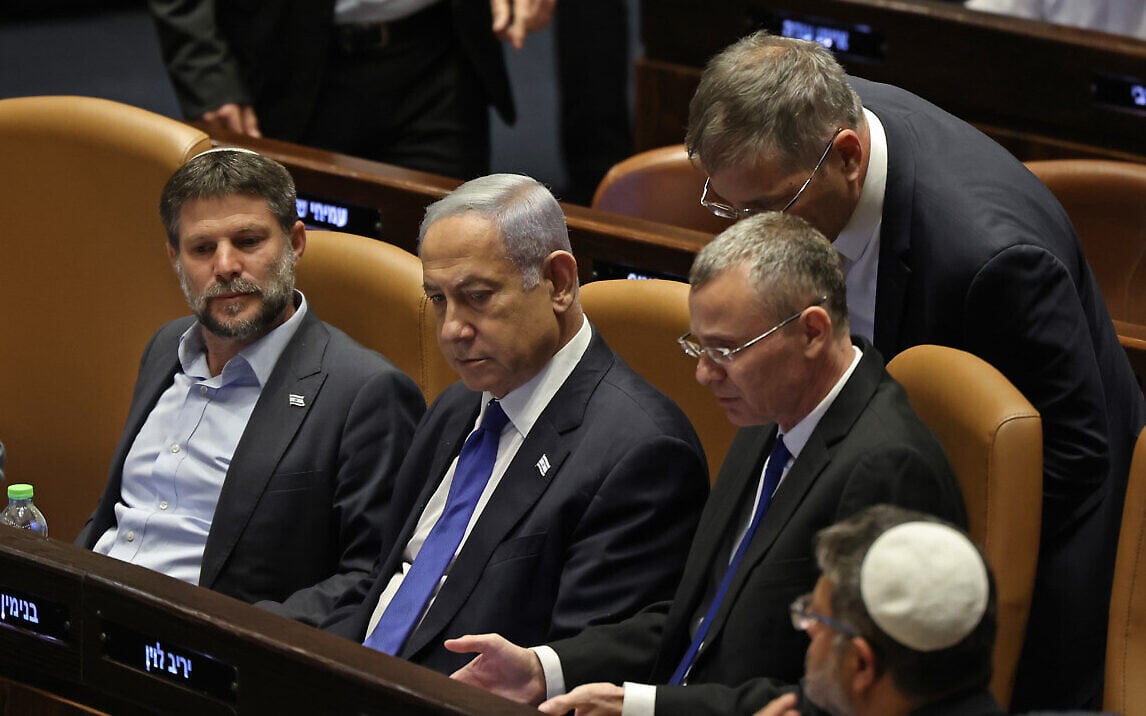
Members of Prime Minister Benjamin Netanyahu’s hardline coalition hailed the passage of the first piece of legislation from its judicial overhaul on Monday, but responses also exposed an internal split between those who defiantly called for the rest of the bills in the package to be adopted in the coming months and those who struck a more conciliatory tone and called for reaching compromises with the opposition in order to heal growing societal rifts.
As responses poured in to the 64-0 vote barring the judiciary from using the “reasonableness” yardstick to invalidate government decisions, a group announced that it had submitted a High Court of Justice petition aimed at revoking the legislation, setting up a major showdown between the branches of government in the coming months.
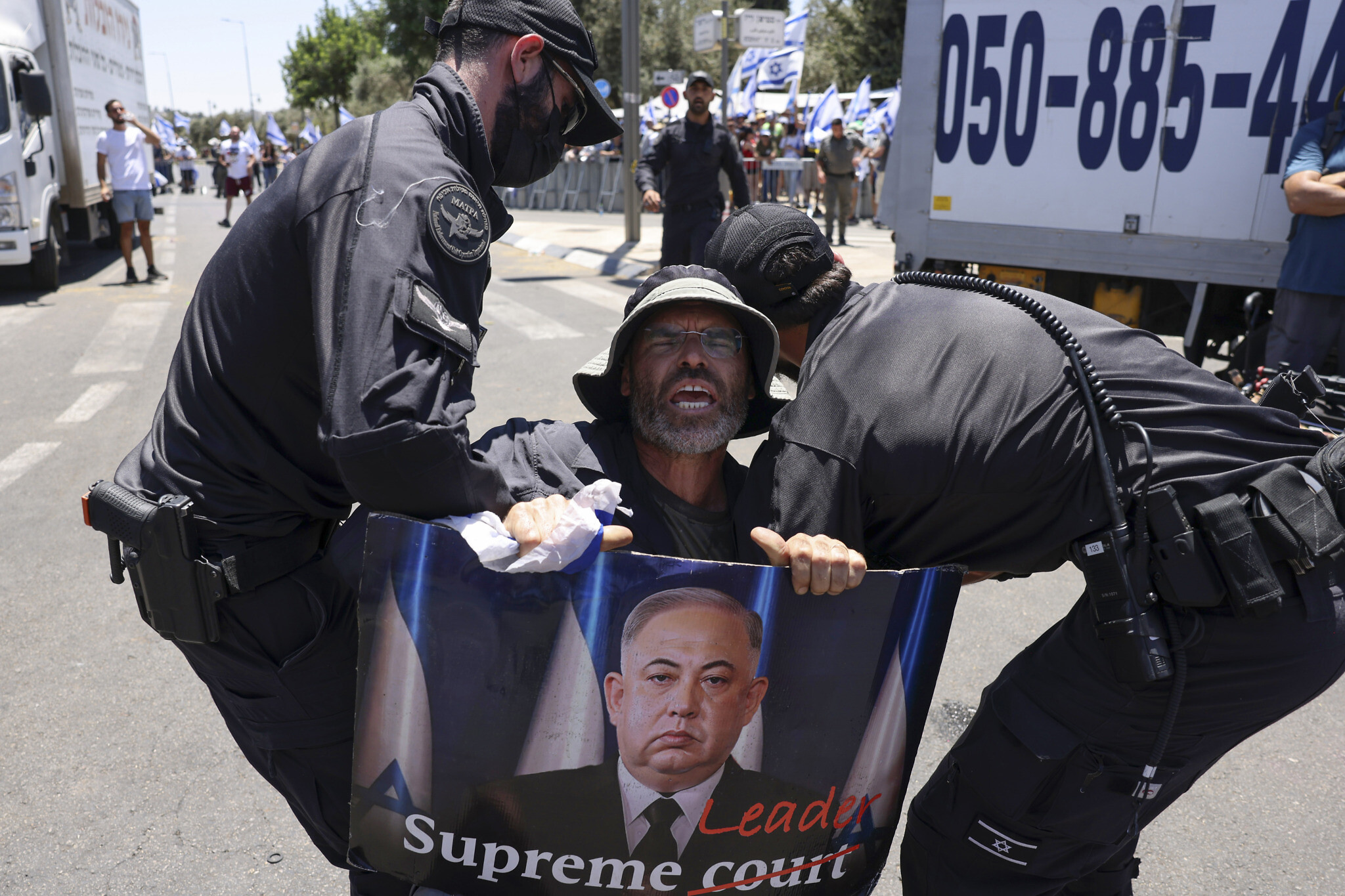
Meanwhile, anti-overhaul protesters blocked the Begin Highway outside the Knesset in Jerusalem, leading to intense clashes with police who sought to clear the road.
Justice Minister Yariv Levin — one of the overhaul’s main architects — took to the plenum podium shortly after the reasonableness law passed and said: “We are now embarking on a long recess. I am embarking on it knowing that we have passed an important law, but without joy and with a real desire to bring together all sectors of society.”
“This is a joint responsibility that is placed on both us [in the coalition] and on the members of the opposition,” Levin continued. “Let’s take advantage of the break and come to an understanding. This may not be in everyone’s political interest, but it is surely the national interest that should guide us.”
Hours earlier, Levin was seen arguing with Defense Minister Yoav Gallant, as the latter sought to convince Netanyahu to approve a softened version of the reasonableness bill or delay the vote in order to allow more time for negotiations with the opposition — possibilities that Levin virulently opposed.
In their respective responses to the first overhaul bill’s passage, a handful of Likud lawmakers focused on the notion that this was only the beginning and that they would not be deterred from advancing more overhaul bills, despite the massive protests and warnings from Israel’s allies abroad. Others stressed that dialogue with the bill’s opponents was now needed.
“We are moving on — on to the Judicial Selection Committee,” said MK Moshe Saada, referring to the next piece of legislation that the coalition hopes to adopt, which would give it control over the appointment of almost all judges.
“We’ve started the repair,” tweeted fellow Likud MK Ariel Kallner. “For the State of Israel and for all the people of Israel, including those who oppose us.”
“When the dust — raised by the feet of the protesters — settles, it will become clear to all of us that democracy in Israel is stronger than ever,” tweeted Likud’s Communication Minister Shlomo Karhi.
“We stopped the dangerous deterioration into the abyss of military rule in a democratic country,” he said, referring to the coalition’s decision to buck the threats of thousands of active reservists who warned that they will cease reporting for volunteer duty if the overhaul is advanced.
“We are repairing [the judiciary] with responsibility and determination. Our door is open as usual for conversations but without intimidation and without threats. we are brothers,” Karhi added.

A large group of coalition lawmakers posed for a selfie after the legislation was passed, but Likud MK Boaz Bismuth insisted that it was not done in celebration, given the pain felt by those in the opposition.
“Today, people take a selfie for everything. It’s like saying good morning. There was no applause after the law was passed,” he told the Kan public broadcaster.
Finance Minister Bezalel Smotrich, who heads the far-right Religious Zionism party, hailed what he called the “start of the repair of the justice system and the restoration of balance between authorities.”
He thanked the various members of the coalition who led the effort and pledged to “continue the repair responsibly.”
Fellow far-right minister Itamar Ben Gvir, who heads the Otzma Yehudit party, celebrated the passage as “good news for Israel.”
“The law we passed today is important for democracy, but it is only the beginning. For a more Jewish and more democratic State of Israel, we must pass the rest of the reform package, including changing the composition of the Judicial Selection Committee and changing the powers of the legal advisers,” he added, referring to a bill that would allow ministers to appoint — and fire — their own legal advisers.
During a Kan interview, Religious Zionism MK Michal Woldiger called on the opposition to use the Knesset recess — which begins at the end of the month — in order to reach a compromise. “Let’s talk and solve this together,” she said.
Fellow faction member MK Zvi Sukkot also insisted in a Kan interview that the coalition was not celebrating the results of the vote because “there are those who are in pain.” However, he also claimed that the opposition was being controlled by the protest movement and was refusing to agree to any compromise.
Meanwhile, Opposition Leader Yair Lapid slammed the coalition for allegedly abusing its powers in a speech issued from the Knesset minutes after the bill was passed. The entire opposition chose to boycott the plenum vote in protest.
“This is a complete violation of the rules of the game,” Lapid said. “The government and the coalition are allowed to decide which direction the country is going, but they cannot cancel the nature of the country.”
The opposition leader insisted that he supports the anti-overhaul protest movement but encourages military reservists to wait before following through on their threat not to report for duty.
“Don’t stop serving, don’t harm the IDF’s readiness so long as we don’t know what the ruling will be,” Lapid said in reference to a High Court petition against the reasonableness law, which he said he was going to file.
Lapid also attacked Netanyahu as “weak,” adding that he has “become a puppet controlled by extremists and messianists.”

As the coalition members gathered for the congratulatory selfie as votes were being tallied, he asked them: “What are you celebrating?”
“It’s a sad day. A day of destruction. A day of senseless hatred. I look at this coalition celebrating and ask, what are you celebrating? That you are dismantling our Jewish state? That people who have served together in the reserves for 30 years are canceling their annual meeting because they know it will end badly?” Lapid said.
Labor party chair Merav Michaeli said in a statement: “This is what a victory that is a loss looks like. A resounding loss.”
“Netanyahu knows that he is now a pariah in the eyes of the entire Western world, a pariah in the eyes not only of the protesters but also of many of those who voted for him,” she continued. “Netanyahu and his partners lost today. It will take some more time for them to fall, but this is the beginning of their fall. It will not be a short fight, and we need a lot of forbearance and determination and faith in ourselves and our truth, and we will win.”
In its High Court petition, the Movement for Quality Government in Israel (MQG) argued that the law passed Monday “is unconstitutional because it fundamentally changes the basic structure of Israeli parliamentary democracy and the nature of the regime, while de facto abolishing the judiciary and seriously damaging the delicate fabric of the separation of powers and the system of checks and balances in the State of Israel.”
MQG also claimed that the legislative process was flawed since not enough time was given in the parliamentary committee controlled by the coalition to properly adjudicate the legislation.










The Times of Israel Community.