

Cold, hard calm: 9 things to know for November 11
Images of suitcases of Qatari cash entering Gaza and making it rain for the Strip have some up in arms and others just happy that war is off the table for a bit
 Add ToI as a Preferred Source on Google
Joshua Davidovich is The Times of Israel's Deputy Editor
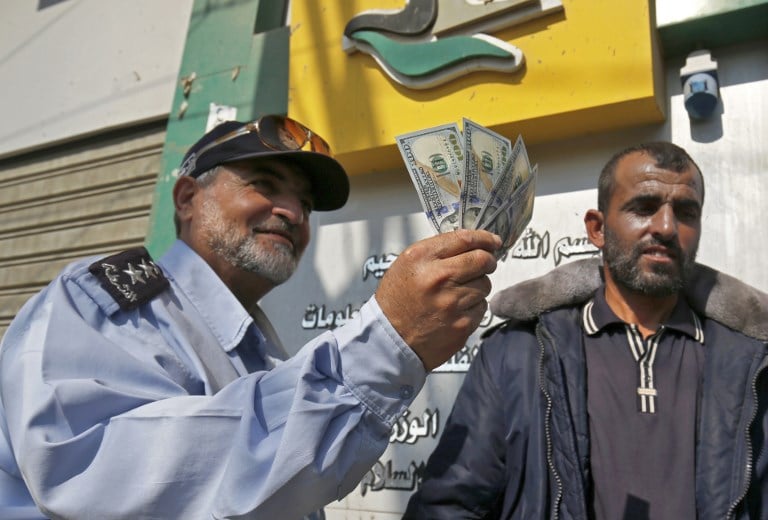
1. Making it rain in Gaza: Most sellers prefer cash, but the sight or idea of stacks of bills, or cash placed in certain receptacles, still seems to be freighted with a sense of criminal or underhanded activity. US President Donald Trump and Fox News pounded the Obama administration incessantly over rumors of suitcases of cash paid to Iran as part of sanctions relief and for the release of hostages. Ehud Olmert went to jail for envelopes of cash. And now Prime Minister Benjamin Netanyahu and his government are being forced to defend the entry of suitcases of Qatari cash into Gaza, mostly to pay salaries to people belonging to the Hamas terror group.
- The LA Times describes the money as “bundles of greenbacks [that] arrived in three bulging suitcases that crossed the border from Israel in an armored car: an estimated $15 million in US currency.”
- Israeli reporter Gal Berger even got an “exclusive” picture of the Qataris making it rain.
Exclusive: 3 suitcases w 15 million dollars in cash entered Gaza today w the qatari envoy through Israel (Erez crossing point). The money goes to Hamas, to pay salaries of civil employees. Exclusive pic: pic.twitter.com/asmrOP0YFu
— Gal Berger גל ברגר (@galberger) November 8, 2018
- Other photographers captured pictures of Palestinians getting their long-awaited salaries, fanning out the bills like future Floyd Mayweathers.
2. Gangster cash: Both Palestinian Authority loyalists and Israeli right-wingers criticized the money transfer, zeroing in on the unsavory way it was brought in and what it’s intended for.
- Palestinian official Ahmed Majdalani calls it “gangster” money smuggled into the Strip by Qatar’s envoy, UAE-based The National reports.
- Despite Israel giving the go-ahead to bring the money into Gaza, Defense Minister Avigdor Liberman criticizes the move, albeit in less colorful terms.
- “This is capitulation to terrorism, and in effect Israel is buying short-term calm with money, while severely undermining long-term security.”
- In Yedioth Ahronoth, right-wing columnist Shlomo Pyoterkovsky calls it “protection money to Hamas,” and a “bribe for terror,” writing that the suitcases are exactly what they look like.
- “The aim of the money is to grease Hamas’s terror wheels, and the ones who will benefit are first and foremost members of the terror group,” he criticizes.
3. Friendly fire: Despite the cash infusion, border protests still took place Friday as usual and some in Gaza were also not happy about the bundles of cash.
- Al Arabiya broadcasts footage of Gazans stoning the car of the Qatar envoy who brought in the suitcases of cash.
WATCH: Palestinians stone convoy of #Qatar|i ambassador to #Gaza#Palestine pic.twitter.com/8gBNMA9mid
— Al Arabiya English (@AlArabiya_Eng) November 9, 2018
- And that wasn’t the only case of friendly fire there.
Don't get in between a reporter and their camera. Taken on Friday during March of Return. #Gaza pic.twitter.com/dogZlJvlzU
— Joe Truzman (@JoeTruzman) November 11, 2018
4. The price of calm: Before leaving to Paris Saturday night, Netanyahu unequivocally defended the cash transfers, and said he’s willing to pay a political price for the move, a surprisingly clear-eyed statement from a man known as a political operator who has stayed in power by making sure he never has to pay the price for missteps.
- The move wins rare praise from broadsheet Haaretz: “This seems to be the right thing to do under the circumstances. True, the photos of the suitcases are embarrassing and carry the connotation of paying a bribe or protection money to the mafia. But the alternative seems to be war,” Amos Harel writes.
- Less surprising is pro-Netanyahu Israel Hayom backing the move, with Yoav Limor putting down a practically identical argument.
5. Your money is no good here: Perhaps seeking to downplay potential political damage from the move, though, Israel Hayom downplays the money transfer under coverage of a Gazan who snuck into Israel and burned down a greenhouse.
- “No money will buy quiet. It won’t help, we need a wider diplomatic initiative,” the paper quotes a resident of Netiv Ha’asara, where the greenhouse was, as saying. “There’s no quiet in the region, and whoever says there is is wrong.”
- In The New York Times veteran Israeli peace negotiator Nimrod Novik also expresses doubt that the money will buy more than a brief retreat from the brink of war.
- “The short-term stuff is only good to calm things down,” he says. “But once things calm down, the Israeli attention span is very short. Our strategic response is a sigh of relief.”
5. What’s Netanyahu flying to Paris for anyway? The gathering of world leaders for Armistice Day is mostly for countries that were somehow involved in World War I, which raged while Israel was barely more than a Zionist dream.
- Netanyahu said Israel still has a connection to the Great War, though, since there were many Jewish soldiers who learned how to fight, and used that knowledge three decades later as Israel fought for its independence.
- Netanyahu also may be hoping to get in some face time with world leaders, specifically Russian President Vladimir Putin to discuss Syria and Iran, though to all appearances the Russians are playing hard to get.
- While Netanyahu’s office has said it was the French who asked that any meeting with Putin be canceled, citing logistical issues and not wanting side bilaterals, a French official tells ToI that they have plenty of rooms and no problem with bilateral meetings on the side.
6. ‘Extremely disappointed’ Russians: Meanwhile, Russia has continued to fume at Israel over its airstrikes in Syria amid reports that Moscow wants Jerusalem to significantly expand the amount of warning it gives Russia before such strikes.
- Russian Ambassador to Israel Anatoly Viktorov tells ToI’s Raphael Ahren that Russia is still “extremely disappointed” with Israel’s actions that led to the downed spy plane in September, which is the root of current tensions.
- “What is needed in our view is to recognize and internalize what happened in order to avoid any such incident in the future. But in order to avoid it we will need to agree on what was the cause of the incident,” he says.
- He also seems to be exasperated with Israeli attempts to push Iranians out of Syria.
- “It’s an unrealistic request,” the Moscow-born veteran diplomat said, “because the presence of Iranian, as well as Russian, troops on the territory of Syria is legitimate. They’re there at the request of the legitimate Syrian government. And Israel could not demand from the Russian authorities to move Iranians from Syrian territories,” he said. “How many Israelis were killed by Iranians in the last three years? And how many Iranians were killed during the attacks carried out by Israel on the territory of Syria this year?”
7. City of lowlights: Netanyahu’s trip to the city of lights is a good opportunity as any to recall the city that has been home to some of his greatest and worst hits.
- In 2015, for instance, he was criticized after being seen jimmying his way to the front during a march of world leaders in Paris following the Charlie Hebdo attacks, then waving cheerfully to the crowd. And then a video caught him missing a bus, left to stand around on the street like some schmo.
- Months later, a camera captured him and Palestinian Authority President Mahmoud Abbas enjoying a warm handshake, the first known contact between the two for years.
- And while Netanyahu wasn’t there, a hot mic in Cannes France in 2011 caught Barack Obama and Nikolas Sarkozy talking smack about the prime minister.
- (No matter what faux pas Netanyahu may stumble into this time, it’s unlikely to outdo the rage against Trump for refusing to pay respects at a military cemetery because of some rain.)
8. Unknown unknowns: Netanyahu also criticized the media before he left for Paris, accusing it of trying to unfairly tie him to the naval acquisitions bribery scandal, in which police recommended his former lawyer and other erstwhile associates be charged.
- “For two years they’re showing me go up and down on submarines,” he said, referring to photos of himself used by many media outlets to accompany items about the matter.
- He added, “You know I didn’t know anything,” but Channel 10 news isn’t sure. The channel’s Raviv Drucker reports that right after the affair broke, Netanyahu called his lawyer (and main suspect) David Shimron to ask if he had had any contacts with ThyssenKrupp rep Miki Ganor (another main suspect and a state’s witness).
9. Keep the corruption local: Yedioth reports that one immediate takeaway from the scandal is that Israel will no longer look to Germany or anywhere else to build its naval vessels, instead doing it in-house, starting with the next generation.
- That may come pretty soon, according to the paper, which reports that the navy is looking to replace its Nirit gunships, from the ’80s, and also needs ships to protect its offshore gas drilling assets.




The Times of Israel Community.