

Duke and hazards: 9 things to know for June 26
A prince visits; Syria heats up; Hamas may be looking to negotiate as plans proliferate for a Gaza without it; and new-old fights for the Jewish Agency
 Add ToI as a Preferred Source on Google
Joshua Davidovich is The Times of Israel's Deputy Editor
1. Things are heating up in southern Syria — what else is new — and new reports overnight point to Israel bombing something near Damascus airport.
Most initial reports indicate that Israel bombed a weapons cache belonging to the Hezbollah terror group, at least according to the Syrian Observatory for Human Rights. Syrian state media says that missiles were fired at the airport, but claims they did no damage.
Germany’s DPA, quoting opposition sources, reports that the missiles targeted a cargo plane carrying something (arms?) from Iran. The report is also carried by Russia’s Sputnik.
Indeed, just hours before the strike, analyst Rick Francona wrote on Twitter that a cargo plane making regular runs between Damascus and an Islamic Revolutionary Guards Corps base in Iran had resumed flights after a 10-day break.
After a hiatus of 10 days, a #Syria|n Air Force (#SyAAF) 29th Brigade IL-76 (YK-ATB) has resumed flights between the military ramp at Damascus International Airport and the #IRGC ramp at Mehrabad airport in Tehran, #Iran. YK-ATB is the primary aircraft used for this route. pic.twitter.com/XWUvI5vPlr
— Rick Francona (@MiddleEastGuy) June 25, 2018
According to flight tracker data, the plane landed at 11:10 p.m. Monday night, hours before the strike.
2. The strike came a day after Israel fired a Patriot missile at a drone that entered Israeli airspace, believed flown by regime forces, and as Syrian regulars took over a post in the no-man’s land between the Israeli and Syrian Golan Heights that had been abandoned by UN peacekeepers.
- Officials told the Kan broadcaster that Israel “sees UNDOF as responsible for tracking and acting against military forces in the separation zone, and is determined to prevent military entrenchment in that area,” suggesting that it may attempt to remove the Syrians by force.
- According to Hebrew-language reports, the IDF is bracing for an uptick in fighting in Syrian areas adjacent to the Israeli border, and expects incidents of stray fire entering Israeli territory.
- Meanwhile, there are reports that Syrians fleeing the fighting are massing on the Israeli border. Israel has never taken in Syrian refugees ( a plan to take in a few fell apart), but this will likely renew pressure on the government to help out beyond operating a field hospital and taking in the injured. The last time there was heavy fighting in the area, Druze in the Israeli Golan rallied for help for their Syrian relatives.
S. #Syria: civilians displaced due to Assad & #Russia|n bombardment amassing near border with #Golan. https://t.co/qNhHVRPp4u pic.twitter.com/AGnDtCUNNl
— Qalaat Al Mudiq (@QalaatAlMudiq) June 25, 2018
- Iran’s Press TV reports that Syria is hoping its takeover of Daraa will put an end to Israel providing medical aid.
- “The territory’s return to the Syrian government control would cut the much-reported collaboration between Israel and militants and deal a blow to Tel Aviv’s plans to annex the Golan Heights,” the channel reports.
3. Israelis and Iranians also made common cause Monday night, as fresh economic protests erupted against Tehran’s leadership.
- Videos posted to social media showed protesters chanting: “Death to Palestine,” “No to Gaza, no to Lebanon” and “Leave Syria and think of us,” referring to Iran’s spending abroad (see item 1).
- “Death to the dictator,” which was also chanted at some rallies according to reports, is splashed across the front page of tabloid Israel Hayom. The paper notes that unlike the last round of protests, Tehranis seem to be taking a leading role this time around.
- Yedioth, which notes that “death to America” and “death to Israel” were not heard at the rallies, reports that the protests are an outgrowth of Iranians’ exposure to outside media, despite regime attempts to control information.
- “Iran’s rulers were sure they could ‘sell’ the American refusal to keep to the nuclear deal as an example of US President Donald Trump’s weakness. But the youth, hooked into Western media, didn’t buy it. The merchants also understood that they couldn’t import or export because of issues related to Iran’s own policies and not because of Trump’s whims,” the paper writes.
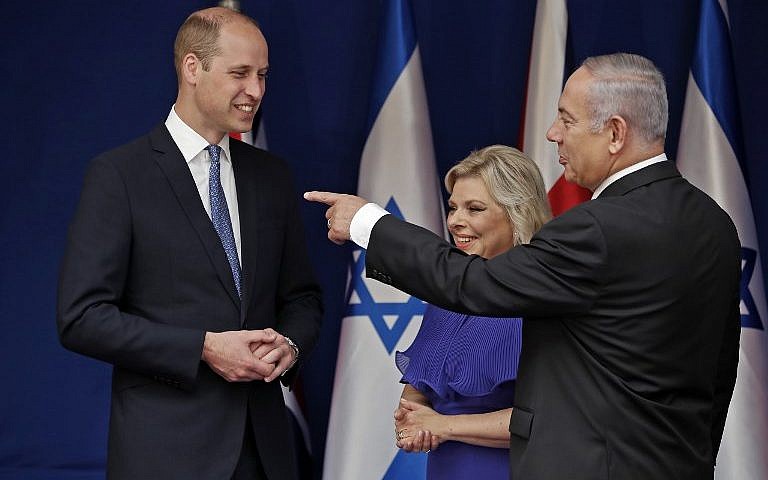
4. Most of Israel’s media, though, is more interested in the visit by Britain’s’ prince William, who landed in Israel Monday night and is visiting Prime Minister Benjamin Netanyahu as these words are written.
- Though the visit is billed as nonpolitical (and indeed the Duke of Cambridge is little more than a rich celebrity) Haaretz’s Noa Landau writes that William’s trip to Israel is another notch in Netanyahu’s diplomatic belt, no matter the fact that London did not soften its language on calling parts of Jerusalem occupied.
- “From Netanyahu’s perspective, which is realist to the point of cynicism, this doesn’t matter in the slightest. Perhaps it’s even a plus: After all, the territories are occupied, but the royal carriage is still coming. Just like Indian Prime Minister Narendra Modi remains Netanyahu’s good friend even when he lays a wreath on Yasser Arafat’s grave,” she writes.
- Even if Netanyahu is okay with the terminology, others are still harping about it. “East Jerusalem … is ‘part of the Palestinian Authority’ just as India is still part of the British Raj, but the Brits live in their own world,” writes Israel Hayom’s Nadav Shragai.
5. Lucky for William, he’ll only be visiting the mess, not trying to fix it, as the Americans are apparently trying to do.
- Amid indications that a slew of Sunni Arab states have signed on to support the peace initiative, Haaretz reports that Hamas says it has gotten Russia to agree to oppose it.
- At the same time, the paper publishes an article surmising that Hamas may be willing to take on the role of negotiating in place of the PA, after a former spokesman for the terror group proposed hypothetical direct talks with Israel.
- “This trial balloon on such a sensitive topic, likely the result of instructions from high up in the ranks of Hamas, reveals a vital discourse going on now within the Islamist movement which rules Gaza. The same organization, formally dedicated to Israel’s destruction, now appears to be suggesting direct talks with it – to break the predicament of its reliance on mediators for what have been years of fruitless indirect talks with Israel,” Muhammad Shehada writes.
- He notes that Hamas may be trying to preempt whatever plan the US is hatching, which deals with the West Bank separately from Gaza, “ to finally get a share of the ‘peace process cake’ – and to have their revenge on the Palestinian Authority at the same time.”
- With the Palestinian Authority also refusing to go along, many see the plan as dead on arrival in any case.
- “It is impossible to be a mediator in a conflict or release a credible peace plan when one side refuses to even talk to you,” Ilan Goldenberg writes in Foreign Policy.
- “Putting out a new US peace plan at this moment would be a terrible mistake that would likely only make matters worse,” he writes, counseling that the US should focus on fixing Gaza instead.
6. Yedioth reports on another plan for easing Gaza’s electricity woes, a solar field in Israel which would pump power into the Strip.
- The paper reports that the panels would be set up near the Erez crossing as a unilateral measure (without Hamas being involved) and that it will change the situation.
- How much it will change the situation is unclear. Gaza currently gets about 208 MW/H which allows the Strip’s residents some 8 hours a day of power. Doubling that to 16 hours would require a solar field at least 520 acres in size, making it one of the biggest in the world, and by far the largest outside the US, China and India. Israel’s current largest field, at Kibbutz Ketura, is a mere 20 acres large.
- It’s not clear if there’s room for such an endeavor near the fairly dense Gaza border, but neighboring Egypt has oodles of sun-drenched space. According to the report, the original plan was to put the field in the Sinai, but “Egypt made clear that as long as the PA is not in control of the Strip, it will not allow a project like that in its land.”
- Israel’s Hadashot reported Monday night that a separate plan is coming together to build a seaport for Gaza in Cyprus, in exchange for the return of captive Israelis and the remains of two IDF soldiers.
- Israel Hayom quotes a defense source saying that with this plan as well, officials will try to make it happen “while going over Hamas’s head.”
7. Sordid tales are also continuing to surface about Sara Netanyahu’s spending at the Prime Minister’s Residence, with former official Yossi Strauss reportedly saying that the Lady Netanyahu would force people to pay for things for her as much as possible, no matter if they could afford it or not.
- Yedioth plays up the report and Israel Hayom devotes only a tiny bit of space to it — and the reason for both are clear (Yedioth is in open war with Netanyahu, Israel Hayom is seen as his mouthpiece).
- Less clear is Haaretz, a paper that has never been a fan of Netanyahu, but has consistently played down or ignored reports regarding Sara Netanyahu this week. Does the paper think the reports are too yellow? Or perhaps it fears distracting from the larger graft probes into the prime minister (as it pointed to when the charges were first filed)? Or perhaps there is just not enough room.
8. What Haaretz does play up is Tzipi Livni’s threat to dismantle the Zionist Union (made up of her Hatnua party and Labor) if she is not allowed to take over as opposition chief for Isaac Herzog, who’s leaving to head the Jewish Agency.
- The paper’s lead editorial endorses a surprising candidate instead of Livni: Joint List leader Ayman Odeh: “Israel needs an opposition that will challenge the current right-wing government, which seeks to annex the territories, weaken democracy and freedom of expression and perpetuate discrimination against the Arab community. Odeh represents the opposite values: He’s in favor of peace, in favor of democracy and in favor of equality.”
9. Herzog won’t necessarily have an easy time in his new job, nor will Netanyahu, writes ToI’s Raoul Wootliff, who notes that the prime minister will have to fight the same fights his father did years ago in the battle between Israel and Diaspora Jewry.
- “Beyond religion and state, the Jewish Agency`s choice of Herzog could also highlight rifts over a plethora of other issues on which the US Jewish community has traditionally been closer to Herzog`s center-left worldview than that of Netanyahu,” he writes.
- Anshel Pfeffer, whose recently released biography of Netanyahu traces much of the father’s fights over the issue, writes in Haaretz that Herzog will have to do more than oppose Netanyahu. The former Labor chief will have to reinvent the doddering irrelevant agency, which is something Pfeffer doubts he is the right person for.
- Herzog “is the epitome of the old Israeli establishment – the son of a Labor MK who became president; a man who has spent his entire career as a lawyer and politician in the nexus of money and power,” he writes. “If the Agency is to regain its relevance, it needs an iconoclast. Someone who will clear out the bureaucracy, sell off the real-estate portfolio and revolutionize its mission.”







The Times of Israel Community.