

Einstein’s ‘pungent’ leather jacket up for auction
Coat said to still smell of scientist’s pipe smoke, expected to go for at least $51,000 in Christie’s sale
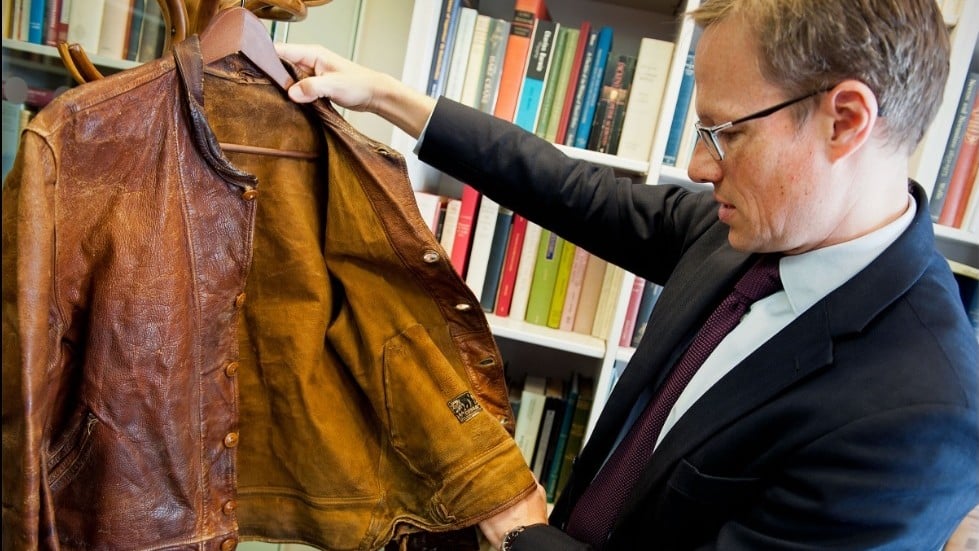
Christie’s auction house is selling a battered leather jacket worn for years by Albert Einstein, which is expected to fetch £40,000-60,000 ($51,000-78,000).
“The jacket first appears in a number of photographs of Einstein, taken at the height of his fame in the mid-1930s,” said specialist Thomas Venning in a blurb published on the auction house’s website.
“This is an incredibly worn, rather pungent leather jacket, that belonged to Albert Einstein,” Venning said. “This jacket seems to capture Einstein’s mood as he embarks on a new life in the US. It’s made by Levi Strauss, and feels particularly American.”
The earliest photos of Einstein wearing the jacket were taking shortly after he applied for permanent residency in the US, having fled Nazi rule in his native Germany in 1933.
Einstein wore the jacket “all the time,” said Venning.
In the memoirs of fellow scientist Leopold Infeld, who worked with him at Princeton, Infeld wrote that Einstein tried to keep material restrictions to a minimum, according to a notice on the Auction on the Christie’s website.
The physicist’s long hair reduced the need for a barber and, according to Infeld, “one leather jacket solved the coat problem for years.”
The current owner received the jacket directly from Einstein. Its strong smell is due to the fact that Einstein frequently smoked a pipe. Venning says the jacket “still smells of smoke, astonishingly, 60 years after his death.”

It will be sold alongside Einstein’s pocket watch – a regular Lepine open-face watch with a silver case, as well as a box of building blocks – a toy similar to the modern Lego bricks.
The watch “dates to around 1900, when Einstein was still a total unknown,” Venning said. The scientist apparently acquired the timepiece when he was about 21 years old.
“Einstein carried this watch with him while working as a patent clerk in Switzerland, before he came up with one of the great ideas to change the world,” Venning said, noting the item’s symbolic aspect, coming from a physicist whose theories would revolutionize the concept of time.










The Times of Israel Community.