

Iran on the brain
Netanyahu’s obsession with ending the nuke deal pays some dividends in the headline department, but pundits say Trump’s disinterest shows it’s a bad play
 Add ToI as a Preferred Source on Google
Joshua Davidovich is The Times of Israel's Deputy Editor
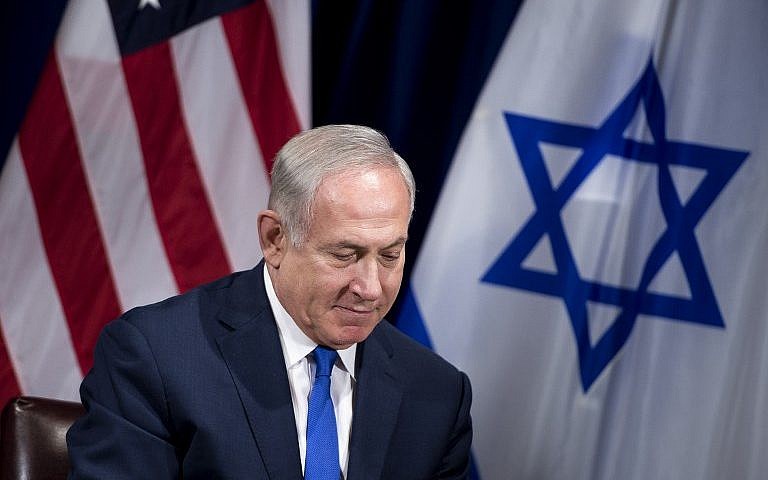
For all the complaining Prime Minister Benjamin Netanyahu does that the media is out to get him (and he is not totally wrong), there are still signs that he wields enough influence to control the conversation.
A case in point is Tuesday morning, a day after he met with US President Donald Trump. Despite Trump not talking at all about the Iranian nuclear deal in a public statement before the meeting, it’s Netanyahu insistence that the US wants to scrap it that leads headlines in Israel’s major dailies.
Israel Hayom’s “The US understands the need to act against Iran” is no surprise, with the paper thought to be pretty much controlled by Netanyahu, but even Yedioth Ahronoth (“United against Iran”) and Haaretz (“Netanyahu: Trump wants to fix the nuclear deal”) are along for the ride.
Despite Haaretz’s headline, which also mentions the premier’s first-ever public meeting with Egyptian president Abdel-Fattah al-Sissi, the paper’s story and commentary do note the vast gulf between Netanyahu’s Iran talk and Trump’s focus on the Israeli-Palestinian peace process.
Iran is not mentioned before the story jumps inside, with its lead graphs instead concentrating on Trump saying that Israeli-Palestinian peace is possible and recalling his tweet that it would be “fantastic.”
“What happened at the start of this meeting evoked feelings of déjà vu. At almost every talk he had with Barack Obama during the latter’s eight years in office, Netanyahu wanted to discuss Iran, but the U.S. president talked about the Palestinians. This ritual repeated Monday night,” Barak Ravid notes in an accompanying analysis.
Another column by Chemi Shalev is more acerbic, chiding Netanyahu for insisting on putting Iran first on the agenda, which he says may end up making it look like Israel hoodwinked the US into making moves it shouldn’t be making.
“The last thing that Trump wants is to be seen as Netanyahu’s stooge. The last thing that’s good for Netanyahu – and for Israel – is for international and American public opinion to suspect that he cajoled the US president, whom many people see as a fool, to abandon an agreement that most of the world supports,” he writes. “The last thing that Israel needs is to be seen as having shifted attention away from North Korea’s ballistic missiles, which pose a far more acute danger to America’s national security, that it forced Washington to deal with two major crises at once, or that it played a key role in sparking a clash that ultimately leads to US soldiers being killed in battle.”
Yedioth on the other hand plays up Netanyahu’s comments on Iran, basing most of its reporting on Netanyahu’s briefing with reporters after the meeting and writing that behind closed doors much of the summit was focused on Iran.
“The president sees Iran as the root of the problem,” the report quotes Netanyahu saying. “The president’s starting point is the same as ours, which we didn’t have with the last administration. It may take time until his stance is translated into actionable steps, but it’s perfectly clear that there is something new here. In the past Congress didn’t have a big enough majority to cancel the deal, but now there is a president who will raise the issue.”
However, columnist Alon Pinkas writes that even if Netanyahu thinks he can convince Trump, the nuclear deal isn’t going anywhere and the prime minister’s obsession with trying to get the US to go back on it is misguided.
‘The drama is manufactured. It’s true that Trump doesn’t love the deal, but Defense Secretary [James] Mattis, national security adviser [H.R.] McMaster and Chief of Staff [John] Kelly — all three of them generals — don’t think it should be canceled. The fake show of the possibility that the US will pull out of the deal — seeing the presidential re-certification due October 15 as a commitment — is mistaken. The deal will not be canceled,” he writes. “What Netanyahu can do, quietly and without unneeded pushiness, is to create pressure to change Iran’s negative and dangerous behavior in the region. It’s not part of the agreement, but there’s a place where Israel and the US are on the same page.”
Israel Hayom mentions Trump’s comments on the Palestinian peace process almost as an aside, focusing the lion’s share of its coverage on Iran. The paper also previews Netanyahu’s speech at the UN expected later Tuesday, writing that it will be shorter than normal, at a slim 20 minutes, perhaps because he doesn’t know that much Persian.
“Netanyahu will turn during his speech at the UN directly to the spiritual leader of Iran, Ali Khamenei, and call on him to halt the threats and declarations of war against Israel and the US,” the paper reports.
Khamenei isn’t the only one making threats. The very next page of Israel Hayom features the same kind of saber-rattling, only this time from an Israeli general promising to “destroy anyone who meddles in our affairs in the north,” a clear reference to Iranian proxies in the region.
“If in the next war in the north there will be foreign interference from Shiite militias, they will not return home,” the paper quotes Tamir Heyman, the head of Israel’s forces in the north, saying. “Their interference in Lebanon, in matters that are not theirs, is intolerable and so our response to them will be the most aggressive there is — annihilation.”
If Israel seems especially focused on Iran lately, even when nobody else wants to talk about it, it may be thanks to a big chunk of the country being on Ritalin (or that Israelis have trouble paying attention). Yedioth reports that the number of Israelis diagnosed with ADHD has gone up in recent years, though it’s still lower than the world average. The paper tries to make a case that geography matters, pointing to Tiberias, Herzliya and Modiin as the cities with the highest rates of ADHD, though it also notes that gender matters, with boys much more likely to have the disorder than girls. With the story coming a month after the paper reported breathlessly that over a million Ritalin scrips were written in the last year, now the paper notes that only half of kids and 20 percent of adults take medication for ADHD. The increase isn’t a problem, the paper explains via doctors.
“In the past we saw that people didn’t want to get tested because of lack of information on the problem or because of stigmas that come with ADHD. Today we see a recognition of the importance of getting tested and treated. There is a sense that children and young adults have the potential to grow and be successful, creative people, and the behavioral and medical treatment helps to bring out the best of their abilities,” the paper quotes Dr. Nikki Liberman, the head of community health for the Clalit HMO, saying. “The drop in treatment at older ages is explained by the fact that as the children grow they only take the medicine when they see a need.”





The Times of Israel Community.