

Iran warns US against Israel’s ‘destructive’ influence on negotiations
Spokesman says talks with US showed enough consensus to continue diplomatic process after ‘very bad experience’ of June war; Khamenei adviser travels to Oman, Qatar
 Add ToI as a Preferred Source on Google
Iran warned Tuesday of Israel’s “destructive” influence on diplomacy ahead of Prime Minister Benjamin Netanyahu’s visit to Washington for talks expected to focus on US negotiations with Tehran.
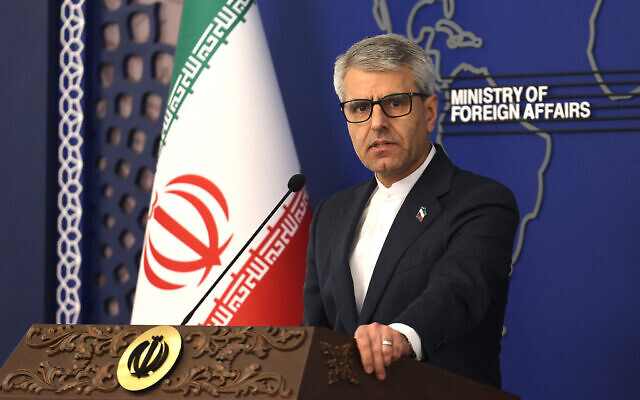
“Our negotiating party is America. It is up to America to decide to act independently of the pressures and destructive influences that are detrimental to the region,” said Iranian foreign ministry spokesman Esmail Baghaei in a weekly press briefing.
“The Zionist regime has repeatedly, as a saboteur, shown that it opposes any diplomatic process in our region that leads to peace.”
Baghaei also said that talks with the United States allowed Tehran to gauge Washington’s seriousness and showed enough consensus to continue on the diplomatic track.
Tehran and Washington resumed talks in Oman on Friday, months after earlier negotiations collapsed following Israel’s bombing campaign against Iran last June targeting nuclear and military sites, which triggered a 12-day air war.
“The Muscat meeting was not a long meeting. In our view, it was to gauge the seriousness of the other side and how to continue this path,” Baghaei said. “After the talks, we felt there was understanding and consensus to continue the diplomatic process.”
During the conflict in June, Israel targeted senior Iranian military officials, nuclear scientists and nuclear sites, as well as residential areas. The United States later joined the campaign, launching its own strikes on key Iranian nuclear facilities.
Iran responded with drone and missile attacks on Israeli civilian and military targets, and by targeting the largest US military base in the Middle East, located in Qatar.
“The June experience was a very bad experience. Therefore, taking these experiences into account, we are determined to secure Iran’s national interests through diplomacy,” Baghaei said.
He insisted that Iran’s focus would remain strictly on the nuclear file in return for sanctions relief. Tehran has repeatedly said it rejects any negotiations that extend beyond that issue.
Baghaei also addressed Iranian security chief Ali Larijani’s visit to Oman to follow up on regional consultations.
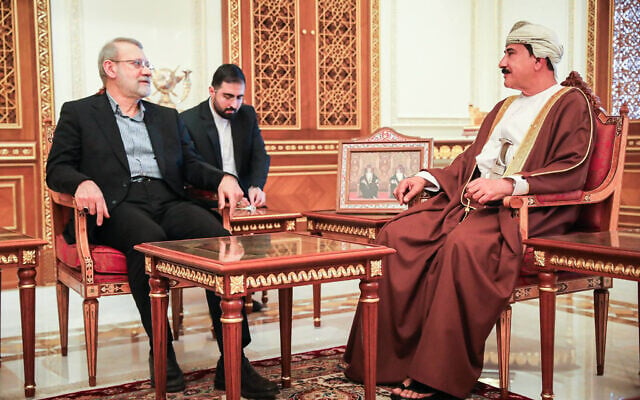
Larijani, who heads the Supreme National Security Council, held talks with Haitham bin Tariq, the sultan of Oman, and Foreign Minister Badr bin Hamad al-Busaidi, Iran’s state news agency IRNA reported Tuesday.
He will next travel to Qatar.
On Saturday, Netanyahu’s office said in a statement that the Israeli premier “believes any negotiations must include limitations on ballistic missiles and a halting of the support for the Iranian axis” — referring to Iran’s allied armed groups in the region.
The talks followed threats from Washington and the deployment of a US aircraft carrier group to the region after Iran’s deadly crackdown on anti-government protests last month.
Monitoring groups say at least roughly 7,000 people have been killed, most on January 8 and 9, but that the full number could be triple that. The clampdown since has also been unprecedented. A monthlong internet blackout has hidden the full extent of what happened, even as more than 50,000 people have been reported detained.
Times of Israel staff contributed to this report






The Times of Israel Community.