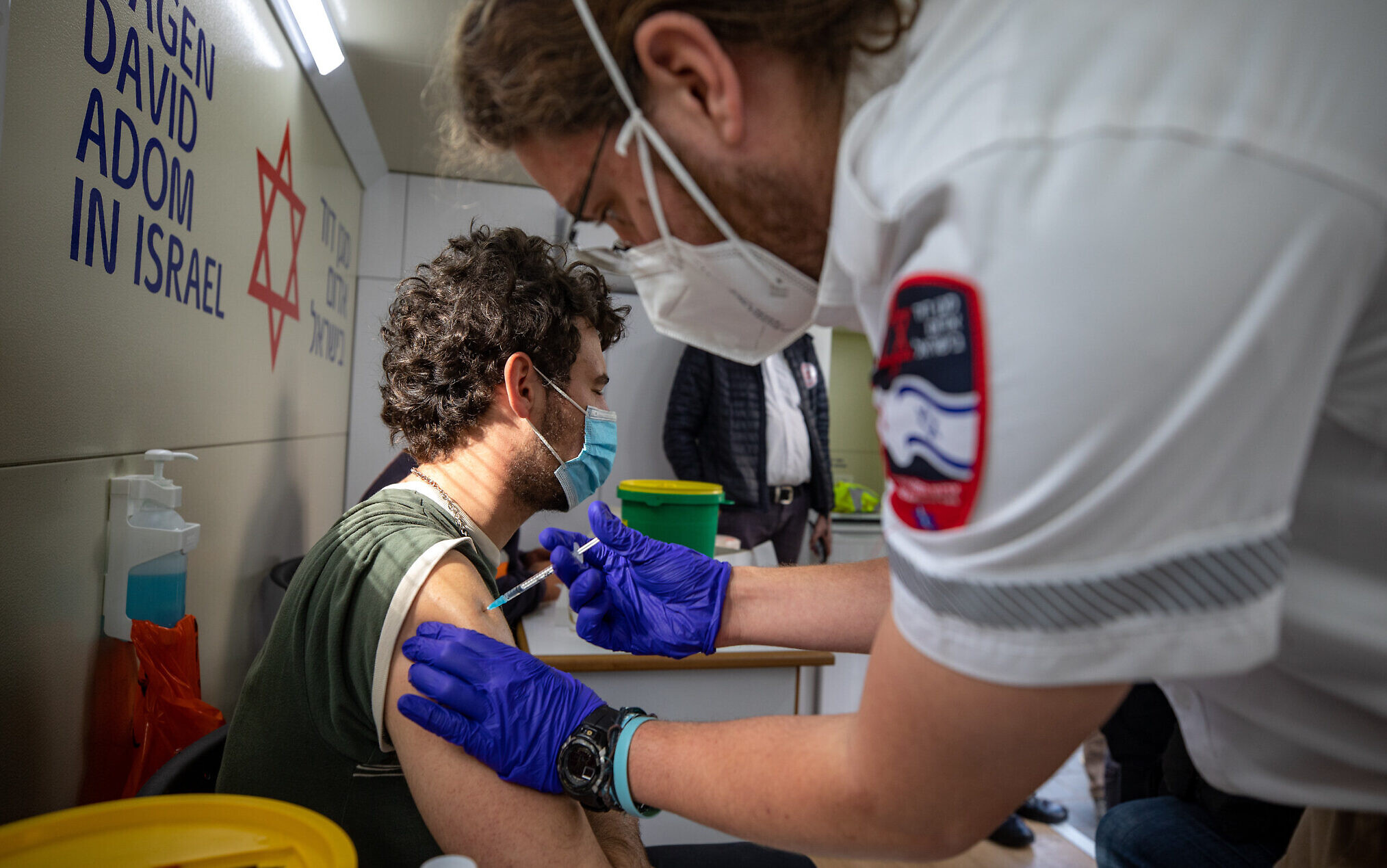
An Israeli man receives a COVID-19 vaccine shot at a mobile Magen David Adom vaccination station at the Mahane Yehuda market in Jerusalem on February 22, 2021. (Olivier Fitoussi/Flash90)
The Health Ministry on Monday informed healthcare providers that they can begin to vaccinate Israelis who have recovered from COVID-19.
The ministry’s recommendation calls for vaccinating patients with a single dose three months after recovery. Only recovered patients over 16 can receive a shot, in keeping with the ministry’s guidelines not to vaccinate anyone younger than that.
Health maintenance organizations (HMOs) can begin administering vaccines to the recovered on Tuesday, a Health Ministry statement said.
Over 323,000 Israelis who were infected with COVID-19 recovered at least 90 days ago, according to Health Ministry figures. The ministry’s website does not provide a breakdown on how many of those are under 16.
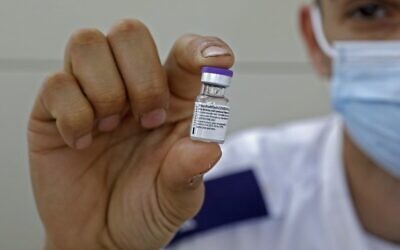
A Magen David Adom paramedic holds up a vile of the Pfizer-BioNTech COVID-19 vaccine, before inoculating Palestinians in a mobile clinic on February 26, 2021, at the Damascus Gate in Jerusalem’s Old City. (Ahmad Gharabli/AFP)
Monday’s announcement follows the recommendation last month by the Health Ministry’s Priority Committee to vaccinate the recovered.
Get The Times of Israel's Daily Editionby email and never miss our top stories
There have been nearly 780,000 confirmed coronavirus cases in Israel since the start of the pandemic and 5,760 people have died. As of Monday, over 4.7 million Israelis — half the country’s population — have received the first dose of the vaccine; close to 3.4 million have received both doses.
New national data showed that just one in 1,500 fully vaccinated Israelis has tested positive for COVID-19, providing the strongest sign yet that widespread inoculation can significantly reduce serious illness from the coronavirus and prevent hospitalization.
Advertisement
Help us report truthfully on social media
As a multimedia journalist, my job is to take the quality, fact-based journalism produced by The Times of Israel newsroom and make it accessible across every platform — from Instagram posts to podcasts to short-form videos.
This is how many, especially young people, consume news these days. But misinformation is rampant on social media. Our team at ToI produces accurate, responsible short-form reporting on Israel and the Jewish world.
If you believe in the importance of factual social media journalism, please consider joining our reader support group, The Times of Israel Community. Your financial support is essential to sustain responsible multimedia reporting.
We’re really pleased that you’ve read X Times of Israel articles in the past month.
That’s why we started the Times of Israel - to provide discerning readers like you with must-read coverage of Israel and the Jewish world.
So now we have a request. Unlike other news outlets, we haven’t put up a paywall. But as the journalism we do is costly, we invite readers for whom The Times of Israel has become important to help support our work by joining The Times of Israel Community.
For as little as $6 a month you can help support our quality journalism while enjoying The Times of Israel AD-FREE, as well as accessing exclusive content available only to Times of Israel Community members.
Thank you, David Horovitz, Founding Editor of The Times of Israel


 Add ToI as a Preferred Source on Google