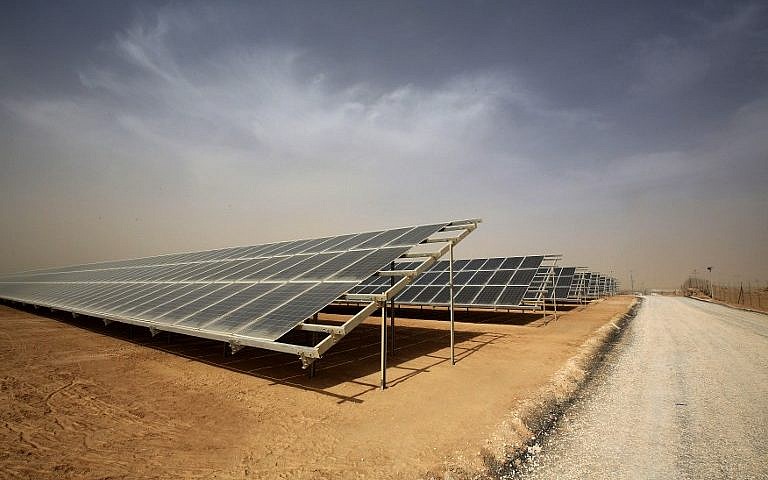
A general view shows part of a new 15 million euro ($17 million) solar plant during its official inauguration at the Zaatari refugee camp in Jordan, on November 13, 2017. (AFP Photo/Khalil Mazraawi)
ZAATARI REFUGEE CAMP, Jordan — Jordan on Monday inaugurated the largest solar park to operate in a refugee facility, aiming to improve the lives of tens of thousands of Syrian refugees at the Zaatari desert camp.
The 4,000 solar panels with a total capacity of 12.9 megawatts are designed to provide 14 hours of electricity a day to Zaatari’s 80,000 inhabitants, according to the United Nations High Commissioner for Refugees.
The project was financed by Germany at a cost of 15 million euros ($17.5 million).
The UNHCR has previously been providing eight hours of electricity a day, costing $500,000 a month, said Stefano Severe, the agency’s representative in Jordan.
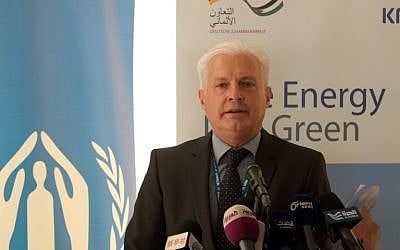
Stefano Severe, the United Nations High Commisioner for Refugees representative in Jordan, gives a speech at the inauguration of a solar plant at the Zaatari refuge camp on November 13, 2017. (AFP Photo/Khalil Mazraawi)
“With this solar panel plant and this grant from Germany, UNHCR will be able to provide 14 hours with zero cost,” he said at a ceremony at the camp attended by Jordan’s Energy Minister Salah al-Kharabsheh and German ambassador Birgitta Siefker-Eberle.
Get The Times of Israel's Daily Editionby email and never miss our top stories
He said the savings would be used to improve other services in the camp.
The additional hours of electricity would improve the refugees’ lives “by giving more opportunities for the kids to study in the nighttime, for people to store food in their fridges, to communicate with the outside world,” said Severe.
In May, Jordan scored a world first for a refugee camp powered by renewable energy, according to the UNHCR, when it opened a two-megawatt solar plant in Azraq which is home to 35,000 refugees from the war across the border in Syria.
Advertisement
Help us report truthfully on social media
As a multimedia journalist, my job is to take the quality, fact-based journalism produced by The Times of Israel newsroom and make it accessible across every platform — from Instagram posts to podcasts to short-form videos.
This is how many, especially young people, consume news these days. But misinformation is rampant on social media. Our team at ToI produces accurate, responsible short-form reporting on Israel and the Jewish world.
If you believe in the importance of factual social media journalism, please consider joining our reader support group, The Times of Israel Community. Your financial support is essential to sustain responsible multimedia reporting.
We’re really pleased that you’ve read X Times of Israel articles in the past month.
That’s why we started the Times of Israel - to provide discerning readers like you with must-read coverage of Israel and the Jewish world.
So now we have a request. Unlike other news outlets, we haven’t put up a paywall. But as the journalism we do is costly, we invite readers for whom The Times of Israel has become important to help support our work by joining The Times of Israel Community.
For as little as $6 a month you can help support our quality journalism while enjoying The Times of Israel AD-FREE, as well as accessing exclusive content available only to Times of Israel Community members.
Thank you, David Horovitz, Founding Editor of The Times of Israel


 Add ToI as a Preferred Source on Google