

No sympathy for the devil: 8 things to know for September 23
The press takes the low road after a deadly attack in Iran, and gets ready for ‘amazing, extraordinary’ speeches at the UN and for a Russian take on the downed plane
 Add ToI as a Preferred Source on Google
Joshua Davidovich is The Times of Israel's Deputy Editor
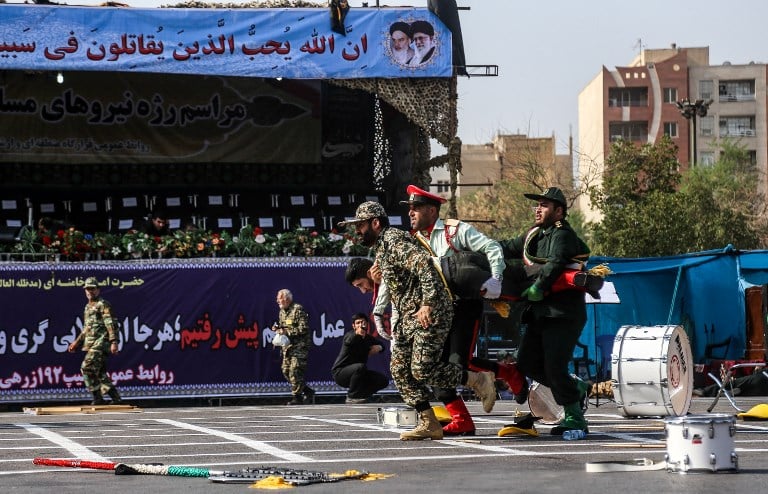
1. Nothing nice to say? The enemy of your enemy is your friend, unless that enemy’s enemy is gunning down women and children in a bloody massacre. Or at least that’s how it probably should be.
- While the Trump administration found a way to express solidarity/horror and almost condemn the attack in Iran, official Israel has remained silent.
- The Hebrew press, however, gives the story major coverage, and while some treat the tragedy respectfully, others might have done well to heed that old adage: If you don’t have anything nice to say, don’t say anything.
- Israel Hayom, the closest thing Prime Minister Benjamin Netanyahu’s government has to a mouthpiece, runs a front page headline of “Terror in the place where it’s manufactured.” Inside, the tabloid uses the possibly worse “Terror at the head of the snake.”
- The paper reports in its lede that among the 29 killed were 12 members of the Islamic Revolutionary Guard Corps, and “apparently senior officers,” though it doesn’t cite any evidence for that. One needs to get to the last few column inches to read the “claim” that a four-year-old girl was among those killed.
- Likewise, tabloid Yedioth Ahronoth calls it an attack on the heads of the Revolutionary Guards, though in fact the parade involved members of all of Iran’s armed forces and the gunmen clearly aimed at women and children as well.
2. Looking for a silver lining: But all of that is just nickel-and-dime stuff compared to the Walla news site, which runs a column with a headline claiming the assault is actually what the regime wanted.
- “The shooting… serves the mythology upon which Iran can unite against those who wish it harm — the US, Israel and the Gulf states. From a point of view of stability, it’s just a glancing shot against the regime, which can cynically regard this as a prize,” reads the article’s subheadline.
- A close reading of the piece presents a slightly more nuanced look, with writer Guy Alster actually arguing that what serves the regime is to blame the US, Israel and others.
- That indicates that headline and subheadline may be the work of a mischievous editor (or someone looking for clicks), which is not insane considering the site is also known for running multiple articles about people from the future.
3. The water shortage precedent: Israel’s government has remained silent, but it’s not out of the question for it to release some sort of statement that turns the tragedy into a talking point against the regime.
- That’s the playbook it has followed until now, such as with a recent video in which Prime Minister Benjamin Netanyahu offered to step in and help Iran with its water woes, following protests in the same region as the attack against the regime over a lack of clean water and other services.
- The man behind that type of video, though, was spokesman David Keyes, who is still on leave while he attempts to clear his name over multiple accusations of sexual misconduct.
4. Setting expectations as high as possible: Netanyahu will have a chance to quip about Iran to the world when he mounts the stage at the UN General Assembly on Thursday for his speech to the annual confab.
- Sources close to Netanyahu tell the Ynet news site that the speech will deal mostly with Iran and will be “amazing, interesting and have new information that will leave the whole world mightily impressed.”
5. Another ‘extraordinary’ speech: Associates of Palestinian Authority President Mahmoud Abbas are also promising an “extraordinary” speech, ToI’s Avi Issacharoff writes, though he notes he’s heard that claim before and it has never held any water.
- According to a report by Arabic paper Asharq Al-Awsat, Abbas will tell the gathered world leaders to either launch an international peace effort or kiss the two-state solution goodbye — not exactly a new threat.
- Issacharoff notes, though, that while the speech may just be bluster, Israel should be worried about actual moves being planned by the Palestinian leader, including an ultimatum to cut funds to Gaza, or an end to security coordination with Israel in the West Bank.
- “Abbas holds the future of the security coordination and, to a large extent, the status quo surrounding Gaza in his hands. He shows impressive ability to control what happens on the ground, has a dramatic influence on the progress of the talks between Egypt, Hamas and Israel on a ceasefire agreement, and has succeeded, by his actions, in changing Cairo’s direction,” he writes.
6. No love for an old love: One person who believes in Abbas is former prime minister Ehud Olmert, who met with him on Friday and gave a fawning interview to the official PA television station, calling him “a great political leader and the most relevant person for the future developments in the relations between Israel and Palestinians.”
- Unsurprisingly, the reaction from the right was fast and furious, with Likud accusing Olmert of “offering the Western Wall to Abbas” and being his spokesman.
- In Israel Hayom, columnist Amnon Lord follows MK Michael Oren’s lead in comparing the meeting to former US secretary of state John Kerry meeting Iranian Foreign Minister Mohammed Javad Zarif.
- “The meeting… was part of a campaign by the Israeli left to give heroin hits of legitimacy with a needle straight into the chieftain suffering harsh blows from the White House,” he writes.
7. The Russian report: Israel is waiting with bated breath for the release of a Russian report on the downing of its spy plane over Syria.
- Amid differing reports over whether the Russians accepted or rejected Israel’s version of the events, the Russian defense ministry said Saturday that a “minute-by-minute timeline of the tragedy will be given with a presentation of objective data from the radars’ data handling system about the air situation in Syria on September 17 and actions of Israel’s air force in the area of the crash.”
- Israeli diplomatic sources tell Yedioth’s Alex Fishman that rather than lower the flames, the delegation to Moscow that aimed to explain away Israel’s role in the crash “has just riled [the Russians] up even more, and highlighted the massive gaps between their versions.”
- In Haaretz, Amos Harel writes that the final decision on whether Russia accepts Israel’s version, and what kind of punishment it metes out over the incident, lies with Putin, who has reason to not just let bygones be bygones.
- “The incident … creates some embarrassment at home for Russia’s government. And the Russians were already unhappy with the scale and intensity of Israeli airstrikes in Syria,” he writes. “Thus, now that Putin has a new lever for pressuring Israel, it’s hard to see him failing to use it just because of his friendship with Prime Minister Benjamin Netanyahu. Despite the two leaders’ close relationship, Russia will certainly try to exploit this incident to the hilt.”
8. Finding G-d: Lastly, and having little to do with Israel, enjoy this poem from the late, great Leonard Cohen.
- Cohen was not particularly religious for most of his life, but one can feel the just-passed Day of Atonement coursing through the verses here.
- Interestingly, he adopts the Orthodox practice of using a dash inside of the “o” in “God” to avoid profaning the holy name.





The Times of Israel Community.