Jacob Magid is The Times of Israel's US bureau chief
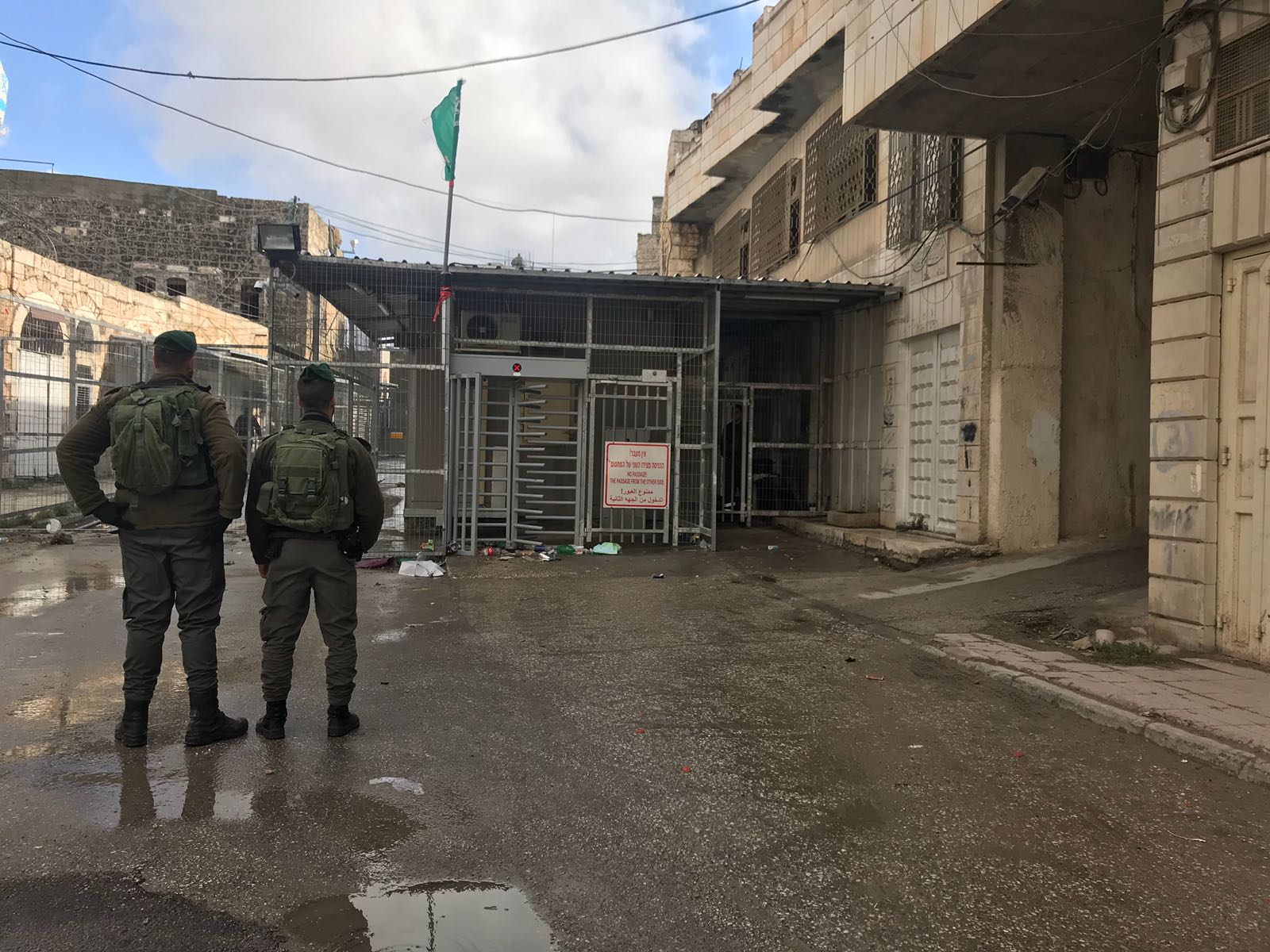
Illustrative: Border Police officers stand at a checkpoint near Hebron's Tomb of the Patriarchs on January 19, 2018. (Border Police)
For the second day in a row, Border Police arrested a Palestinian suspect in the West Bank city of Hebron on Saturday, after finding a knife hidden under his clothes at the entrance to the Tomb of the Patriarchs holy site.
After the 15-year-old boy set off the metal detector at a checkpoint outside the holy site, officers cocked their weapons at him and asked him to slowly raise his shirt.
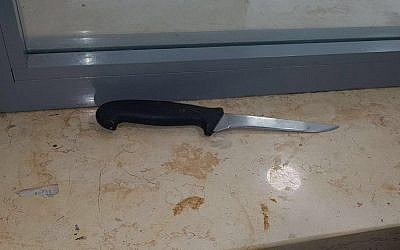
Upon recognizing the knife underneath, security forces detained the teen and took him in for additional questioning.
Less than 24 hours earlier, Border Police forces made a similar arrest of a 23-year-old Palestinian man who raised the suspicions of officers at the holy site’s entrance. They uncovered a knife under his clothes upon carrying out a full-body inspection.
The knife found by Border Police hidden under the clothes of a 15-year-old Palestinian, who was detained outside Hebron’s Tomb of the Patriarchs on February 10, 2018. (Border Police)
Also Friday, security forces arrested an armed Palestinian teenager at the entrance to the West Bank settlement of Hashmonaim.
Get The Times of Israel's Daily Editionby email and never miss our top stories
The Tomb of the Patriarchs is a frequent target for attempted stabbing attacks.
In January Border Police officers made similar arrests of a man and a woman in two separate incidents at the site, after finding knives on their persons.
A Palestinian teen was arrested trying to enter the holy site with a knife in December, and in November two 17-year-old Palestinians were also detained after each attempted to smuggle a knife into the site in two separate incidents a day apart.
Advertisement
Help us report truthfully on social media
As a multimedia journalist, my job is to take the quality, fact-based journalism produced by The Times of Israel newsroom and make it accessible across every platform — from Instagram posts to podcasts to short-form videos.
This is how many, especially young people, consume news these days. But misinformation is rampant on social media. Our team at ToI produces accurate, responsible short-form reporting on Israel and the Jewish world.
If you believe in the importance of factual social media journalism, please consider joining our reader support group, The Times of Israel Community. Your financial support is essential to sustain responsible multimedia reporting.
We’re really pleased that you’ve read X Times of Israel articles in the past month.
That’s why we started the Times of Israel - to provide discerning readers like you with must-read coverage of Israel and the Jewish world.
So now we have a request. Unlike other news outlets, we haven’t put up a paywall. But as the journalism we do is costly, we invite readers for whom The Times of Israel has become important to help support our work by joining The Times of Israel Community.
For as little as $6 a month you can help support our quality journalism while enjoying The Times of Israel AD-FREE, as well as accessing exclusive content available only to Times of Israel Community members.
Thank you, David Horovitz, Founding Editor of The Times of Israel


 Add ToI as a Preferred Source on Google