Pentagon authorizes $1 billion for Trump’s Mexican border wall
Acting defense secretary cites law that he said gives his department authority to build fences to block drug-smuggling, after president declared national emergency
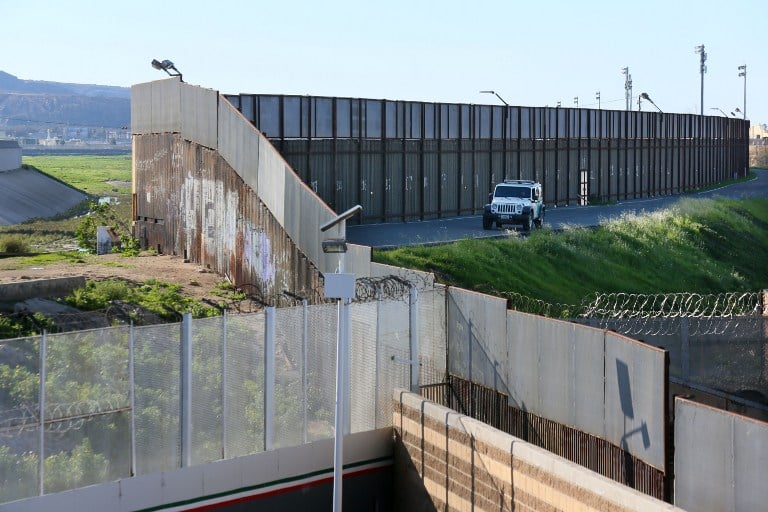
Illustrative: A Border Patrol vehicle sits along the US-Mexico border wall on January 25, 2017, in San Ysidro, California. (Sandy Huffaker/Getty Images/AFP)
WASHINGTON — Acting Pentagon chief Patrick Shanahan said Monday he had authorized $1 billion to build part of the wall sought by US President Donald Trump along the US-Mexico border.
The Department of Homeland Security asked the Pentagon to build 57 miles (92 kilometers) of 18-foot (5.5-meter) fencing, build and improve roads, and install lighting to support Trump’s emergency declaration as concerns the border.
Shanahan “authorized the commander of the US Army Corps of Engineers to begin planning and executing up to $1 billion in support to the Department of Homeland Security and Customs and Border Patrol,” a Pentagon statement read.
The acting defense secretary defended the move by citing a federal law that he said “gives the Department of Defense the authority to construct roads and fences and to install lighting to block drug-smuggling corridors across international boundaries of the United States in support of counter-narcotic activities of federal law enforcement agencies.”

In this file photo taken on January 1, 2019 acting US Secretary of Defense Patrick Shanahan arrives for his first day in his new job at the Pentagon in Washington, DC. (Saul Loeb/AFP)
The statement was released just hours before Shanahan was due to testify in Congress to present and defend the Pentagon’s draft budget.
Get The Times of Israel's Daily Editionby email and never miss our top stories
Frustrated by Congress’s refusal to provide the budget he sought to build a border wall, Trump declared a national emergency last month in order to bypass lawmakers to unlock $8 billion in funding.
The move drew condemnation from both the president’s rival Democrats and fellow Republicans, who warned it was an abuse of presidential powers and created a dangerous precedent.

Advertisement
We can't do this work alone.
The war with Iran has been draining for all of us in Israel. But when I heard about a high casualty incident – ballistic missile impacts in Arad and Dimona that left nearly 200 people wounded – I drank a cup of coffee, packed a bag, and headed south.
There, I spoke with Shilgit, the head of an after-school program for underprivileged youth. Standing outside her destroyed center, Shilgit said it was a miracle that no children were hurt and spoke about the community coming together in the hours since.
As a Times of Israel reporter, I’m committed to telling stories of resilience like Shilgit’s. But my colleagues and I can't do this alone. If you value work like this,please consider joining our reader support group, The Times of Israel Community. Your financial support is essential to keep real human reporting like this going.
We’re really pleased that you’ve read X Times of Israel articles in the past month.
That’s why we started the Times of Israel - to provide discerning readers like you with must-read coverage of Israel and the Jewish world.
So now we have a request. Unlike other news outlets, we haven’t put up a paywall. But as the journalism we do is costly, we invite readers for whom The Times of Israel has become important to help support our work by joining The Times of Israel Community.
For as little as $6 a month you can help support our quality journalism while enjoying The Times of Israel AD-FREE, as well as accessing exclusive content available only to Times of Israel Community members.
Thank you, David Horovitz, Founding Editor of The Times of Israel