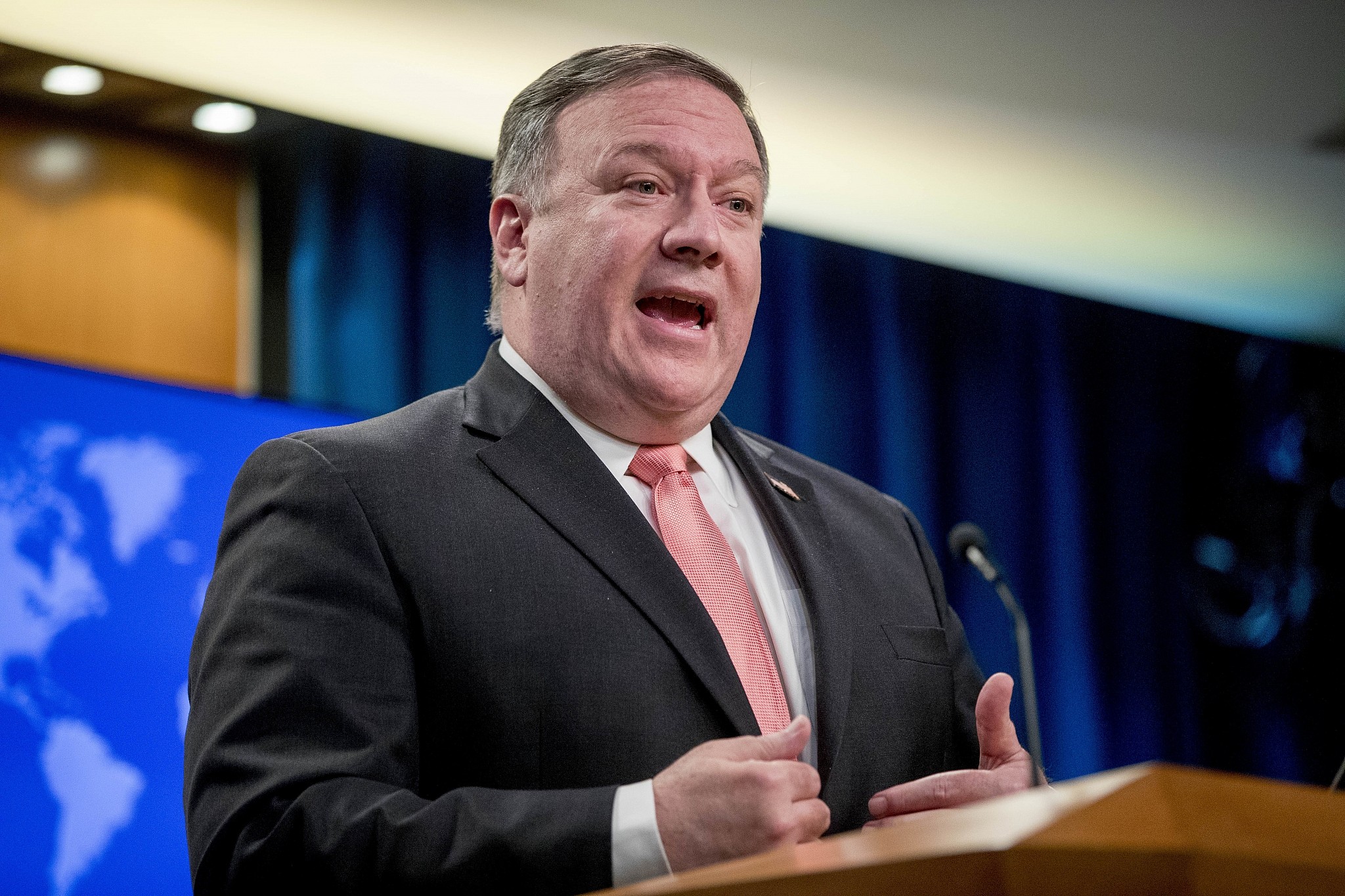
In this Oct. 23, 2018 photo, Secretary of State Mike Pompeo speaks to reporters at a news conference at the State Department in Washington.. (AP Photo/Andrew Harnik)
WASHINGTON — US Secretary of State Mike Pompeo defended the Trump administration’s reimposition of sanctions against Iran from conservative critics who argue more should be done to isolate the country.
In an interview with “Fox News Sunday,” Pompeo refused to reveal which countries received waivers from US sanctions to continue importing Iranian oil. But he said the eight unidentified nations “need a little bit more time to get to zero.” He would not rule out the Trump administration extending the waivers beyond six months
Pompeo maintained that despite the waivers, “these sanctions have already had an enormous impact.” He added that Trump’s policy of “maximum pressure will be fully in place as of tomorrow.”
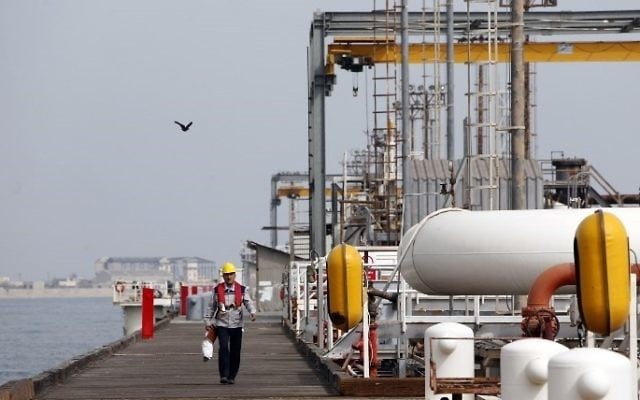
This photo from March 12, 2017, shows an Iranian laborer walking the platform of the oil facility in the Khark Island, on the shore of the Gulf. (AFP/Atta Kenar)
President Donald Trump removed the US from the 2015 Iran nuclear deal earlier this year, triggering the sanctions being imposed Monday. Pompeo said they are designed to “alter the Iranian regime’s behavior,” especially its support of terrorist groups like Hezbollah.
Trump told reporters as he left the White House on Sunday for political rallies in the South that the sanctions are the strongest ever imposed by the United States.
Get The Times of Israel's Daily Editionby email and never miss our top stories
“We’ll see what happens with Iran. But they’re not doing very well,” he said. The president did not respond to a question about the waiver.
Pompeo said earlier on CBS’ “Face the Nation” that he was “confident” Iran would not restart its nuclear program with the US withdrawing from the deal.
Pompeo and Treasury Secretary Steven Mnuchin were expected to provide more details on the sanctions at a briefing Monday.
Advertisement
Help us report truthfully on social media
As a multimedia journalist, my job is to take the quality, fact-based journalism produced by The Times of Israel newsroom and make it accessible across every platform — from Instagram posts to podcasts to short-form videos.
This is how many, especially young people, consume news these days. But misinformation is rampant on social media. Our team at ToI produces accurate, responsible short-form reporting on Israel and the Jewish world.
If you believe in the importance of factual social media journalism, please consider joining our reader support group, The Times of Israel Community. Your financial support is essential to sustain responsible multimedia reporting.
We’re really pleased that you’ve read X Times of Israel articles in the past month.
That’s why we started the Times of Israel - to provide discerning readers like you with must-read coverage of Israel and the Jewish world.
So now we have a request. Unlike other news outlets, we haven’t put up a paywall. But as the journalism we do is costly, we invite readers for whom The Times of Israel has become important to help support our work by joining The Times of Israel Community.
For as little as $6 a month you can help support our quality journalism while enjoying The Times of Israel AD-FREE, as well as accessing exclusive content available only to Times of Israel Community members.
Thank you, David Horovitz, Founding Editor of The Times of Israel


 Add ToI as a Preferred Source on Google