

Them’s fightin’ words
Netanyahu prepared to go it alone versus Iran, no school for children in the south, a fishy science project and Israelis’ favorite smuggled goods.
Three out of the four Hebrew dailies dedicate their main front page headlines this morning to Prime Minister Benjamin Netanyahu’s fiery speech at the Knesset yesterday, in which he hinted that Israel would not wait for US permission to strike Iran if it felt it had to do so and reminded listeners that it had acted alone before when it attacked the Iraqi nuclear reactor in 1981.
Israel Hayom leads with the headline: “Difficult, daring, possible,” referring to a solo Israeli attack to prevent Iran from acquiring nuclear weapons. Editor in Chief Amos Regev writes that in crunch time Israel cannot trust outsiders, whose commitment he questions, and must rely solely on itself to get the job done. At the end of the article, which continues to a two-page spread on Pages 2 and 3, Regev concludes by assessing that such a strike, as difficult and as daring as it may be, is in fact possible.
According to Maariv, the decision to strike Iran is all but a done deal. Its main headline reads: “Estimate: a majority of the defense cabinet is in favor of a strike on Iran.” Senior defense correspondent Ben Caspit writes that several cabinet ministers told him in private talks that Netanyahu’s speech yesterday sounded like a preparatory speech for an attack.
Haaretz also leads the paper with reporting on the speech under the headline: “Netanyahu: We have acted without American backing in the past.”
Yedioth Ahronoth nearly ignores Netanyahu’s speech, providing little coverage of it in an article on Page 6. Instead it focuses on problems closer to home, leading with the headline “135,000 students at home.” The article reports that despite Home Front Command assessments allowing schools to operate, mayors and regional council heads in the south decided not to take the risk after a missile fired towards Beersheba yesterday raised serious doubts about the ceasefire agreement reached with Palestinian factions in Gaza.
Other stories making the front page this morning include a Haaretz story covering the thousands of leaked emails of the Assad family that made it to the press. Under the headline: “At the height of the massacre the Assad couple went online shopping,” the article tells of the couple’s blatant disregard for the gruesome goings-on under their rule. The main photo on the front page shows Bashar and Asma Assad walking in a luxurious setting, seemingly oblivious to the suffering around them.
Yedioth features an education-related story on the front page reporting on the Education Ministry’s decision to form a committee of experts to assess whether the number of matriculation exams is too high.
The paper’s main front page photo shows former Hamas captive Gilad Shalit praying at the Western Wall in Jerusalem.
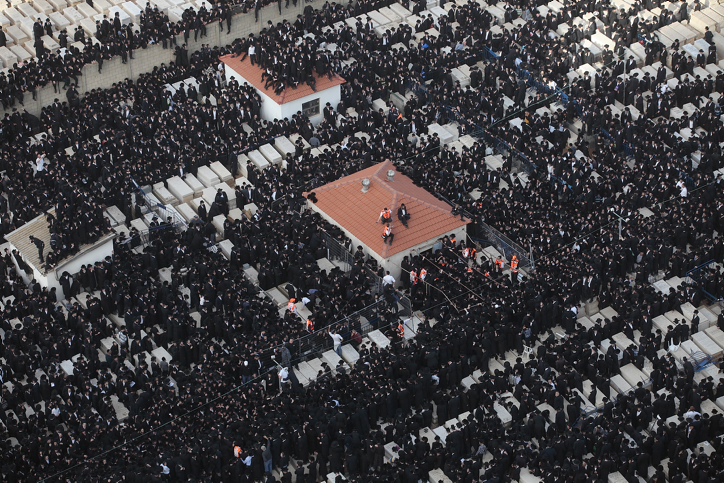
Maariv features a front page photo from the funeral of the head of the Vizhnitz Hassidic court, Rabbi Moshe Yehoshua Hager. The accompanying story tells of the tens of thousands of followers who attended the funeral procession of one of the state’s most influential rabbis.
At the bottom of the page, Maariv reports on a brutal hazing that took place on an army base, during which veteran soldiers from the Givati Brigade beat their younger comrades with wood and rubber clubs and stapled insignias to their flesh.
For new Iron Dome battery it’s all about location
On Page 5 Maariv reports that a fourth Iron Dome battery will be operational within 10 days and that the army will install it in the center of the country to protect the major metropolitan region. The article notes that if the situation in the south re-escalates, the new battery will likely be transferred to the region to aid defensive measures there.
In non-defense related news, Maariv reports on a social integration initiative taking place in a Karkur kindergarten, south of Haifa, where children of Israeli-born parents and Ethiopian immigrants learn together, sharing a Hebrew and Amharic-based curriculum. Whereas in other places children coming from diverse backgrounds often study in separate institutions, the novel initiative seeks to achieve integration from a very early age.
On Page 16 Maariv reports on a junior high school science project that may be adopted by the government. Five eighth-graders from Yehud invented a sticker that detects whether frozen fish have been exposed to heat, thus spoiling them. The simple sticker, which changes its color from green to red if the frozen fish are spoiled, may be adopted by the Agriculture Ministry as an inspection tool, according to Maariv.
Haaretz reports on Israeli’s smuggling practices. According to the article, based on an annual customs report, Israelis’ favorite goods to smuggle last year were cellphones, Viagra and fake brand-name clothes. The article states that customs caught people smuggling undeclared goods 10,082 times last year, up from 9,850 in 2010, and that taxes on these goods equaled a total of NIS 80 million.
Yedioth Ahronoth reports on page 18 of a new cultural initiative sponsored by the Sports and Culture Ministry that will see free children’s plays performed on hundreds of stages in Israel’s periphery during the Passover holiday. According to the article, the initiative was adopted due to the popularity of a similar initiative held during the recent Hannukkah school break.
A Yedioth investigative report looking into healthcare discrepancies between the center and the periphery reveals that there were more cases of preventable deaths in Israel’s outlying areas than in the center of the country. While the differences are marginal, the research shows that in the south and in the north more preventable deaths took place between 2007 and 2009 than in Tel Aviv, Jerusalem or the central districts. The region with the lowest number is Judea and Samaria.
Existential questions
Ari Shavit writes in Haaretz that the question of whether or not to attack Iran is the most important one since the founding of the state and urges properly thinking out the answer. “When confronting this existential question, there is no right or left, no bad guys or good guys, and no warmongers or pacifists. When facing this existential question, we cannot be critical or sloppy and we cannot think dogmatically. Standing at the last crossroad, the debate we conduct with ourselves has to be deep, wise, responsible, clear, and level-headed,” writes Shavit.
In Yedioth, Yonatan Yavin writes about the stupidity of war and takes offense at the word “round,” which has been adopted to describe the recent escalation of cross-border violence in the south. “’Round’ denotes a type of routine, something that happened in the past and will yet to take place again, so you better get used to it. Under the table, policies of initiated warfare have successfully infiltrated our nation. But when exactly did the Israel Defense Forces become the Gaza Attack Forces, which executes en masse and without trial? And why go ahead with an assassination at a time when there is a relative calm, when Hamas is in the midst of shifting alliances in light of the changes in the Arab world and is abandoning at least some parts of Iranian fundamentalism? Why fire now?” he asks.
In Maariv, Dror Raphael writes about the hypocrisy of the MKs who demanded the removal of a clothing company ad showing model Gal Gadot in the nude. “[News presenter] Yonit Levy presents snuff films every evening at 8 pm… but Gadot’s nudity is ‘outragous,’” mocks Raphael. “Television is full of blood, murder and rape that pollute the public space and consciousness. Gal Gadot’s breasts are two mounds of morality and natural beauty compared to all that surrounds them.”







The Times of Israel Community.