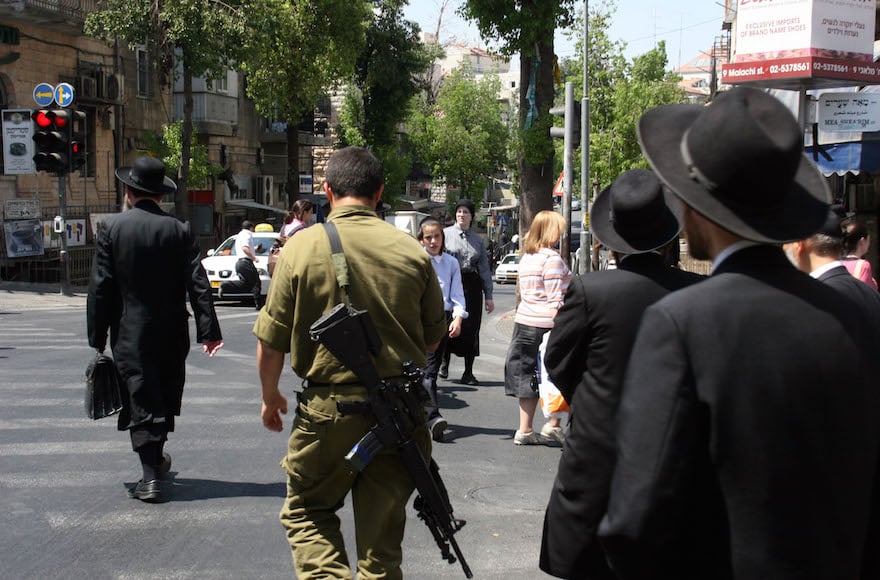
Illustrative: Ultra-Orthodox Jewish men in the Mea Shearim neighborhood in Jerusalem walk alongside an Israeli soldier. June 6, 2008. (Lara Savage/Flash 90)
Police said Thursday that a soldier was attacked by a crowd of ultra-Orthodox Jews as he walked through the Jerusalem neighborhood of Mea Shearim.
According to police, dozens of rioters hurled objects at the Israel Defense Forces soldier while shouting insults at him.
He was taken to safety by police officers who arrived on the scene and was given medical treatment for a light wound he received to his hand.
“The Israel Police will work with all the means at its disposal in order to identify those who took part in verbal or physical attacks on uniformed men and bring them to justice,” police said in a statement.
Many in the ultra-Orthodox community shun the mandatory military service that applies to most Israelis, and the community has historically enjoyed blanket exemptions from the army in favor of religious seminary studies.
Get The Times of Israel's Daily Editionby email and never miss our top stories
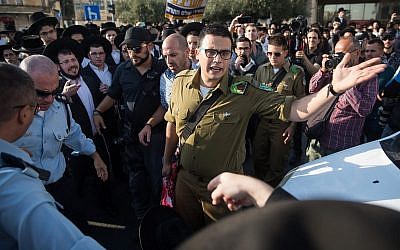
Ultra-Orthodox Jewish men argue with an Israeli soldier during a protest in Jerusalem against the draft for members of their community on October 17, 2017. (Yonatan Sindel/Flash90)
Tuesday’s elections were triggered after staunchly secular Avigdor Liberman of the right-wing Yisrael Beytenu party refused to enter a coalition led by Prime Minister Benjamin Netanyahu in the wake of the April vote unless a bill formalizing exemptions to mandatory military service for seminary students was passed without changes, a demand rejected by the ultra-Orthodox parties in the prospective government.
Liberman on Wednesday reiterated his insistence that ultra-Orthodox military draft was among his preconditions for entering any coalition.
Advertisement
Help us report truthfully on social media
As a multimedia journalist, my job is to take the quality, fact-based journalism produced by The Times of Israel newsroom and make it accessible across every platform — from Instagram posts to podcasts to short-form videos.
This is how many, especially young people, consume news these days. But misinformation is rampant on social media. Our team at ToI produces accurate, responsible short-form reporting on Israel and the Jewish world.
If you believe in the importance of factual social media journalism, please consider joining our reader support group, The Times of Israel Community. Your financial support is essential to sustain responsible multimedia reporting.
We’re really pleased that you’ve read X Times of Israel articles in the past month.
That’s why we started the Times of Israel - to provide discerning readers like you with must-read coverage of Israel and the Jewish world.
So now we have a request. Unlike other news outlets, we haven’t put up a paywall. But as the journalism we do is costly, we invite readers for whom The Times of Israel has become important to help support our work by joining The Times of Israel Community.
For as little as $6 a month you can help support our quality journalism while enjoying The Times of Israel AD-FREE, as well as accessing exclusive content available only to Times of Israel Community members.
Thank you, David Horovitz, Founding Editor of The Times of Israel


 Add ToI as a Preferred Source on Google