

US officials approach tumult in Egypt with caution
Foreign Minister Kamel Amr assures American counterpart that Morsi’s deposition was legitimate, not a military coup
 Add ToI as a Preferred Source on Google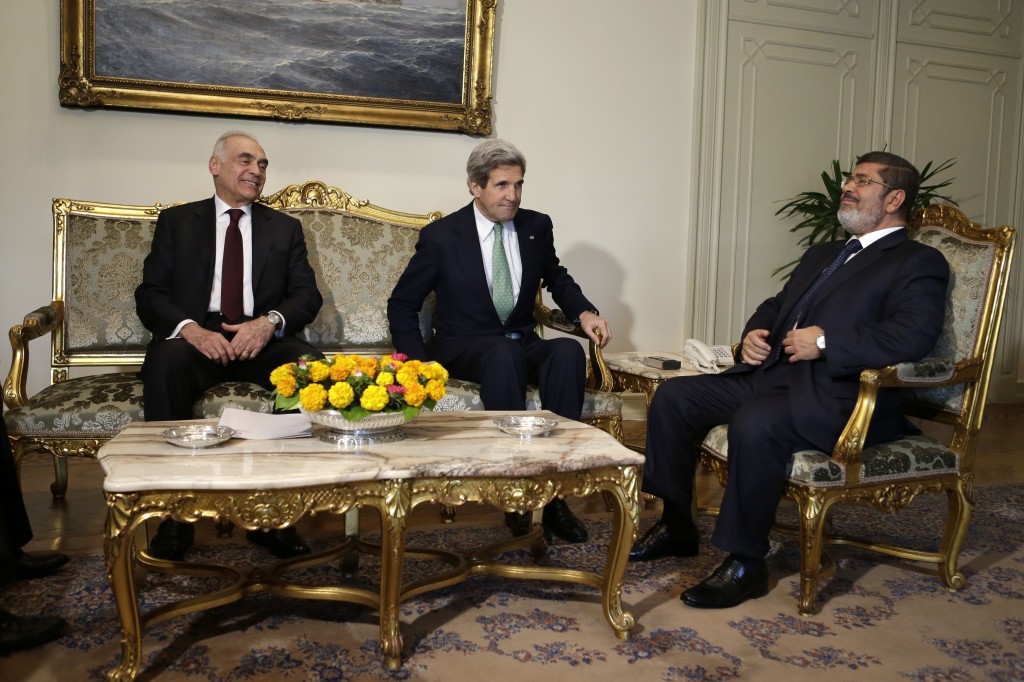
President Barack Obama and his national security team worked carefully Thursday in the aftermath of the ouster of Egyptian president Mohammed Morsi, urging the restive nation to quickly return authority to a democratically elected civilian government and avoid violence. The administration still declined to take sides in the volatile developments as Egypt’s military installed an interim government leader.
Ahead of Washington’s Fourth of July fireworks, Obama met with his national security team in the White House situation room for briefings on their calls to Egyptian leaders and other partners in the region, National Security Council spokeswoman Bernadette Meehan said in a statement.
The carefully worded messages from the US officials conveyed “the importance of a quick and responsible return of full authority to a democratically elected civilian government as soon as possible,” Meehan said.
The series of calls by Secretary of State John Kerry, Secretary of Defense Chuck Hagel and National Security Adviser Susan Rice went to officials from Egypt, Israel, Qatar, Turkey and Norway.
Egyptian Foreign Minister Mohamed Kamel Amr told Reuters that he assured Kerry over the phone Thursday that Morsi’s overthrow was not a military coup.
“The American side is a strategic partner for Egypt and the welfare of the Egyptians is important to them,” said Amr, who heads the Foreign Ministry in Cairo until a replacement is appointed. “I hope that they read the situation in the right way, that this is not a military coup in any way. This was actually the overwhelming will of the people.”
Were Morsi’s overthrow deemed a military coup, Egypt could face economic sanctions from the US, a troubling prospect for Cairo, which relies heavily on American aid.
The US officials also urged a transparent political process in Egypt and the avoidance of “any arbitrary arrests of President Morsi and his supporters,” Meehan said.
The delicate diplomacy highlights difficult policy choices for the administration: Denounce the ouster of Morsi outright, and the US could be accused of propping up a ruler who’s lost the public’s support. It’s a prospect with eerie echoes of autocrat Hosni Mubarak, whom the US supported for decades before the 2011 revolution that cleared the path to power for Morsi and his Muslim Brotherhood. Look the other way, however, and the US could be accused of fomenting dissent or lose credibility on its commitment to the democratic process.
The administration is acting as if it accepts what happened in Egypt — and actually believes it could turn out for the best. At the same time, officials are attempting to keep their distance, laying down markers for what they want to see in the long term, while leaving it up to the military to make sure that happens.
But the White House may also be concerned that in the short term, the situation could spiral out of hand, with the military using the clamoring in the streets as an excuse to confront the Muslim Brotherhood with excessive force. In bringing up US aid in conversations with Egyptians without cutting it off, the US leaves itself room to escalate the situation if need be, but also to work with Egypt’s new government if it moves in the right direction.
After Morsi was forcibly removed from office, Obama said the US would “not support particular individuals or political parties,” acknowledging the “legitimate grievances of the Egyptian people” while also observing that Morsi, an Islamist, won his office in a legitimate election.
“We believe that ultimately the future of Egypt can only be determined by the Egyptian people,” Obama said in a statement late Wednesday. “Nevertheless, we are deeply concerned by the decision of the Egyptian armed forces to remove President Morsi and suspend the Egyptian constitution.”
He notably stopped short of labeling Morsi’s ouster a coup, leaving himself some wiggle room to navigate a US law that says the government must suspend foreign aid to any nation whose elected leader is ousted in a coup d’etat. But Obama did say he was ordering the government to assess what the developments portended for aid to Cairo. The US considers the $1.5 billion a year it sends Egypt to be a critical US national security priority.
“I now call on the Egyptian military to move quickly and responsibly to return full authority back to a democratically elected civilian government as soon as possible through an inclusive and transparent process, and to avoid any arbitrary arrests of President Morsi and his supporters,” Obama said.
Egyptian military leaders have assured the Obama administration that they were not interested in long-term rule following their toppling of Morsi. On Thursday, the supreme justice of Egypt’s Supreme Constitutional Court, Adly Mansour, was sworn in as interim president.
On his other request, Obama appeared to have less success. Shortly after Obama issued his statement, a Muslim Brotherhood spokesman said Morsi and 12 presidential aides had been placed under house arrest. Morsi, meanwhile, denounced his ouster as a “full coup.”
In portions of a CNN interview broadcast Wednesday night, the chairman of the US military’s Joint Chiefs of Staff, Gen. Martin Dempsey, said Washington has received assurances from the Egyptian military that US citizens there would be protected.
As American cities were making final preparations for Fourth of July celebrations, fireworks erupted Wednesday night over Cairo’s Tahrir square upon news the military had suspended the Islamist-drafted constitution and called for new elections.
The mood was less jubilant at the State Department, where officials concerned about the threat of further unrest ordered all nonessential US diplomats and the families of all American Embassy personnel to leave Egypt.
Although initially encouraged by Morsi’s promise to abide by Egypt’s 1979 peace treaty with Israel and his role in a truce brokered between Israel and Gaza’s Hamas rulers in November, the US grew more skeptical about Morsi as opponents complained in louder and louder voices that his promises to enact democratic reforms were going unmet. Secretary of State John Kerry warned in April that Egypt might be backsliding in its transition to democracy, citing arrests, street violence and the government’s inability to embrace its opposition.
Despite the odd optics that supporting an expulsion-by-force of a democratically elected leader would entail, the State Department appeared Wednesday to be laying the groundwork for a tacit acceptance of the military’s move. The State Department spokeswoman Jen Psaki refused to criticize Egypt’s military over the ultimatum it gave Morsi. But she did say the US was disappointed with a speech Morsi gave the previous night after Obama urged him to present plans to address the opposition’s concerns.
“Last night was an opportunity for him to propose new steps, which he … did not,” Psaki said.
There were early signs that if Obama accepts the military’s actions, he won’t be without support on Capitol Hill. House Majority Leader Eric Cantor, a Republican, said Egyptians had made clear they believe Morsi threatens the type of democracy they aspired to in their 2011 revolution.
“As President Obama has said, democracy is about more than elections,” Cantor said. “The Egyptian military has long been a key partner of the United States and a stabilizing force in the region, and is perhaps the only trusted national institution in Egypt today.”
But other lawmakers were already asserting that Egypt’s military had triggered a provision in US law that requires aid to be suspended if a military deposes a democratically elected government. Sen. Patrick Leahy, who heads the Appropriations panel that oversees foreign aid, said he hoped Egypt’s military would make good on its vow to return power to the people, but that in the meantime, US law was clear about what should happen.








The Times of Israel Community.