

Arabs make a move on Syria
Hamas deeply divided on cooperation with Abbas; bin Laden reportedly showed remorse
Elhanan Miller is the former Arab affairs reporter for The Times of Israel
The Arab League decision to appeal to the UN Security Council to send a joint Arab-International peacekeeping force to Syria leads the news in Arab media Monday. London-based liberal daily Al-Hayat dubs the decision “a possible turn of events in dealing with the escalating Syrian crisis.” Saudi foreign minister Saud Al-Faysal is at the center of attention, leading the anti-regime Arab decision. Al-Hayat quotes large segments of Al-Faysal’s speech in the Arab League meeting in Cairo Sunday.
A-Sharq Al-Awsat, a Saudi-owned daily published in London, unsurprisingly celebrates the Arab League decision as a Saudi diplomatic achievement. “The Arab movement followed the Saudi demand,” reports the daily, adding that the Saudis reccommended former Jordanian foreign minister Abd Al-Ilah Al-Khatib as head of the joint Arab delegation. A-Sharq Al-Awsat’s front page features three photographs side by side: one of Saud Al-Faysal, one of a bombarded living room in the town of Zabadani and a third of smoke rising from houses in the Baba Amr neighborhood of Homs.
Al-Quds Al-Arabi, a hard-line daily published in London, chooses to focus on the empty half of the cup, namely on the two Arab states which abstained in the vote against Syria: Lebanon and Algeria. The article features a photo of a man masked in a black-and-white Kafiyah (Palestinian head cloth), carrying a sign that reads: “the people want a declaration of Jihad” (presumably against the Assad regime). Saud Al-Faysal’s speech on Syria is described by the daily as a “furious attack on the Syrian regime.”
All three publications devote very little space at the end of the reports to developments on the ground and to the daily death toll in Syria.
“Syria has been treading on coals for months and the Russian veto has only prolonged its journey,” writes Al-Hayat editor Ghassan Charbel. “Syria used to be a player and has become a playground. Syria, which used to export the coals, is now being burnt by their flames.”
Hamas split on reconciliation
The split within the ranks of the Palestinian Hamas movement continues to occupy the Arab media.
Al-Hayat reports on its front page on the meeting between Supreme Iranian Leader Ali Khamenei and Hamas Prime Minister Ismail Haniyah in Tehran Sunday. According to the report, Khamenein “warned” Haniyah against any compromise with Israel. According to Khamenei’s website, the daily reports, Haniyah replied that Hamas’ goal remains “liberation from the river to the sea and refusal of negotiations with Israel.”
The Iranian embrace of Haniyah comes days after an agreement reached with the head of Hamas’ political bureau Khaled Mashal to accept Palestinian President Mahmoud Abbas as interim prime minister, a move Iran views as preceding a dangerous rapprochement with Israel, Al-Hayat reports.
Al-Quds Al-Arabi claims that the split within Hamas on the future relations with the PLO have reached the ranks of the Al-Qassam Brigades, the organization’s military wing. Muhammad Deif, the organization’s founder, reportedly opposes reconciliation with Fatah while his deputy, Ahmad Jaabari, endorses it. Hamas’s parliamentary deputies are also divided on the question of reconciliation, with Gaza deputies opposing it and the West Bank deputies supporting it.
Bahrain back in the headlines
After a long period of absence, tiny Gulf archipelago Bahrain returns to the headlines following a new round of opposition demonstrations in the capital Manama in celebration of the first anniversary of last years anti-government protest movement centered in Pearl Square.
Al-Arabiya, a Saudi-funded news channel broadcasting from Dubai, views the largely Shiite opposition movement with suspicion. It defines Facebook calls for further demonstration as “an escalation,” defining the demonstrations as “Shiite protests.”
The Bahraini King Hamad Aal Khalifa underscored the sectarian nature of the protests movement in an interview with the German daily Der Spiegel, saying that he only called for Arab Gulf military intervention following Iranian threats of intervention. He said opposition protests called for his downfall and in support of Iranian Supreme Leader Ali Khamenei.
Al-Quds Al-Arabi, generally favorable to the Arab revolutions, denies in its coverage of Bahrain that any such pro-Iranian calls were heard.
Bin Laden’s will: Don’t do as I did
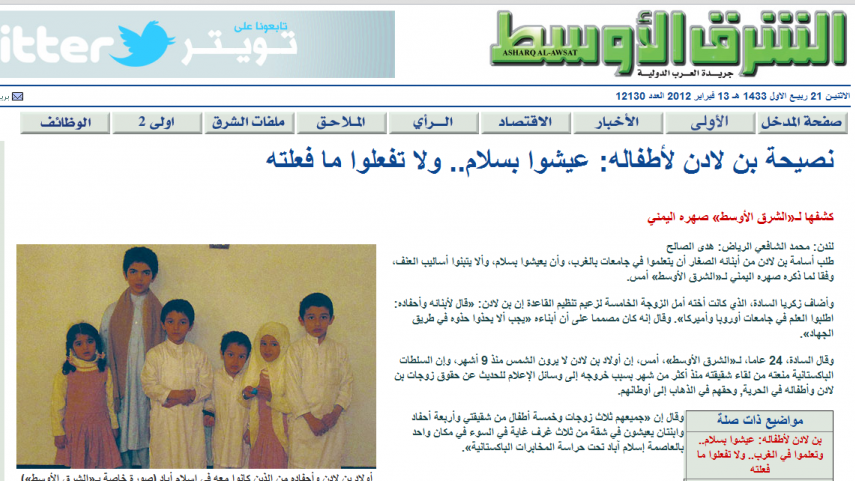
A-Sharq Al-Awsat features an exclusive interview with the brother-in-law of the world’s most famous terrorist, Osama bin Laden, on its front page Monday. According to Yemeni national Zakaria A-Sada, Bin Laden advised his children to study in Western universities, endorse peace and abhor the path of violence he himself adopted. Sada then bemoaned the harsh conditions under which his sister and bin Laden’s other three wives are being held in the Pakistani capital Islamabad.






The Times of Israel Community.