

Crying uncle Sam
After a chemical weapons attack in Syria, papers wonder when the US will finally intervene, but don’t hold your breath for the cavalry, most say
 Add ToI as a Preferred Source on Google
Joshua Davidovich is The Times of Israel's Deputy Editor
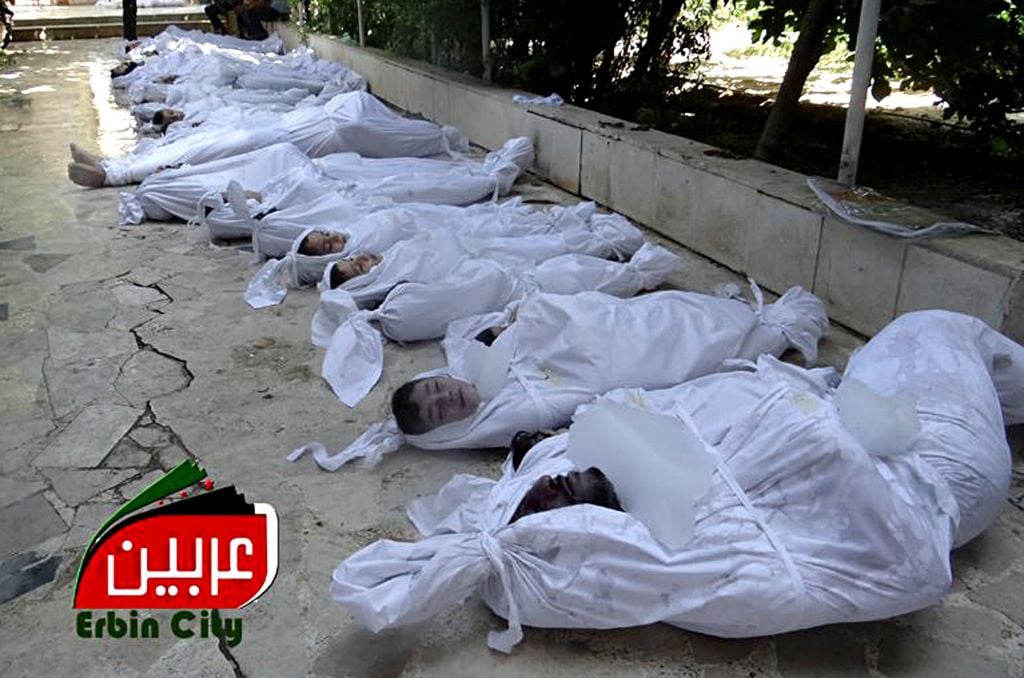
Righteous anger over the deaths of hundreds — maybe over a thousand — Syrians in a reported chemical weapon attack, and the lack of American response, is evident across the front pages of the Israeli press Thursday morning.
“The world is silent,” cries Yedioth Ahronoth next to a picture (the same used by three of the four main dailies) of an old man stooping in a sea of white body bags. “The red line has been crossed,” screams Israel Hayom, with a “Pay attention Obama” teaser, but Maariv’s headline clues readers in that there is a low chance the US will get involved.
“Shame on America,” Amir Rappaport starts off in Maariv, before deciding to pull his punches and explain why realpolitik makes it difficult for Washington to intervene. “The truth is the US has been warned off by Russia, which has detected American weakness and wants to reassert its place as a world power. The Russians are threatening that if the US and Europe put a no-fly zone over Syria, or get involved in some other extraordinary way, it will supply [Syrian President Bashar] Assad with advanced S-300 missiles. Unlike the US, Russia is proving that it sticks by its covenants until the end, even in a case when nearly all is lost, like with Assad.”
The paper also quotes rebel commander Abu Adnan saying that he doesn’t expect IDF tanks to roll into Syria but “we’re counting on [Israel] and the US, that they know exactly what creative ways to help us overcome Assad. We believe they know the weak points of the regime and look forward to quality Israeli shelling in the near future, just as it struck Assad’s weapons at Qassiyoun and Latakia. Every delay by Israel and the US only strengthens the radical Islamists.”
In Haaretz, Chemi Shalev writes that Washington has begun to shy away from involvement in Syria, even quieting down on the demand that Assad leave, fearful of getting bogged down in another quagmire. But Israel, which he says wants Assad out, is seizing on Wednesday’s attack to try and prod the White House into action.
“Israel views the rise of Islamic jihadists as a lesser evil, and was therefore quick to pounce on the gruesome videos coming out of Damascus in order to declare Assad guilty and possibly nudge Obama to finally act against him,” he writes. “Israelis find it hard to accept, however, that their newfound militancy against Assad, which is supported by several Republican lawmakers, is not shared by the majority of Americans. According to the latest polls on the subject, Americans decisively oppose military intervention in Syria or even supplying weapons to the rebels.”
That desire is played out on the front page of Israel Hayom, which doesn’t beat around the bush with the headline “Yes Obama, Assad can.”
The paper’s Dan Margalit looks into his crystal ball and predicts a whole lot of hemming and hawing: “The world will discuss, the UN will convene, the inspectors will say they are cut off in Damascus. There is a real fear that even a crime like this won’t change the interests of the sides. The Americans are for the fall of Assad but are unwilling to lift a finger. Maybe a finger, but not more.”
That’s likely what Assad saw as well, Yedioth’s Alex Fishman says, trying to get to the heart of why the Syrian tyrant would carry out such an attack with UN inspectors in Damascus and on the one-year anniversary of Obama’s red-line statement.
“The Syrian army shot chemical weapons at its people because it can, and because it gets backing from Russia and Iran. Though chemical weapons are not its first choice, it will use them when pushed into a corner. And that’s the takeaway the world needs to learn from the incident yesterday. There is no reward or punishment, and war policies don’t come out of humanitarian concerns, but the only thing that sets them are cold interests.”
Ready, aim, shoe
Speaking of tyrants (of sorts), the paper wrote about an interesting new exhibit/carnival game at the Ein Hod artists gallery, which lets visitors throw shoes at a picture of Finance Minister Yair Lapid. Hit a bullseye and win a highly taxable cup of arak or lemonade! Not everyone is so enthralled with the idea, though, Yedioth reports.
“There was a lot of excitement around it,” a father who brought his children to the museum tells the paper. “It made me very angry, and I tried to keep my kids from joining in, but they pleaded ‘Abba, all the kids are throwing.’ … To me this is incitement to violence.”
Haaretz writes about the appointment of the prime minister’s new national security adviser, outgoing deputy Mossad chief Yossi Cohen. Barak Ravid opines that Cohen is a great spy, but is an odd choice for the position.
“Cohen is an experienced intelligence officer and a gifted handler of agents, who was marked as a star early in his career. However, he spent most of his years at the clandestine organization in recruiting and managing agents. He is a brilliant spy and operations manager, but is not a strategist, a diplomat or an expert in foreign relations,” he writes.
“Cohen has very little experience in any of the issues that take up the daily schedule of a national security adviser, such as the peace process with the Palestinians and the settlements issue, relations with the European Union or the Western nations’ dialogue with Iran, as well as matters such as Israel’s nuclear policy or understandings with the US administration.”






The Times of Israel Community.