

Dig, dug, do something?
The Hamas tunnel threat pops back into the press, as does the question of how to deal with the Gazan underworld
 Add ToI as a Preferred Source on Google
Joshua Davidovich is The Times of Israel's Deputy Editor
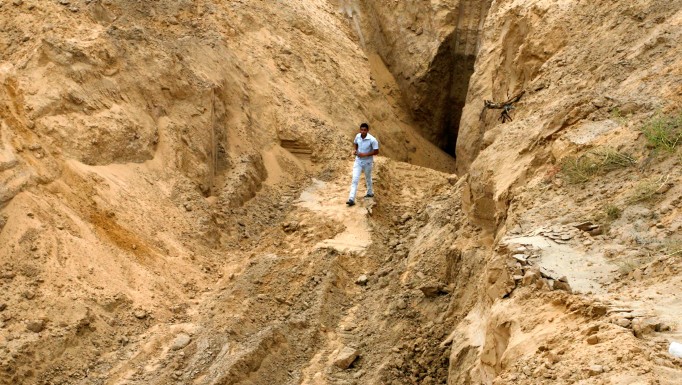
The resurgence of Hamas tunnels inside and out of Gaza should come as a surprise to exactly no one, but with Israel’s security being literally undermined by the terror group, the issue has popped back into the press in a big way.
Both the Yedioth Ahronoth and Israel Hayom tabloids give the subject front page treatment after Prime Minister Benjamin Netanyahu responded to the scuttlebutt about digging sounds and Hamas braggadocio that it’s rebuilding tunnels.
In Yedioth, the tunnels represent a dilemma, mirroring the one Netanyahu and his government faced ahead of the 2014 Gaza war. Correspondent Yossi Yehoshua takes readers back to those days and a vow from Brig. Gen. Sami Turgeman that the next time the tunnel threat rears its head, Israel will need to act of its own initiative and not wait until a war breaks out. That’s the case now, Yehoshua notes, but the politicians are still not taking his advice.
“The dilemma for the political leadership in a case like this will be whether to act immediately or to wait until the next confrontation,” he writes. “The answer is not unequivocal. Unlike in the north, where a preventative strike against Hezbollah would have dramatic consequences, in the southern theater, the reaction to preventative action against Hamas will be manageable, but the action itself will torpedo any chance of reaching an arrangement and bringing quiet to an area that hasn’t been seen in the last 20 years.”
The dilemma is also clear in Israel Hayom, even if the tabloid hides the wider discussion beneath headlines with the calming and sword-clanging quotes “We are checking every suspicion they are digging tunnels,” and “If we do strike them, it will be more severe than Protective Edge,” both paraphrases of Netanyahu from a speech Sunday night.
Yet the paper also quotes politicians critical of Netanyahu, like Labor’s Omer Bar-Lev, who asks why Netanyahu is dilly-dallying. In answer to that, the tabloid offers testimony from Defense Ministry representative Shlomo Gantzer, who told a state control committee meeting held near the Gaza border yesterday that residents who think they hear digging sounds under their homes may be mistaken.
“Every complaint of residents in the area on hearing digging sounds that was checked by the IDF has come up negative,” he’s quoted saying. “There have been discussions with Defense Minister Moshe Ya’alon on constructing a barrier, and discussions have taken place in the National Security Council and the Knesset Foreign Affairs and Defense Committee, and the general cost of the barrier has been approved, but here we enter into technical details.”
Haaretz, which buries (get it? Buries) the story on the bottom of page 4, tops its article with one of those technical details Ganzer got into, namely that the Defense Ministry has committed to a timetable for developing new technologies to help uncover tunnels being dug by Hamas into Israel.
What the paper does lead with is the more immediate threat in the West Bank, following the shooting of three soldiers by a Palestinian security officer. While the attack was seemingly a one-off, Amos Harel writes that some fear it may be a harbinger of a sea change in the four-month-old wave of violence.
“It’s still not certain that a new trend is emerging, although the assailant’s identity is likely to serve as fodder for Israeli public diplomacy in its attacks on the PA and its demands that PA President Mahmoud Abbas stop the terror. In practice, all the relevant Israeli defense agencies … constantly stress the need to preserve the excellent security coordination with the PA,” he writes. “But more widespread involvement in acts of terror by members of the PA security services and the armed Fatah wing Tanzim is a nightmare scenario that has worried the Israeli defense establishment for months. Together, the Tanzim and security services have tens of thousands of guns, and the PA’s so-called Dayton Brigades, trained by US officers, have at least basic combat training.”
Israel Hayom’s Daniel Seryouti notes, though, that even if Palestinian leaders want to continue the security coordination, the Palestinian street increasingly feels it needs to end.
“The statement two days ago by the head of the Palestinian intelligence services Majid Faraj that security coordination with Israel is good for the Palestinians and will continue even despite the peace process deadlock just added fuel to the angry fire growing in Palestinian society over their security men,” he writes. “It has grown to the point of labeling those who work with Israel as traitors and Faraj even received threats on his and his family’s life after his statements.”
Good walls make good neighbors?
There’s simply no pleasing everybody, but one can certainly try, as the government proved Sunday with the approval of a plan to expand the Western Wall plaza to create a space for mixed-gender non-Orthodox prayer. The compromise deal, which is tantamount to the old joke of a Jew stranded on an island building two synagogues (“the one I pray at, and the one I won’t go to”) is not lost on much of the press, which plays up the agreement-by-division aspect of the move.
“Two walls for two people,” reads the headline in Haaretz, and the paper’s Yair Ettinger notes that the deal has everyone feeling like they came away a winner.
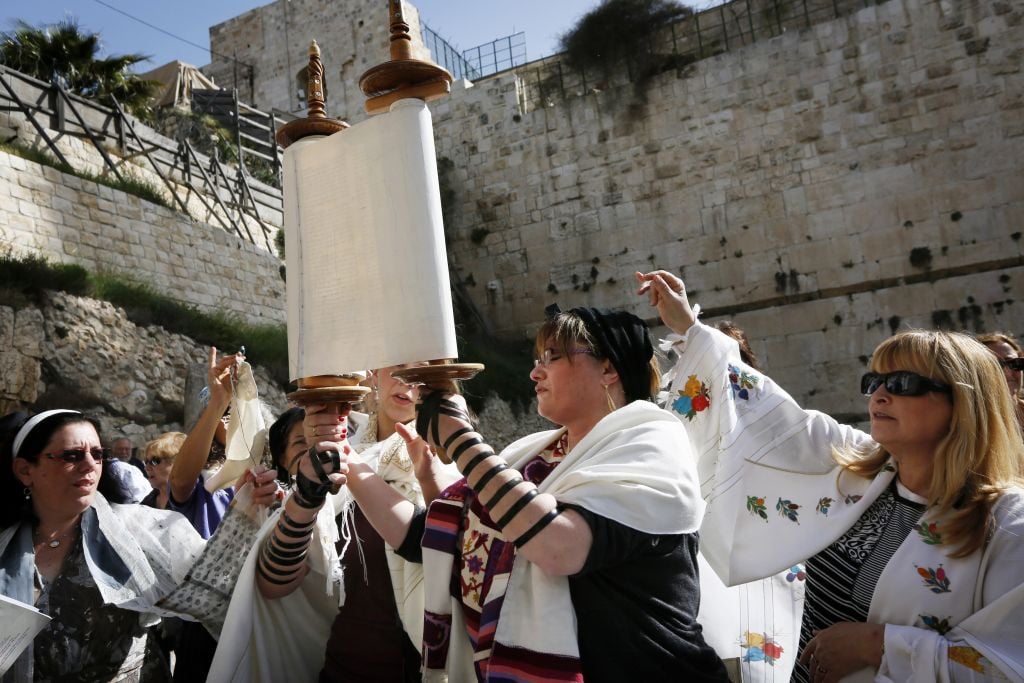
Not so in Yedioth, though, which highlights opposition to the agreement by Orthodox feminists who have been fighting to be able to pray separate but equal from men, Torah, tallit and all.
“This plan is bad because it comes at the expense of Orthodox women. This takes us backwards and erases progress made by religious women,” the paper quotes activist Hanna Kehat saying. “Orthodox feminists are not Reform, but want more participation in their prayer and community. I won’t give up on wearing a tallit, and I’m ready to go to jail for that.”
In Israel Hayom, Dan Margalit titles his column “The Kotel facing westward,” a nice little play on words given American Reform and Conservative Jews’ role in the decision, and argues that not every problem has a solution. While noting that claims Reform Judaism is just an easy hop away from intermarriage may be justified, he also rejects the idea that the status of Reform Jews was at the heart of the issue, as some made it out to be.
“The government wasn’t asked to recognize yesterday the standing of the Reform Movement in Judaism, even though it comprises most American Jews. It was asked to respond to a specific crisis going on for years of women asking for not only their Judaism to be recognized, but also their national-religious heritage as they understand it,” he writes. “Being rejected time after time caused great distress not only to them … but also to a wider public of secular Jews who feel a connection to the Torah, and there is no reason to alienate them.”










The Times of Israel Community.