

Netanyahu’s self-made battle against ‘Danonism’
The PM knew exactly what Danny Danon thought of Palestinian statehood, and that Danon is reliably outspoken on the matter. So why promote him, and many other emphatic opponents of Palestine?

 Add ToI as a Preferred Source on Google
David Horovitz is the founding editor of The Times of Israel. He is the author of "Still Life with Bombers" (2004) and "A Little Too Close to God" (2000), and co-author of "Shalom Friend: The Life and Legacy of Yitzhak Rabin" (1996). He previously edited The Jerusalem Post (2004-2011) and The Jerusalem Report (1998-2004).
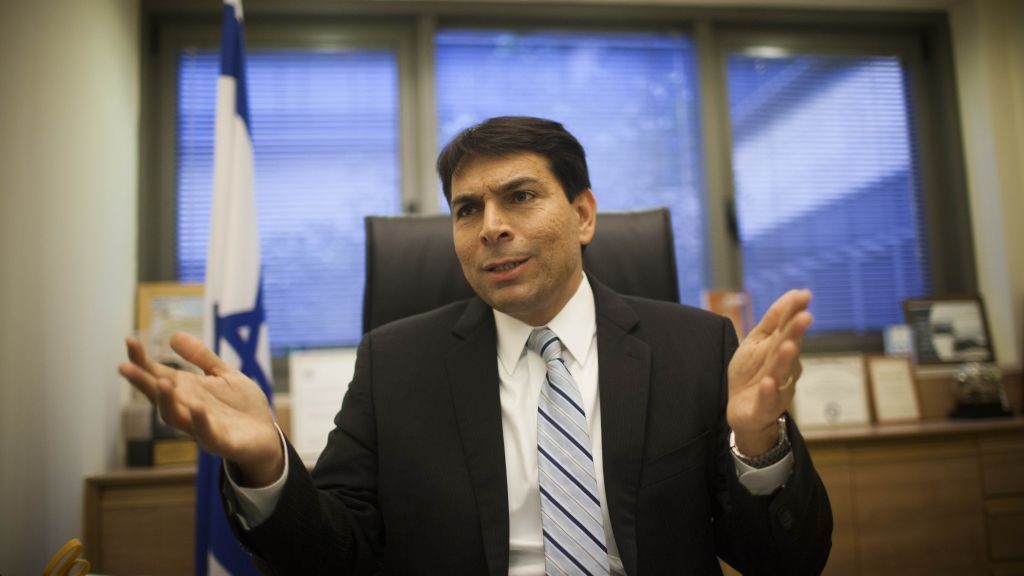
The Times of Israel’s interview with Deputy Defense Minister Danny Danon has been big news for the past few days. I’m not entirely sure why.
A Labor MK urged Prime Minister Benjamin Netanyahu to fire the offending minister. Danon’s direct boss, Defense Minister Moshe Ya’alon, never much of a fan, is reportedly shunning him. Justice Minister Tzipi Livni, nominal head of the nonexistent Israeli-Palestinian peace talks, is urging Netanyahu to reject “Danonism” — a new political designation, which might perhaps be defined as the unapologetic enunciation of well-known hawkish political beliefs and assessments to the ostensible dismay, inconvenience and embarrassment of the prime minister.
A source in the Prime Minister’s Office telephoned me on Shabbat afternoon — an extremely unusual development, and one that might have sparked trouble in a coalition with an ultra-Orthodox contingent — to distance Netanyahu from Danon’s remarks in the interview.
Really, I don’t get it. Danon said nothing that we didn’t all know beforehand.
He said that he personally opposed Palestinian statehood. He said that most members of the Likud Knesset faction oppose Palestinian statehood. He said most members of the coalition oppose Palestinian statehood. All undeniably true and familiar.
He also said that if the issue of creating a Palestinian state was brought to a vote in the Likud or in the coalition, this majority of opponents would block the move. Again, hard to argue with, and no great revelation.

I can well understand why all this was discomfiting for Netanyahu, who issues relentless public assurances that he seeks a two-state solution with the Palestinians. And I can see why the timing of Danon’s comments was a little awkward, given that US Secretary of State John Kerry is heading back this way soon to try again to get Israel and the Palestinians back to the negotiating table.
But if Netanyahu had wanted to avoid such embarrassments from the reliably hawkish and outspoken Danon, the simplest solution would have been not to appoint Danon to the high-profile position of deputy defense minister in the first place.
By the same token, Netanyahu need not have chosen to appoint another firmly on-record longtime opponent of Palestinian statehood, Likud colleague Ze’ev Elkin, as his deputy foreign minister, while also keeping the foreign minister’s post open for his Likud-Beytenu number 2, Avigdor Liberman, who relentlessly derides the notion of potential progress toward a viable accommodation with the Palestinians. (“This is our land, and it’s our right to apply sovereignty over it,” Elkin said at a conference last July. “Regardless of the world’s opposition, it’s time to do in Judea and Samaria what we did in [East] Jerusalem and the Golan. It’s time to end this system in which the Palestinians take and take and we give and give.”)
Similarly, Netanyahu need not have chosen as his coalition chief yet another Likud colleague, Yariv Levin, who makes his opposition to Palestinian statehood anything but a secret.
And he certainly need not have appointed as housing minister Uri Ariel, the Jewish Home Knesset member who penned a paper last year urging that Israel, far from partner the Palestinians to statehood, annex the entire West Bank.
Ideally, indeed, if Netanyahu wanted to project an urgent desire for a two-state solution, he could have left the Jewish Home party — all of whose 12 members oppose Palestinian statehood — out of his coalition altogether. But in this he was doomed by Yair Lapid’s Yesh Atid, which both conditioned its entry into the coalition on its alliance with Jewish Home, and prevented Netanyahu from bringing in the ultra-Orthodox parties.
So some of Netanyahu’s two-state difficulties were a function of coalition arithmetic. The new imperative to struggle against “Danonism,” however, is a battle entirely of his own making. Which can only leave one wondering quite how upset he really is by its eruption.







The Times of Israel Community.