

Some see racist undercurrent in British decision to leave EU
Use of anti-migrant imagery and rhetoric by ‘leave’ campaigners ‘comparable to Nazi propaganda and just straightforwardly racist,’ expert claims
 Add ToI as a Preferred Source on Google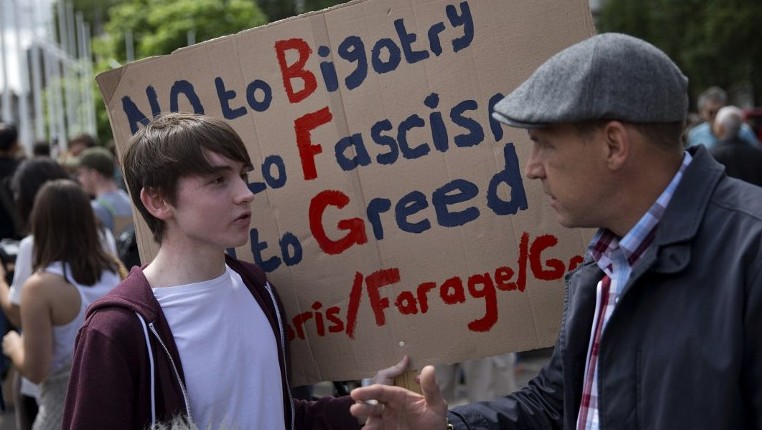
LONDON — Some leading British politicians and academics are interpreting Britain’s choice to abandon the European Union as a deliberate decision to sacrifice economic stability in exchange for the right to stop the flow of immigrants — a decision, they say, that was partly driven by racism.
In a bitter campaign marked by allegations of racial prejudice, global financial leaders repeatedly warned that a departure from the 28-member European bloc would produce long-term financial uncertainty. On Friday, the pound plunged to a historic 30-year low.
“Either people discounted that or they decided that the price of sovereignty and stopping the hordes of migrants was worth the economic hit,” said Brian Klaas, a fellow in comparative politics at the London School of Economics.
“This is a global moment of fear,” Klaas said, drawing comparisons to the rise of the presumptive Republican US presidential nominee, Donald Trump.
“Both the Trump voters and the disenchanted working class voters in northern England have decided they’re the victims of globalization and that the cause of their suffering is a bureaucracy far away,” he said. “This is a protest vote, even if it’s misguided.”
Last week, a leave campaigner unveiled a poster showing hundreds of non-white migrants making their way across Europe, alongside the words, “BREAKING POINT.” Critics labeled the poster as racist, but UK Independence Party leader Nigel Farage insisted he couldn’t “apologize for the truth.”
“There isn’t anything subtle about this sort of campaigning, it’s comparable to Nazi propaganda and just straightforwardly racist,” said David Gilborn, a race relations expert at the University of Birmingham. “The fact that people could have voted for this despite the crudest representations of racism is quite astonishing.”
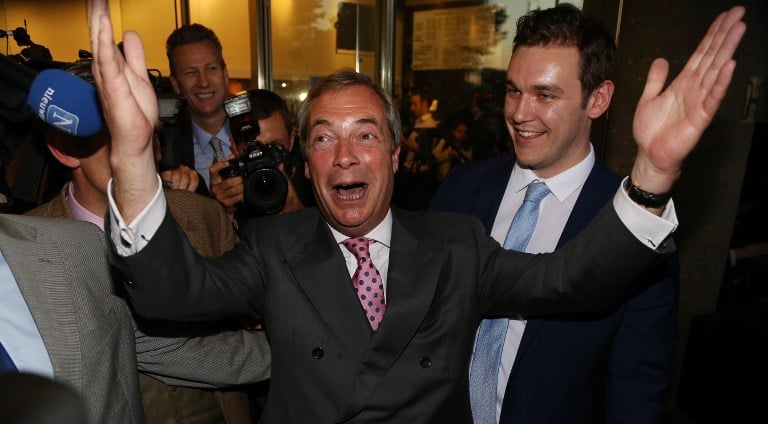
Farage brushed off charges that the poster was racist and maintained that the main immigration issue is that Britain has lost control of its borders to EU bureaucracy. He said he has always believed “we should open our hearts to genuine refugees” and said that most of the people coming to the UK — as evidenced by the poster — are young males. “The EU has made a fundamental error that risks the security of everybody,” Farage said, adding that the EU’s acceptance of Syrian refugees makes the continent more vulnerable to terrorist attacks.
He has repeatedly denied since UKIP’s formation that the party is racist, pointing to its black and ethnic minority candidates. It has emphasized the argument that British workers are hit hard by unlimited cheap labor.
Gilborn said that right-wing parties weren’t alone and that mainstream parties have slowly adopted anti-immigrant policies. Prime Minister David Cameron’s Conservatives have repeatedly cited their determination to stem immigration, he noted. “They’ve created an atmosphere of xenophobia and were not able to pull it back.”
Labour politician and former European Commissioner Peter Mandelson argued that Britons were ultimately less concerned about the European Union itself than migration issues.
“Their passions and emotion were stirred up utterly irresponsibly by the leave campaign over immigration,” he said.
Gilborn said he hoped the leave decision would force the UK to confront underlying racism in society. He said even the Archbishop of Canterbury had legitimized the popular fear of migrants, when he said in March that it was “outrageous” to describe people with such worries as racist.
“In fragile communities particularly — and I’ve worked in many areas with very fragile communities over my time as a clergyman — there is a genuine fear,” Welby said. “What happens about housing? What happens about jobs? What happens about access to health services? There is a genuine fear.”
Gilborn said: “the way in which much of the EU debate was shaped was based on the idea of ‘ordinary people’ being threatened by ‘the other,’ meaning people who don’t look like you.”
Copyright 2016 The Associated Press.








The Times of Israel Community.