A San Francisco teen hopes to release a documentary about his bar mitzva project — sending sports equipment to the country that sheltered his grandfather during the Holocaust
Ah, bar mitzvas, when a young man’s thoughts turn to adulthood, Jewish tradition… and the US trade embargo against Cuba.
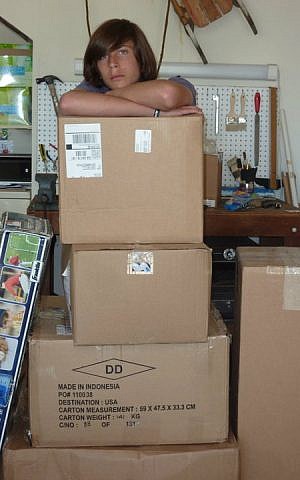
Mica Jarmel-Schneider, a San Francisco student and bar mitzva boy. (photo credit: courtesy)
Well, usually not that last one. But America’s relationship with the Caribbean nation indeed provides the backdrop for an upcoming documentary, currently in the works in the US. The film, whose makers are now seeking donations online, tells the true story of Mica Jarmel-Schneider, a San Francisco student who learns about the embargo, which earlier this year turned 50, via a community-service project inspired by his passage into Jewish adulthood.
A devoted sports fan, Jarmel-Schneider was motivated by his bar mitzva to send baseball equipment to Cuba, which had given refuge to his grandfather during the Holocaust. The project runs into trouble — or is “thrown a curve ball,” according to publicity materials — when he discovers that US policy forbids shipment of the gear to the communist country.
The unusual service project led in turn to the even more unusual documentary, which currently bears the unfortunate title “Got Balz?” In addition to a six-person squad of professional filmmakers, Jarmel-Schneider and his family have enlisted a publicity team (which notified us about the effort) and an accountant. They’ve just kicked off a $40,000 fundraising effort, which they hope will help pay for editing and distribution.
We can't do this work alone.
The war with Iran has been draining for all of us in Israel. But when I heard about a high casualty incident – ballistic missile impacts in Arad and Dimona that left nearly 200 people wounded – I drank a cup of coffee, packed a bag, and headed south.
There, I spoke with Shilgit, the head of an after-school program for underprivileged youth. Standing outside her destroyed center, Shilgit said it was a miracle that no children were hurt and spoke about the community coming together in the hours since.
As a Times of Israel reporter, I’m committed to telling stories of resilience like Shilgit’s. But my colleagues and I can't do this alone. If you value work like this,please consider joining our reader support group, The Times of Israel Community. Your financial support is essential to keep real human reporting like this going.
We’re really pleased that you’ve read X Times of Israel articles in the past month.
That’s why we started the Times of Israel - to provide discerning readers like you with must-read coverage of Israel and the Jewish world.
So now we have a request. Unlike other news outlets, we haven’t put up a paywall. But as the journalism we do is costly, we invite readers for whom The Times of Israel has become important to help support our work by joining The Times of Israel Community.
For as little as $6 a month you can help support our quality journalism while enjoying The Times of Israel AD-FREE, as well as accessing exclusive content available only to Times of Israel Community members.
Thank you, David Horovitz, Founding Editor of The Times of Israel