

Whisky with the ayatollah
The US may see cause for hope in Iran’s new president, but Israeli commentators believe the new boss is same as the old boss, and Khamenei is pleased as punch
 Add ToI as a Preferred Source on Google
Joshua Davidovich is The Times of Israel's Deputy Editor
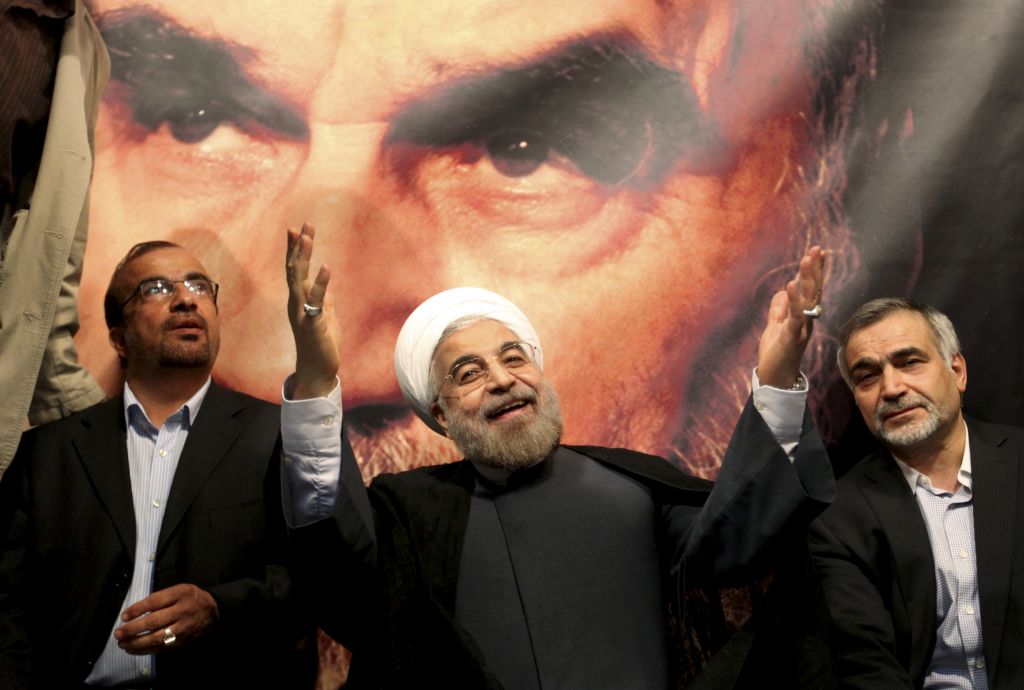
It’s happened a million times throughout the eons. You make one little comment to CBS about an openness toward détente with Iran and boom, it’s on the front page of every Hebrew paper in Israel.
Of course, you are the White House chief of staff, and each and every one of your words are seen as a window into Obama administration policy.
Loose cannon Denis McDonough made the outrageous statement Sunday that the election of Hasan Rowhani as president of Iran is a “potentially hopeful sign,” setting the Hebrew press aflame. Of course he also said for any détente to take place they would have to “come clean” on the nuclear program, but why let a pesky thing like nuance get in the way of a good headline?
Yedioth Ahronoth’s, for instance, is a doozy: “US: Give Rowhani a chance.” Luckily, the paper, which features a full page spread of stills from a video showing a woman dancing in Tehran (filler, much?), also has some analysts who add many words to the debate, some of which are even relevant. Security correspondent Alex Fishman prefaces his column with the claim that nobody knows what will happen with Iran’s nuclear program and Israel’s defense establishment isn’t even hazarding a guess. Instead of writing “So I certainly won’t either. Thank you for your time,” he blathers on for several more paragraphs of reports, questions and lots of guesswork.
Maariv is more focused on trying to augur the future based on Rowhani’s past statements, noting a 2004 speech in which the relative moderate, then head of the nuclear negotiating team, praised his country for running the world around in circles with pointless talks while scientists scrambled to get the nuclear program up and running behind closed doors. The paper’s David Shein follows Benjamin Netanyahu’s line, that there’s no cause for hope with Rowhani’s victory given the fact that the ayatollahs control everything anyway: “Nobody in Iran expects Rowhani to run up against Khamenei. In Iran, they understand that despite Rowhani’s smiling face, he is still an inseparable part of the ayatollahs’ regime. Nobody in Iran deludes themselves into thinking strategic or critical decisions will be made by Rowhani. It’s clear to all that Khamenei will continue to hold the reins. He will manage the foreign policies in the Middle East and the West, will make decisions about the nuclear program and will stand at the head of the armed forces.”
Haaretz puts the central bone of contention right on the table with this punctuation mark-laden headline: “US: Rowhani’s election gives us hope; Netanyahu: The West cannot delude itself.” The paper’s US correspondent Chemi Shalev notes that the election of Rowhani gives US President Barack Obama a chance to return to one of themes of his 2009 Cairo speech, namely engaging Tehran. “At that time, Obama was interested in reaching understandings with Iran in order to facilitate the withdrawal from US troops from Iraq. Now he may be seeking ways in which Tehran could help him avoid similar complications in Syria.… Thus, whether by Machiavellian design or the dictates of an unforeseen reality, Khamenei’s decision to allow Rowhani’s election to stand has already yielded significant dividends for Tehran. It has gained the Iranians a reprieve, at least for the time being, from the inexorable slide to ever harsher sanctions and possible US military action. And it has deprived Israel and its supporters of their most potent weapon against Iran’s nuclear plans: Mahmoud Ahmadinejad.”
Yet Ahmadinejad’s ghost still lingers in the halls of Israel Hayom, which defenestrates subtlety and blasts “’Moderate,’ but what about the bomb?” across its front page. Its man on the street feature finds that most Israelis are similarly pessimistic about Rowhani being cause for hope. “As I see it, the new president will also be bad for Israel,” says Israel Greenblatt. “I have no faith in him. They are all the same.”
The paper’s Boaz Bismuth writes that Rowhani’s nice smile has replaced Ahamdinejad’s evil countenance, but little will change beyond that, and the regime is actually pleased with the results, to the point that they will defy the tenets of Islam in celebration. “Were we in Iran, we could imagine a surreal picture of Khamenei and Rowhani in their inner chambers raising a glass a nice whisky from the days Rowhani learned law in Glasgow. One day a change will come to Iran. Salvation will come. It will come from the street, not through elections.”
Means and meanies
Speaking of ayatollahs, Shas spiritual leader Rabbi Ovadiah Yosef’s attack of Rabbi David Stav also gets wide press coverage. You say one little thing about how the moderate chief rabbi candidate is evil and destroying Torah and suddenly the whole world is against you. But while words will supposedly never hurt you, Yedioth reports that some thugs decided to add sticks and stones to Yosef’s diatribe, attacking Stav outside a Bnei Brak wedding by pushing him and yelling at him.
Things got bad even inside the hall, the paper says: “When Stav got up to dance, MK Ariel Atias from Shas left the circle in protest. ‘They tried to trip him and threw curses at him,’ a guest at the wedding said. ‘When he left the hall, dozens of people surrounded him and some them shouted shaygetz and evildoer. There were others who were embarrassed and apologized to him, but he quickly left the place.’”
In Maariv, Roee Lachmanovitch claims that Yosef’s sermon was actually directed not at Stav but at the national religious movement as a whole, which the Sephardi Haredi community fears as a spiritual competitor, and yet which it was willing to deal with in horse trading over who will be next chief rabbi. “Rabbi Stav was not the target of the speech, he was just a means. A means to send a message from the Sephardi Haredi community to the Ashkenazi Haredim: Don’t fear, we have nothing to do with the national religious; the Haredi covenant between Ashkenazim and Sepharadim is stronger than any attempt at discussions with the national religious.”
Haaretz reports on a law proposal that would make all Israelis automatic organ donors, forcing them to opt out of the program instead of opting in. According to Health Minister Yael German, quoted in the story, this will solve the apparently widespread problem of Israelis wanting to sign up, but not being able to take the approximately 30 seconds it takes to do so: “There are many Israelis who want to donate, but can’t find the time to fill out the form,” she says.
Meanwhile, the ministry says opting out will require either a phone call, which is always a pleasant experience when dealing with Israeli bureaucracy, or a trip to the post office, which, if you’ve never been, is really more like a vacation to Disneyland.






The Times of Israel Community.