

A scandal too far?
As yet another case of alleged misconduct involving the prime minister comes to light, even Netanyahu’s allies in the media seem less keen to defend him
- See more Times of Israel on Google - add us as a Preferred Source
Adiv Sterman is a breaking news editor at The Times of Israel.
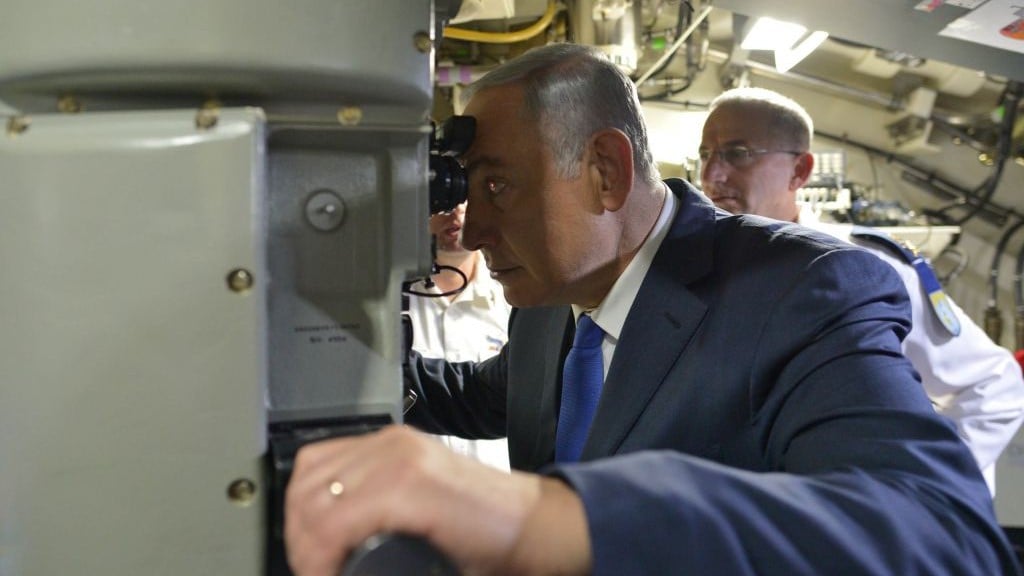
Between the publication of a report by the state watchdog that found Prime Minister Benjamin Netanyahu acted improperly regarding involvement in the Bezeq telecom giant when he was holding the portfolio of communications minister, and recent developments having to do with alleged illegalities in the purchase by Israel of German submarines, the premier has a lot to worry about.
The reporting on these issues in Yedioth Aharonoth and Haaretz appears damning, which is to be expected from publications which are not typically aligned with the prime minister’s political leanings. However, the real surprise comes from Israel Hayom, which for years has all but explicitly celebrated its strong ties with Netanyahu but now seems to concede as well that a metaphorical noose is tightening around Netanyahu’s neck.
“State comptroller: The prime minister did not disclose his friendship with [Bezeq head Shaul] Elovitz,” reads Israel Hayom’s headline. The paper explains that State Comptroller Yosef Shapira wrote in a report that there was a lack of transparency over decisions made by Netanyahu regarding Bezeq before he was barred from involvement with Bezeq and handed over decision-making in that area to the director general of the Communications Ministry, Shlomo Filber. While Netanyahu’s dismissal of the allegations against him as a “futile” attempt to manufacture a scandal is featured by the paper, the daily makes no special effort to conceal the apparent gravity of the prime minister’s situation. Still, not one op-ed on the matter can be found within the paper’s main pages, signaling perhaps that Israel Hayom’s columnists are still maneuvering with caution when it comes to Netanyahu.
“Getting tangled up,” reads Yedioth’s main headline, plastered beneath a photo of Netanyahu at center, accompanied by images of Filber and the prime minister’s lawyer David Shimron on his right and left, respectively. Shimron, along with former commander of the Israeli Navy Maj. Gen. (res) Eliezer Marom, has been brought in for questioning as a suspect in the submarine affair; both are now under house arrest.
“Of power and greed” is the title Nahum Barnea, one of the daily’s leading columnists, chooses for his piece on the scandals. “The comptroller did not officially call for a criminal investigation, but his harsh descriptions don’t leave much choice for the attorney general,” Barnea predicts. “Each case on its own, and all of them together, cumulatively, reek heavily of corruption,” he continues. “Power corrupts, said Lord Acton. Also time corrupts. Much power over a long period of time corrupts seven-fold,” Barnea adds, referring to Netanyahu’s lengthy term as prime minister.
While Haaretz’s pages are filled with detailed reports on the aforementioned cases and investigations, the paper’s editorial focuses on the Hungarian government decision to end a billboard campaign against Jewish billionaire and philanthropist George Soros — a campaign deemed anti-Semitic — ahead of Netanyahu’s scheduled to visit the country next week. While Israel’s ambassador to Hungary slammed the campaign over the weekend for “sowing hatred,” on Sunday the Foreign Ministry in Jerusalem clarified that while it condemns bigotry against Jews, it was not defending Soros, who it described as defaming Israel and undermining its right to defend itself.
Haaretz’s editorial criticizes the government — as well as, of course, Netanyahu — for the handling of the situation. “Nationalism was and still is inherently connected to anti-Semitisim, and as part of that to the hatred of the Jew, who is seen as undermining the nation in the country where he lives,” Haaretz’s editor writes. “The conduct of Netanyahu’s government [in relation to the campaign against Soros] teaches us that even Israel, the Jewish state, is not immune to this type of hatred… Those who promote universal agendas and fight for human rights, even those of minorities and foreigners, are condemned in Israel as enemies. Their Jewishness does not stand to their credit in the test of loyalty.”
Among all the political scandals at home and abroad, significant but less prominent news is often relegated to the back pages of the leading newspapers. Such is the case with Israel Hayom’s report on the deteriorating state of the Dead Sea, one of Israel’s most and beautiful natural wonders. According to the daily, the Knesset Lobby for Regional Cooperation and the Lobby for Saving the Dead Sea recently convened for an urgent meeting in order to discuss possible ways in which to slow down the body of water’s rapid drying-up process.
The paper adds that the Dead Sea is lowered by about 750 million cubic meters each year, with almost a fifth of the loss being attributed to the activities of the chemical plants operating in the area. The disappearance of the Dead Sea is a concern not only in terms of tourism and the general aesthetic in the area, but also in terms of the dangers the process creates in the form of deadly sinkholes on surfaces which were previously underwater.









The Times of Israel Community.