

Soviet Jewry activists commemorate ‘a singular day in Jewish history’
Twenty-five years after chants of ‘Let my people go!’ rang out in Washington DC, organizers of the fight to free the USSR’s Jews recall a landmark triumph
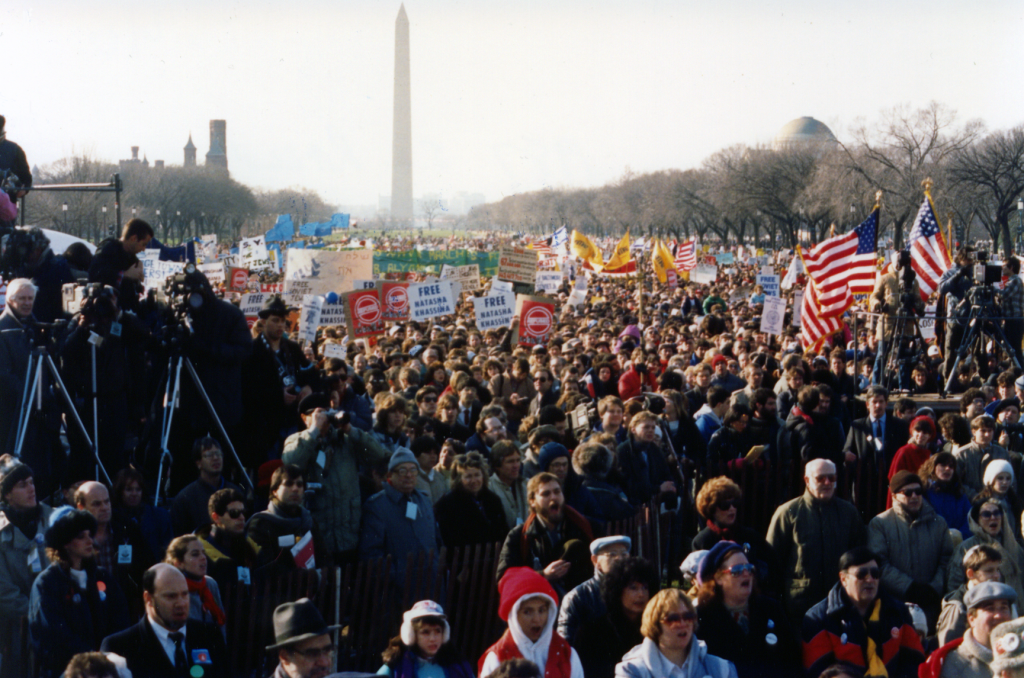
WASHINGTON DC — If you’re an American Jew under 30, you might want to sit down. The following piece of information may shock you: There was a day, not too long ago, when Jews calling themselves Orthodox, Conservative, Reform, Reconstructionist, secular, left-wing, right-wing and everything in between came together in solidarity on a single issue.
The issue was freedom for Soviet Jews, and the day was Dec. 6, 1987, exactly 25 years ago.
“That cold late-autumn day in Washington DC was a singular day in Jewish history,” says Steve Rakitt, 57, who came to the rally on one of three buses chartered by the Rhode Island Jewish Federation.
‘We changed history and freed a people from oppression’
“When we got on the bus, we didn’t know what to expect,” says Rakitt, now the VP and CEO of the Jewish Federation of Greater Washington. “But as we got closer to Washington, we started seeing dozens of other buses and a huge amount of traffic. Then, when we arrived at the Capitol, we saw an enormous sea of people – something we’d never seen before, and that I haven’t seen since.”
Rakitt was one of 250,000 participants from all 50 states who turned out in the American capital on the eve of Soviet leader Mikhail Gorbachev’s first visit to Washington for talks with President Ronald Reagan. The day became known as Freedom Sunday, as the rallygoers demanded that Soviet Jews be permitted to emigrate to Israel and the West. For decades, “refuseniks” were Jews behind the Iron Curtain who had been denied permission to leave for the US, Israel or elsewhere.
The Freedom Sunday protestors carried thousands of signs, erupted into spontaneous chants and songs and included iconic refuseniks such as Natan Sharansky and Ida Nudel. American political and cultural leaders turned out in support, too, such as then Vice President George H.W. Bush, Nobel laureate Elie Wiesel and the legendary singers and songwriters Peter, Paul and Mary.
Rakitt calls Freedom Sunday the “single-largest event in American history when people marched for the rights of people living outside the US.”
The enthusiasm and intensity of the march paid immediate dividends. President Reagan used the rally to urge his Soviet counterpart to ease travel restrictions for Soviet Jews. Not long after, the floodgates opened, and 1 million Soviet Jews immigrated to Israel, with another 500,000 moving to America. Four years later, of course, the Soviet Union itself would cease to exist.
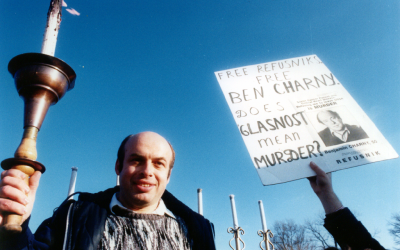
Some of those who braved the December weather in Washington believe that today’s Jewish community is losing touch with one of its greatest triumphs.
“This success story has not been integrated into our contemporary Jewish narrative or our understanding of American history,” Daniel Eisenstadt and Michael Granoff, two prominent American Jewish leaders, wrote in September. “Few under the age of 30 know it ever happened.”
So the two men got together and formed Freedom 25, which describes itself as “a coalition of more than a dozen nonprofits and Jewish organizations committed to helping refocus Americans generally and North American Jewry specifically on this history and its lessons.”
Twenty-five years later to the day, Freedom 25 is hosting a “virtual march” with online events, petitions and other activities. The goal is to attract 1 million online signatures and raise awareness of “this defining moment in Jewish and human rights history.”
Eisenstadt and Granoff are especially keen to make today’s Jews aware of the remarkable achievements of Jews from the former Soviet Union.
‘Google . . . might not have been created without the Soviet Jewry movement’
“Former Soviet Jews have changed the way we work and live through various high-tech innovations,” they said. “Google, co-founded by Sergei Brin, who immigrated to the United States, might not have been created without the Soviet Jewry movement.”
In Israel, immigrants from the former Soviet Union have earned five Nobel Prizes and made groundbreaking advances in fields such as engineering, physics and medicine.
For Rakitt, the way to honor the legacy of the Soviet Jewry movement is to make sure its lessons are not lost on the next generation.
“My children,” he says, “know what I’ve told them about the movement and that day in December – that we actually changed history and freed a people from oppression.”



The Times of Israel Community.