

Bombshells instead of cartoon bombs: 9 things to know for September 28
Netanyahu is praised for a UN speech that is not just gimmicks, but some refuse to heed him; Abbas is seen as weak as Gaza girds for war, and Israelis are glued to Ford-Kavanaugh
 Add ToI as a Preferred Source on Google
Joshua Davidovich is The Times of Israel's Deputy Editor
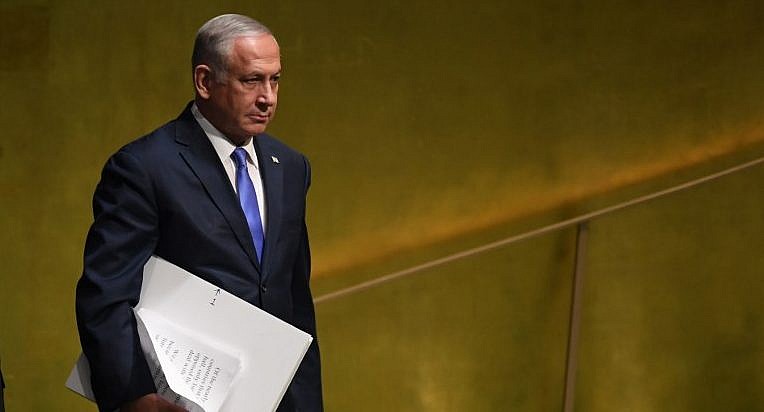
1. New Iran info turns heads: By now, Prime Minister Netanyahu’s shtick and props at his annual United Nations speech is considered de rigueur, from pictures of cartoon bombs to plans of Auschwitz gas chambers. This time, though, his reveal of an alleged secret nuclear facility in Tehran was enough to convert even some of the most cynical corners of the Israeli press and the punditerosa.
- Haaretz’s Yossi Verter, not normally one to shower praise on the prime minister, calls Netanyahu’s speech “one of his most professional, persuasive and effective appearances.”
- “Well equipped with Israeli intelligence achievements, he formulated a precise and credible indictment against Iran and its proxies in the Middle East,” he writes (though the print edition, unlike other papers, headlines with his revelation of alleged Hezbollah missile sites, which it plays below coverage of both Gaza and the Ford-Kavanaugh showdown.
- “This time it’s no gimmick. Info. Netanyahu is making headlines. A picture. Actually revealing something. This is new. Amazing job by him,” Hadashot news’s Udi Segal wrote on Twitter during the speech.
- Another veteran political correspondent, Channel 10’s Barak Ravid, writes that after watching nine Netanyahu speeches on the ground from the UN that “this year it was not a nothing speech. Netanyahu is providing a lot of new and interesting information and not just hasbara talking points.”
2. Feters gonna fete: Less surprising is the feting from Israel Hayom, which is seen as closely linked to Netanyahu.
- Reporter Moti Tuchfeld gushes that aides weren’t lying when they hinted in recent days that the speech would be “especially influential.”
- “Netanyahu dropped an atomic bomb it will be hard to ignore,” writes columnist Amnon Lord in the paper.
- Former ambassador to the UN Ron Prosor writes in the same tabloid that Netanyahu’s moves “didn’t only expose Iran’s nakedness, but also the European leadership and the IAEA.”
- Somewhat interestingly, Iranian opposition group NCRI, a favorite of the Trump administration, has totally ignored Netanyahu’s speech, despite the group itself being behind previous revelations of secret nuclear sites.
3. Not everyone was impressed: Yedioth Ahronoth’s Shimon Shaffir writes that the speech and US and Israel’s increasingly hard-line and isolated positions on Iran could lead to war.
- “If Israel, backed by the US, continues to push confrontational policies against Iran with no attempt to get to some sort of arrangement with them, we could pay a terrible price in human lives,” he writes.
- On Twitter, former prime minister Ehud Barak mocks Netanyahu over the fact that the only people watching the speech were Israelis, with America’s eyes glued to the Kavanaugh hearing: “An elegant, smug and arrogant speech … A liberal use of intelligence materials and sources. Not for operations, for talking. We’ll pay and continue to pay for it. But we found our next representative to the UN,” he quips.
4. Brushing away the claims: Also on Twitter, Iranian Foreign Minister Mohammad Javad Zarif calls Netanyahu’s speech “an arts and craft show.”
No arts & craft show will ever obfuscate that Israel is only regime in our region with a *secret* and *undeclared* nuclear weapons program – including an *actual atomic arsenal*. Time for Israel to fess up and open its illegal nuclear weapons program to international inspectors.
— Javad Zarif (@JZarif) September 27, 2018
- As my colleague Judah Ari Gross notes, though, Zarif’s whataboutist tweet doesn’t quite contain a denial of Netanyahu’s charges.
- The Associated Press notes that Iran’s Press TV ran the speech live, until the stuff about his revelations came out, at which point they cut away.
- Reporting on the speech and seemingly looking to dismiss his claims, Iran’s Tasnim news agency, seen as linked to the IRGC, writes that Netanyahu “held up a satellite image which he said showed where the warehouse was located in Tehran, and a photograph of a nondescript wall and metal gate, which he said showed the exterior of the warehouse.”
5. Iran just a distraction: ToI’s Raphael Ahren writes that while the speech may shift some attention to Iran briefly “the Palestinian question will not go away.”
- Indeed, many of those covering Netanyahu’s trip to the UN note that the real lasting upshot isn’t going to be about nuclear rugs but the Palestinian issue and a deepening rift with Europe.
- Haaretz’s lead editorial calls the speech “a work of art with regard to evading the principal issue that has been threatening Israel’s existence for 51 years now, namely, the Israeli-Palestinian conflict.”
- Yedioth columnist Alon Pinkas, a former top diplomat and frequent critic of Netanyahu, says the real news was Trump’s two-state half-declaration, though he doesn’t put much stock behind it being backed by policy. Instead he bemoans Israel tying its fortunes to a president who was openly laughed at in the UN.
- “It’s bad for the US. And from there it’s bad for Israel, whose diplomatic prowess flows directly from the diplomatic prowess and global influence of America.”
6. Gaza gears up for war: Palestinian Authority President Mahmoud Abbas also spoke at the UN, though his speech gets short shrift in the Hebrew press.
- Little noticed was a section where he seemed to threaten to cut off money to Gaza, though analysts believe doing so made lead to a new war there.
- ToI’s Avi Issacharoff writes: “Clearly getting the message, some Gazans, shortly after Abbas’s address ended, gathered to protest his remarks in the city of Rafah in an event backed by Hamas, with masked men holding signs reading, “Abbas doesn’t represent me.”
- Haaretz’s reports that the IDF believes the chances of war in Gaza have increased dramatically in the last few weeks, and is now only a matter of time. According to the report, the army has noticed Hamas increasing military activities as if it is gearing up for a fight, noting the near constant low-level riots along the border, led by the terror group.
7. Be careful out there: Fellow terror group Palestinian Islamic Jihad is set to appoint a new leader for the first time in 23 years, Gal Berger from the Kan Broadcaster reports.
- Roi Kais, from the same outlet, notes on Twitter that the first leader was assassinated, the second is in a coma, and so “I expect a cautious future for the third.”
8. Lame swan song: What coverage there is in the press of Abbas’s speech notes that rather than deliver a fiery bromide to ignite Palestinian resistance, Abbas sounded lamer than a lame duck.
- Abbas’s speech “constituted a forlorn address by an 83-year-leader who insisted he has only ever sought peace, defied his audience to tell him if the Palestinians had ever “committed a single mistake in our long journey” — and played self-servingly fast and loose with the facts of recent history,” writes ToI editor David Horovitz. Haaretz’s Jack Khoury calls it “a clear expression of helplessness and a lack of strategy.”
9. No skin in the game, but glued to Ford-Kavanaugh: Shortly before Netanyahu’s speech, Haaretz reporter and funnyman Chaim Levinson joked online that “My heart is with Netanyahu, whose speech at the UN won’t even be mentioned on Sean Hannity.”
- Indeed, the whole world, Israel included, seemed tuned in to the extraordinary and heartbreaking Senate hearing, in which Dr. Christine Blasey Ford recounted an alleged sexual assault by Supreme Court nominee Brett Kavanaugh, who then defended himself to the Senate panel and was forced to regale them with the inside jokes of a 17-year-old.
- Unsurprisingly, the dramatic session gets front page coverage in the mainstream Israeli press, despite the fact that the matter really has nothing to do with Israel.
- Yedioth’s Orly Azulay, who leaves her own politics out of her coverage, still comes off as somewhat sexist writing that “in her blue suit, which recalled a school uniform, [Ford] looked at times like the frightened high school student who in the past, according to her claims, suffered a severe sexual assault.”
- In pro-Trump Israel Hayom, columnist Avraham Ben Tzvi takes the pro-Trump line that Ford’s evidence is “weak,” and the politicians now need to go ahead and confirm or deny the nominee.
- “Just like [Anita] Hill 27 years ago, Ford did not manage to show the panel a smoking gun,” he writes, comparing the hearing to accusations against Clarence Thomas that nearly torpedoed his nomination.
- Despite the average Israeli probably not knowing who Anita Hill is, the analogies to the case show up in just about every piece on the hearing.
- Haaretz’s Daphne Maor says things have changed since 1991 and Ford’s testimony made history, both for her being able to recount horrific details in such a setting and for the #MeToo movement: “A growing number of billionaires, politicians, businesspeople, big investors, CEOs and known figures in the entertainment world are discovering that they can no longer act with impunity.”




The Times of Israel Community.