

Abbas’s forlorn, inflexible ‘we made no mistakes’ speech sounds like a swan song
PA leader tells UN General Assembly the Palestinians have always been ready to negotiate — neglecting to mention, of course, the opportunity he carefully chose to pass up in 2008

 Add ToI as a Preferred Source on Google
David Horovitz is the founding editor of The Times of Israel. He is the author of "Still Life with Bombers" (2004) and "A Little Too Close to God" (2000), and co-author of "Shalom Friend: The Life and Legacy of Yitzhak Rabin" (1996). He previously edited The Jerusalem Post (2004-2011) and The Jerusalem Report (1998-2004).
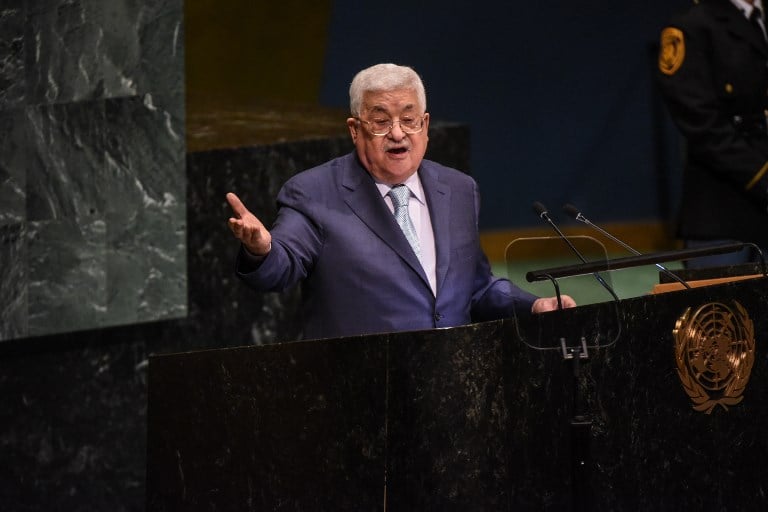
The Palestinian Authority President Mahmoud Abbas on Thursday told the United Nations General Assembly that Israelis were defiling the Palestinians’ holy sites on a daily basis.
He charged that Israel’s nation-state law strips non-Jewish Israelis of their rights to citizenship, and said the law would “inevitably lead to the creation of one racist state, an apartheid state,” negating any chance of a two-state solution.
He inflated even the figures compiled by the US-defunded UNRWA Palestinian refugee agency and claimed that there are now six million Palestinian refugees, out of 13 million Palestinian people worldwide, and asserted that they are all being treated as a “redundant” people who should be gotten rid off.
And yet Abbas’s speech to the UNGA was the most mild he has delivered to this forum in years. It was still more restrained, by his standards, when compared to the vitriol he has poured into more recent addresses in Ramallah: In January, notably, he asserted that Israel was a colonial project totally unrelated to Judaism, and intimated that European Jews at the time of World War II were so unconnected to the Holy Land that they preferred to take their chances with the Nazis.
Abbas’s speech Thursday, rather, constituted a forlorn address by an 83-year-leader who insisted he has only ever sought peace, defied his audience to tell him if the Palestinians had ever “committed a single mistake in our long journey” — and played self-servingly fast and loose with the facts of recent history.
Strikingly, for instance, he asserted that the Palestinians had never refused an offer to negotiate — apparently confident, and likely with good reason, that few of his listeners would recall how he stayed away from the negotiating table for the first nine of the ten months during which a very reluctant Prime Minister Benjamin Netanyahu agreed to freeze settlement building in 2009-10 under pressure from the Obama Administration.
And needless to say, there was no mention of his greatest missed opportunity, when he chose not to say yes to a 2008 offer by prime minister Ehud Olmert that proposed a framework for resolving the refugee issue and provided the Palestinians with what amounted to 100 percent of the West Bank for their state — with one-for-one land swaps enabling Israel to extend sovereignty to three major settlement blocs, and the Palestinians compensated with territory inside Israel’s current sovereign borders. Olmert was also willing to relinquish Israeli sovereignty in the Old City — to an international trusteeship.
Olmert is long gone from power now, of course, though he may be reluctant to acknowledge it, and Abbas, who is in far from good heath, will sooner or later leave the world stage as well. Israel has been led for almost a decade now by Netanyahu, who will never offer the terms that Abbas spurned from Olmert — and who, it should be stressed, will certainly not be pressured by the Israeli mainstream to do so.
While President Donald Trump asserted with his characteristic confidence on Wednesday that the Palestinians would “absolutely” come back to the negotiating table, and that he aimed to wrap up a peace deal in this first term of his presidency, such optimism is shared virtually nowhere else.
When he dealt with specifics on Thursday, Abbas made plain that his negotiating stance has not changed. He still wants all the Jerusalem areas captured by Israel in the 1967 war. If he’s ready for a compromise on all those millions of refugees, he wasn’t saying so. Repeatedly professing a desire for peace, having reportedly selected the least inflammatory of the various draft speeches prepared for him, Abbas nonetheless gave no reason to believe that he would say yes today to an Olmert-style offer — to an offer no Israeli government is remotely likely to present in the foreseeable future.
Some in his entourage had promised that Abbas would deliver a fiery address — full of bitter threats and furious promises. Instead, he left a door open to an American role in negotiations — having ruled out any such role in previous months. He asserted time and again a commitment to non-violence and to fighting terrorism. But the rhetoric was tired. Abbas, most deliberately, missed his moment years ago. He still won’t agree to terms Israel can live with it. His speech sounded like a swan song. And the near certainty that whoever succeeds him will be still more implacable only underlines the tragedy.









The Times of Israel Community.