

50 years on, Jewish bestseller ‘World of Our Fathers’ finds a new audience
Irving Howe’s classic account of early 20th-century Jewish immigrants in the US is a nostalgic touchstone, including for anti-Israel progressives at odds with his pro-labor Zionist views
 Add ToI as a Preferred Source on Google
Andrew Silow-Carroll is the editor-in-chief of JTA
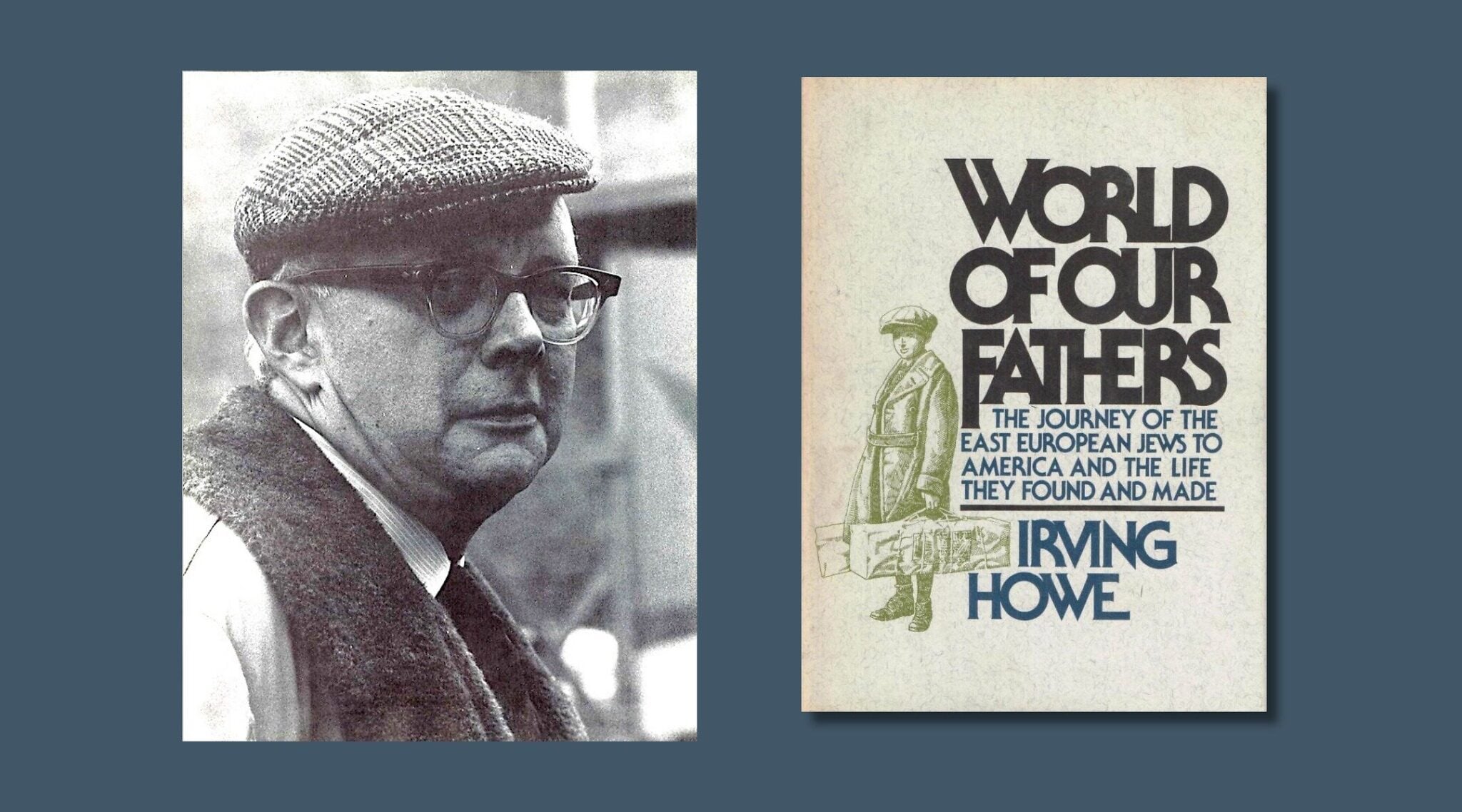
JTA — Once you could walk into almost any American Jewish home, scan the bookshelves and find a copy of Irving Howe’s “World of Our Fathers.” The imposing 700-page history of the Eastern European Jews who came to America at the turn of the 20th century was practically standard equipment in a Jewish home, right next to the brass menorah and the olive-wood camel from Israel.
Written with the historian Kenneth Libo and published in 1976, “World of Our Fathers” became a bestseller and won the National Book Award. How many people actually read it cover to cover is an open question, but its presence on the shelf said something about the people who owned it: that they knew where they came from, or at least they wanted to.
That’s pretty much how I remembered the book, as a lively portrait of the immigrant Jewish, Ashkenazi world of my grandparents: the garment workers and union organizers, the Yiddish newspapers and theaters, the intellectuals and political radicals, the neighborhood institutions and communal networks that helped transform impoverished newcomers into American success stories.
And yet on its 50th anniversary, another essential aspect of the book is being thrown into sharp relief. Howe (1920-1993), a literary critic, founder of the leftist Dissent magazine and leading New York Jewish intellectual, was also a founder of what became the Democratic Socialists of America. While clear-eyed about the success and failures of Jewish socialism, “World of Our Fathers” is as much a celebration of Jewish radicalism as it is a history of Yiddish culture and immigrant chutzpah.
The anniversary falls at an auspicious time for democratic socialists. In this month’s elections, six DSA-backed candidates won seats in Congress, while members of the DSA were elected mayor in Los Angeles, Washington, DC, Ann Arbor and Providence, joining New York and Seattle.
That’s far beyond the dreams of the Jewish immigrants who helped elect Jewish socialist Meyer London to Congress for three terms in the early 20th century.
For Jews drawn to the DSA’s progressive politics — and who either agree with or are at least willing to overlook the organization’s anti-Zionism — Howe’s book, still in print, is less about nostalgia than an inheritance they are eager to recover.
“This book was very inspiring to me,” said Sam Adler-Bell, a contributing writer at New York Magazine and a member of the editorial board of Dissent. “I had to look to the past to find a kind of sense of myself as a socialist and ultimately as a Jew.”
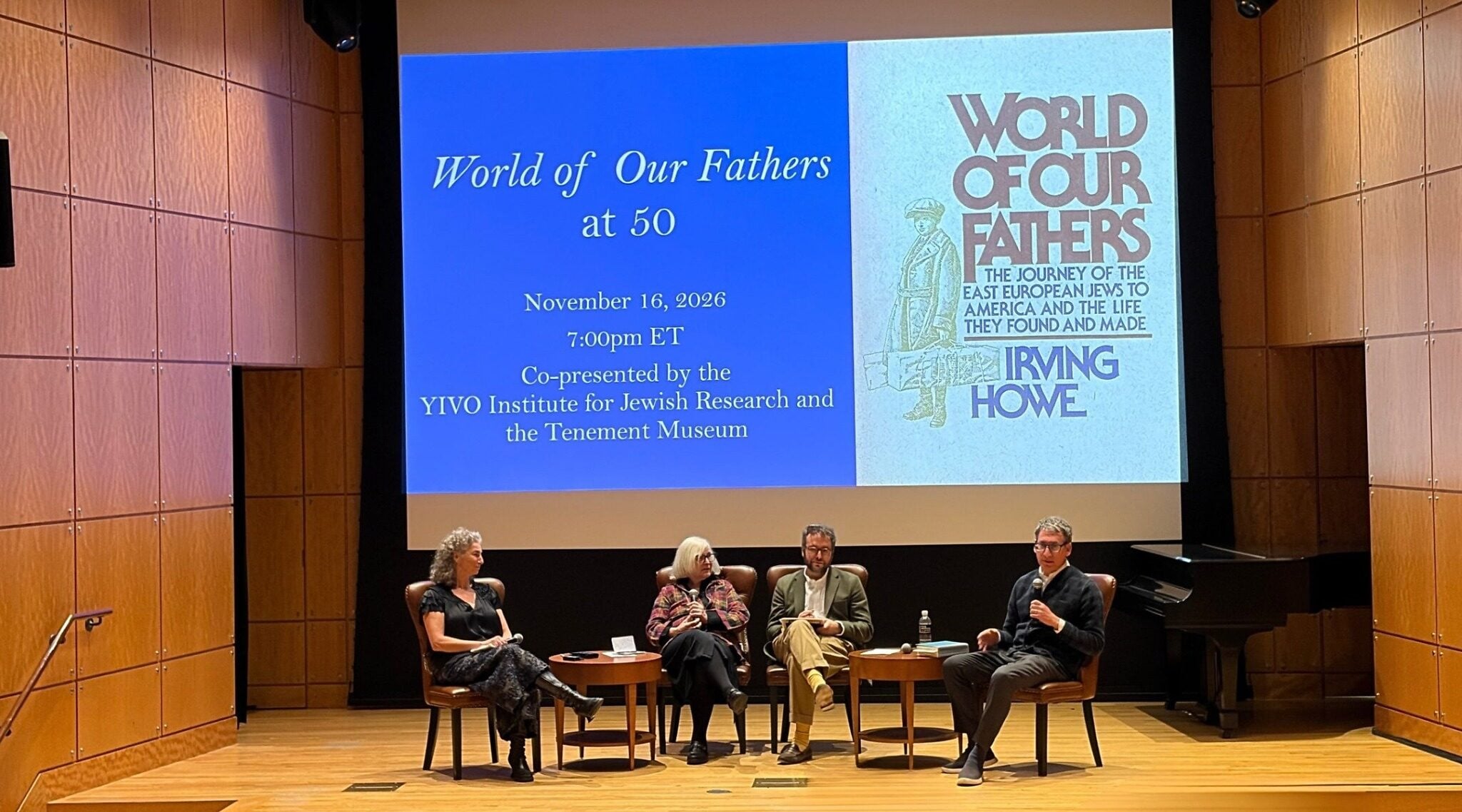
Adler-Bell was the youngest member of a panel held Monday at the Center for Jewish History in Manhattan, organized by the YIVO Institute for Jewish Research and the Tenement Museum to mark the book’s 50th anniversary. Moderated by Annie Polland, president of the Tenement Museum, the panel also included Hasia Diner, professor emerita of history at New York University, and Tony Michels, a professor of American Jewish history at the University of Wisconsin-Madison.
Diner, a scholar of American Jewish immigration, praised the rich literary qualities of the book, even if she bristled at Howe’s sometimes sweeping generalizations about the diverse Jewish immigrant community, and, starting with the title, its scant treatment of immigrant women. “As a reader, I was sort of sucked into it because of the expressiveness,” said Diner.
She described how the book captured what Howe called a “historically complex and deep culture” that was in the process of disintegrating, especially at a time when its heirs were inclined to romanticize the immigrant past.
“It’s in a way a follow-up to ‘Fiddler on the Roof,’” said Diner, referring to the Broadway musical that wrapped Yiddish culture and “tradition” in a gauze of sentimentality. “Howe’s saying [Eastern European Jewish culture] was already in disarray before it came to America.”
Michels, whose scholarship focuses on Jewish radicalism and immigrant politics, recalled discovering the book in college after becoming a reader of Dissent, which Howe had founded in 1954 with Lewis Coser.
Michels eventually wrote his dissertation on immigrant Jews, socialism and Yiddish culture. Howe’s book, he said, helped point him in that direction.
The panelists also noted that Howe intended the book not only as a work of history, but as a message to the left. The book appeared at a time when the New Left and allied 1960s protest movements were widely seen as exhausted ideologically and discredited by violent radicalism. Howe’s book, said Michels, is an argument for menschlichkeit — Yiddish for human decency — in politics as in everyday affairs.
That was part of Howe’s message to the left of his own time, Michels suggested: Don’t abandon compassion in the name of ideological purity.
“Ultimately, menschlichkeit offers a sustaining ethic for socialists,” Michels said. “If you don’t have an ethical element to it, then you’re headed to disaster.”
Adler-Bell remembered seeing the book on relatives’ shelves as a child, though he did not read it carefully until his early 20s. By then he had decided to become a socialist, at a time when the idea had little cultural cachet.

“I joined the DSA in 2011, when the DSA remained more or less a reading club for elderly Jewish social democrats,” he recalled. “I love elderly Jewish social democrats. That’s why I felt very at home there.”
With no particularly vibrant socialist movement around him, he looked to the past for a sense of himself, both politically and Jewishly.
He has noticed a similar phenomenon among younger Jewish socialists in recent years. Friends and peers have been pulling “World of Our Fathers” off their parents’ and grandparents’ shelves, often texting him to report how much they had been struck by it.
The attraction, he suggested, is not merely historical. The arguments and divisions among the immigrant radicals — over class, religion, Jewish identity and political strategy — remain recognizable to young Jewish leftists today.
There is, however, a modern-day political complication. While Howe and fellow democratic socialists like Michael Harrington were “good socialists in the pro-labor Zionist mold,” as the journalist and political scientist Elliot Jager recently put it in an essay about the book, today’s DSA is stridently anti-Zionist.
“Howe believed that Jews have the right to national self-determination. The DSA doesn’t. That’s a pretty fundamental difference,” said Michels. “So I imagine he would be feeling fairly, let’s say, conflicted, if not deeply upset by what the DSA has become.”
Adler-Bell, who often writes critically of Israel, said Howe would have appreciated the pragmatism of today’s DSA, which included running candidates on the Democratic Party line and supporting candidates “who are not revolutionaries at all.” But he agreed that Howe would have disagreed with the DSA over Zionism, even as he himself could be a critic of Israeli policy and leadership.
But just as Jewish anti-Zionists represent a small if vocal minority of American Jews, Howe’s contemporary critics accused him of exaggerating the socialist, secularist tendencies of the Jewish immigrants in service of his own ideology.
“Reading it, one would suppose that the entire population of East European Jewish immigrants … were radical or at least vaguely and sentimentally socialist,” the conservative writer Midge Decter wrote in a scathing Commentary essay. “For the legendary world of Mr. Howe’s fathers included virtually no synagogues, no yeshivahs, no rabbis, a few Democratic ward-heelers but certainly no Republicans….”

Twenty years after the book came out, Kenneth Waltzer also dinged Howe for emphasizing the immigrants’ socialism and labor organizing, but not “capitalism and enterprise.”
At the Center for Jewish History, Michels defended Howe’s emphasis on Jewish labor and socialism. Howe wasn’t claiming that every immigrant was a socialist, he said, but that the movement helped mobilize the larger community around the practical concerns of everyday life: how to pay the rent, feed a family and adapt to America.
Nor did the immigrants see the desire to rise in the world and the fight to improve conditions for working people as opposing impulses.
“For many immigrants, the desire to change society and change the world and make some money and move up were hard to disentangle,” Michels said.
And while Howe doesn’t begrudge the workers and labor organizers who created the conditions for their own children to become professionals and business owners, he regrets what was lost along the way.
Menachem Feuer, in an essay about the book’s anniversary on the blog Schlemiel Theory, writes that Howe understood that paradox of Jewish success: The very achievements that made the immigrant experience a triumph also helped bring about the disappearance of the culture Howe wanted to preserve.
That ambivalence was apparent in the YIVO discussion, particularly when the panelists considered the book’s epilogue. In it, Howe laments that, despite the Jews’ eventual economic success and institution building, “very little of what held the immigrant Jews together — the fabric of their ways, the bond of common tradition, the sharing of language — was able to survive much beyond a century.”
The popularity of the book might have attested to that very anxiety. For the generation that bought “World of Our Fathers” in the 1970s, it may have been a way to reconnect with a family history that had been left behind in the rush toward American affluence and acceptance. For many readers, Howe’s book still offers a way to look back at a world that had helped make their own lives possible. And for some now living in a new age of Jewish anxiety and uncertainty, it offers a way forward.
In her closing remarks at the YIVO panel, Polland, the moderator, recalled a familiar maxim of the historian Marcus Lee Hansen.
“‘What the son wishes to forget, the grandson wishes to remember,’ and it strikes me in thinking about ‘World of Our Fathers’ how lucky and fortunate we are that here was a son that wished to remember,” she said. “Not only did he wish to remember, he wished to research it, and he wished to form it into a world that could be passed down to a variety of audiences.”
The views and opinions expressed in this article are those of the author and do not necessarily reflect the views of JTA or its parent company, 70 Faces Media.









The Times of Israel Community.