

All eyes on Iran after PM’s bombshell revelation — but probably not for long
Netanyahu’s striking exposure of a secret atomic warehouse in Tehran may divert global diplomatic attention from the peace process, or lack thereof, but only temporarily

 Add ToI as a Preferred Source on Google
Raphael Ahren is a former diplomatic correspondent at The Times of Israel.
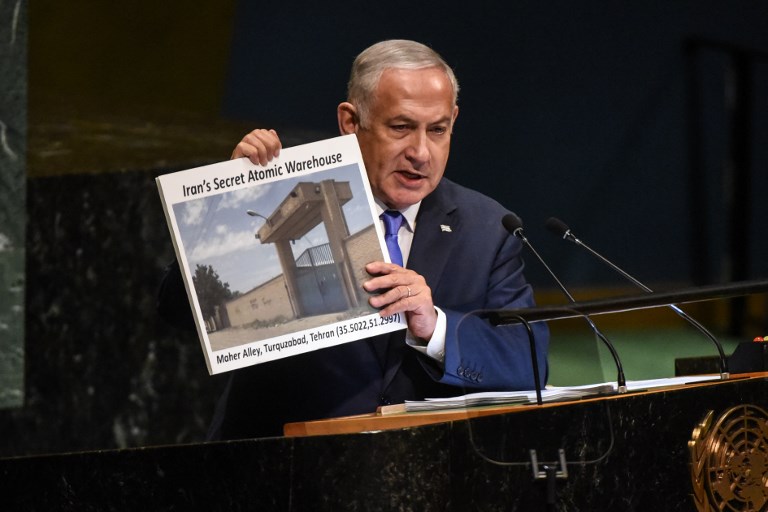
UNITED NATIONS, New York — Prime Minister Benjamin Netanyahu’s bombshell speech at the UN Thursday, featuring revelations about a secret nuclear warehouse in the heart of Tehran, which included its precise location for people to look up at home, had everything you’d expect: It was rich on Biblical themes, included praise for Israel’s vibrant democracy, was marked by the scolding of European anti-Semitism, and contained outraged rebuttals of Palestinian accusations.
As in most of his recent UN speeches, the centerpiece of Thursday’s 40-minute address was Iran and its nuclear ambitions. But his disclosure of top-secret intelligence on the atomic warehouse may prove effective, at least temporarily, in drawing global attention to the Islamic Republic’s nuclear duplicities.
Until Netanyahu’s appearance Thursday afternoon, much of the global political and diplomatic leadership here, when considering Israel’s part of the Middle East, was, as is the norm, preoccupied with the non-existent peace process between Israelis and Palestinians, and the growing humanitarian crisis in Gaza.
US President Donald Trump’s surprising explicit endorsement Wednesday of a two-state solution (he later backtracked to say that he’d be “okay” with any framework the two parties agree on) gave some people hope that his forthcoming peace plan may, after all, be more realistic than they had initially feared.
Many of the diplomats and ministers at the General Assembly this week were focused on the administration’s decision to cut all funding to the Palestinians, including to UNRWA health and educational institutions, hospitals and even coexistence projects.
On Wednesday, officials from 40 countries attended an event sponsored by the Palestinian mission to the UN that was trying to promote a multilateral approach to the peace process, seeking to sideline the US as the dominant player in this arena.
On Thursday morning, Palestinian Authority President Mahmoud Abbas first accepted the presidency over the Group of 77, a bloc of 134 developing nations representing nearly 80 percent of the world’s population. Moments later, he took the podium at the General Assembly and urged the world once more to recognize a Palestinian state and pressure Israel into concessions.
Later that day, the European Union held a ministerial meeting at the sidelines of the General Assembly dedicated to raising funds for UNRWA.
The Ad Hoc Liaison Committee Meeting, a consortium of primary donor countries to the PA, also held a meeting at the sidelines of the GA, which was attended by US peace envoy Jason Greenblatt.
Netanyahu’s characteristically polished and powerful speech, in which he said he was revealing something that “has not been shared publicly before,” has the potential to divert the world’s attention away from the Palestinian question to Iran, at least for a few days.
Netanyahu exposed a “secret atomic warehouse for storing massive amounts of equipment and material from Iran’s secret nuclear weapons program,” and called on the International Atomic Energy Agency urgently look into the matter.
“Go inspect this atomic warehouse, immediately, before the Iranians finish clearing it out,” he said, directly addressing IAEA head Yukiya Amano.
On May 1, a day after Netanyahu presented the findings of the Mossad’s daring raid a few months earlier on Iran’s secret nuclear archive, the IAEA brushed off the extraordinary Israeli haul. It haughtily declared that the vast haul of material from Iran’s nuclear weapons archive, purloined from under the noses of the Iranians, featured “no credible indications of activities in Iran relevant to the development of a nuclear explosive device after 2009,” and declared the matter closed.
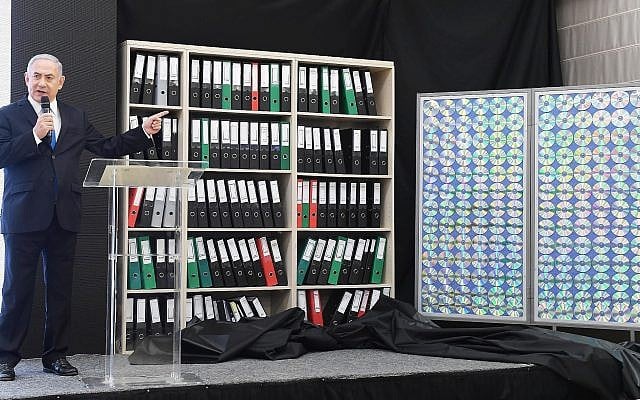
Netanyahu on Thursday castigated the agency for its inaction, saying its failure to do its job properly had led him to reveal the existence of a second secret nuclear site in Tehran.
“Now for those of you at home using Google Earth, this no-longer-secret atomic warehouse is on Maher Alley, Maher Street. You have the coordinates, you can try to get there,” he said.
He predicted “some increased activity on Maher Alley in the days and weeks ahead,” as Iranians will be “desperately trying to finish the job of cleaning up that site.”
Just last month, Netanyahu added, Iran removed 15 kilograms of radioactive material from facility.
Even the staunchest defenders of the 2015 nuclear deal with Iran would likely have been taken aback by Netanyahu’s revelation, even amid the denials that can be expected from Tehran, with the prime minister shifting discussion to what he considers the biggest challenge to Israel and the free world.
“The greatest threat to Israel does not come from Syria, nor does it come from Lebanon or from what Iran does in Syria, or even from what Iran does inside Iran. Rather, Israel’s number one worry continues to be the Islamic Republic’s ambition to acquire nuclear weapons,” he had told reporters on Wednesday.
“Iran wants to create nuclear weapons with the declared goal to destroy us,” he said.
At that same briefing, he also replied to questions about the US administration’s upcoming peace plan and Trump’s apparent preference for a two-state solution, but this topic clearly preoccupies him far less than the Iranian threat.
In the days ahead, more eyes will be on Iran, on the IAEA, and on the five countries that remain committed to the 2015 nuclear deal.
But the Palestinian question will not go away. Sooner the peace process, or its absence, will return to the headlines — especially if UNRWA runs out of funds or if the US finally presents its peace proposal.







The Times of Israel Community.