

Celebrating the Exodus in the desert
260 participants hold an all-day open-air seder in Moab, Utah with Adventure Rabbi Jamie Korngold
MOAB, Utah (JTA) — How do you open the door for Elijah when your seder is outdoors in the middle of the Utah desert?
That was one of the challenges facing the 260 people who came from all parts of the US to participate in the fifth annual Adventure Rabbi Passover retreat held last weekend at a campsite on the Colorado River near Moab, Utah.
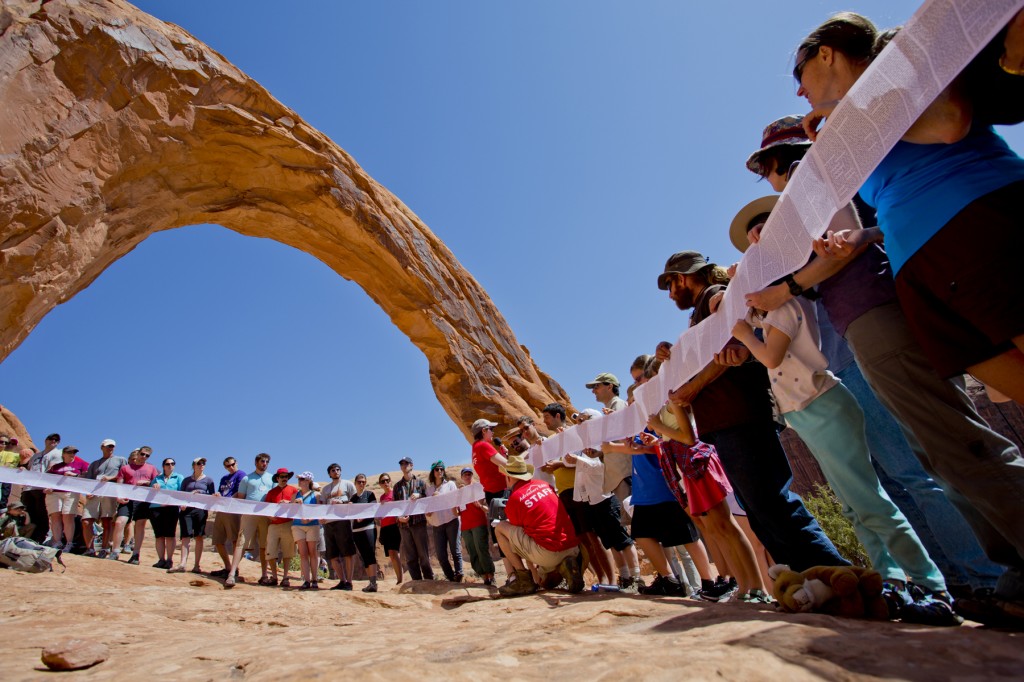
The main event, a seder that lasted from 11 a.m. to 7 p.m., took place on Saturday, the first day of Passover, and included a three-mile round-trip hike to the Corona Arch geological formation.
The decade-old Adventure Rabbi program is the Boulder, Colorado-based brainchild of Rabbi Jamie Korngold, a Reform rabbi who has translated her passion for outdoor adventure into something she describes as “a cutting-edge model for synagogue life in the 21st century.”
“A lot of us are looking for ways to make Judaism more vibrant, more meaningful, more accessible, more spiritually rich,” Korngold said. “The tool we use is the outdoors.”
The idea for the Passover retreat originated with a non-Jewish father whose family had participated in Adventure programs.
“One Passover it occurred to me, this whole story takes place in the desert, but we’re all indoors and our house is too small for all the guests and there’s no ‘reclining’ going on anyway,” Steve Mertz said. “We should be doing this outside in the desert.”
He and his wife, Kara, who is Jewish, brought the idea to Korngold in 2007, and the first Passover retreat was held the following year. The couple and their two children, aged 18 and 5, have attended every year since.
This year’s event was the largest ever: Participants came from 16 states reaching from California to New York, from Arizona to Wisconsin.
Standing in a circle on the first day of Passover at the foot of the Corona Arch, surrounded by Red Rock sandstone cliffs, participants held aloft a fully unfurled, backpack-sized Torah that has been carried to some of the highest peaks in the Rockies.
Cantor Rollin Simmons of Aspen, Colorado, who came with her husband, Rabbi David Segal, and their 4-month-old baby, Levi, chanted the scroll’s verses about Moses’ encounter with the burning bush, then used the same trope (tune) as she translated the verses into English.
After rolling up the Torah, participants — like Miriam and the women in the Exodus story — danced with timbrels at the arch.
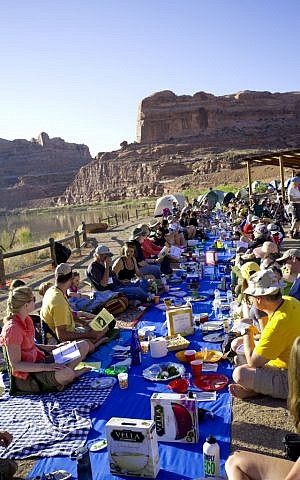
A couple of hours later, back at the campsite for the dinner portion of the seder, the staff and volunteers rolled blue fabric runners on the ground and placed seder plates, wine boxes and hand sanitizer (the campsite has no running water) along its length.
Participants pulled up cushions or sleeping pads, and the seder resumed its traditional course, using an Adventure Rabbi Haggadah adapted from a Reform Haggadah. The dinner menu included traditional chicken soup with matza balls and brisket, along with salmon and vegetarian dishes.
With no physical door to open for Elijah, participants read from the Haggadah that “We open our virtual door for Elijah.”
The retreat began last Friday evening with an optional first-night seder; about half the group came and sat at picnic tables.
Following the Four Questions, the adults broke up into eight discussion groups focused on such topics as “Why is Elijah in the Passover Seder,” “Today’s Mitzrayims: Societal/Cultural Slaveries,” “Today’s Burning Bushes and Plagues” and “If You Had 20 Minutes to Pack, What Would You Take?”
Participants then joined together as the children performed a Dr. Seuss-inspired version of the Passover story.
Laura Kessler, a professor at the University of Utah Law School, relished the opportunity to spend an entire day on the seder.
“At our family seder, we often rush to finish the seder so we can eat,” Kessler said. “Here there was plenty of time for reflection and to absorb inspiration from the amazing setting.”
Next Passover, though, won’t find an Adventure Rabbi seder in Moab.
Instead, Korngold is taking literally the traditional words that close the seder: “B’shana haba’ah b’Yerushalayim” — Next year in Jerusalem.

The Times of Israel Community.