Sue Surkes is The Times of Israel's environment reporter
A griffon vulture is released into the wild in the Negev highlands in southern Israel, after being marked and fitted with a radio transmitter. (Yuval Dax, INPA)
The Israel Nature and Parks Authority on Tuesday released 64 endangered griffon vultures into the wild, hoping that the new Jewish year will be a brighter one than the last.
The birds had been caught by the INPA to have their health checked, and to be marked and fitted with radio transmitters so that their movements can be followed.
They were set free in southern Israel’s Negev highlands.
There are about 200 griffon vultures overall in Israel. They face dangers of electrification by power lines, habitat disappearance and water shortages.
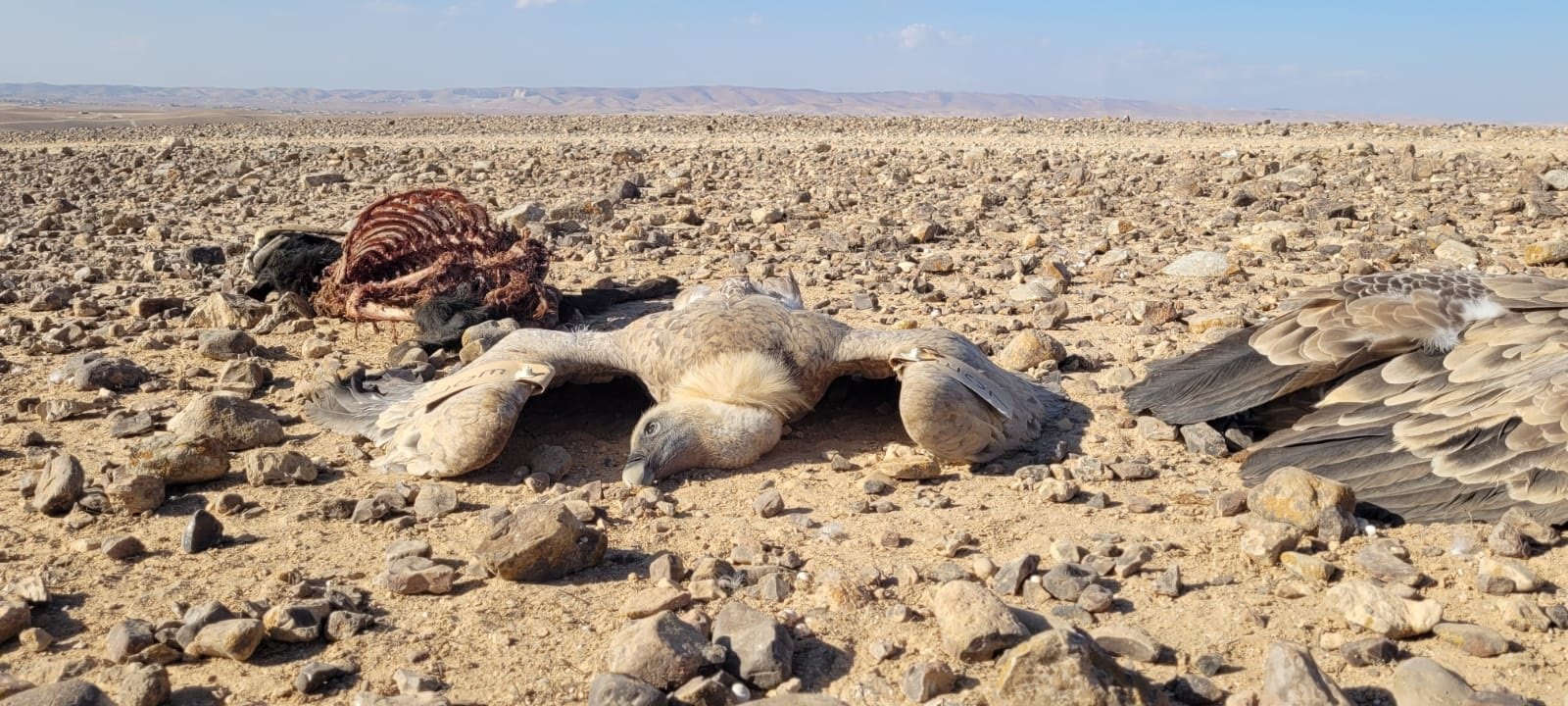
One of nine dead vultures shown next to the carcass of a goat in the Judean Desert in what the Israel Nature and Parks Authority suspects is a malicious poisoning event, October 24, 2021. (Eyal Ben Giat, INPA)
The INPA invests massive efforts to breed the vulture and to protect the wild population, even fielding teams — mainly of volunteers — to protect vulture eggs in nests.
In August 2020, it was reported that griffon vulture numbers were at an eight-year high, although the population was still endangered.
Advertisement
The organization has long campaigned for changes to the law that would make it easier to prosecute wildlife poisoning and impose far more severe punishments.
Help us report truthfully on social media
As a multimedia journalist, my job is to take the quality, fact-based journalism produced by The Times of Israel newsroom and make it accessible across every platform — from Instagram posts to podcasts to short-form videos.
This is how many, especially young people, consume news these days. But misinformation is rampant on social media. Our team at ToI produces accurate, responsible short-form reporting on Israel and the Jewish world.
If you believe in the importance of factual social media journalism, please consider joining our reader support group, The Times of Israel Community. Your financial support is essential to sustain responsible multimedia reporting.
We’re really pleased that you’ve read X Times of Israel articles in the past month.
That’s why we started the Times of Israel - to provide discerning readers like you with must-read coverage of Israel and the Jewish world.
So now we have a request. Unlike other news outlets, we haven’t put up a paywall. But as the journalism we do is costly, we invite readers for whom The Times of Israel has become important to help support our work by joining The Times of Israel Community.
For as little as $6 a month you can help support our quality journalism while enjoying The Times of Israel AD-FREE, as well as accessing exclusive content available only to Times of Israel Community members.
Thank you, David Horovitz, Founding Editor of The Times of Israel


 Add ToI as a Preferred Source on Google