

Herod the Great: The King’s Final Journey
An exhibit about the man who transformed the landscape of the ancient Land of Israel
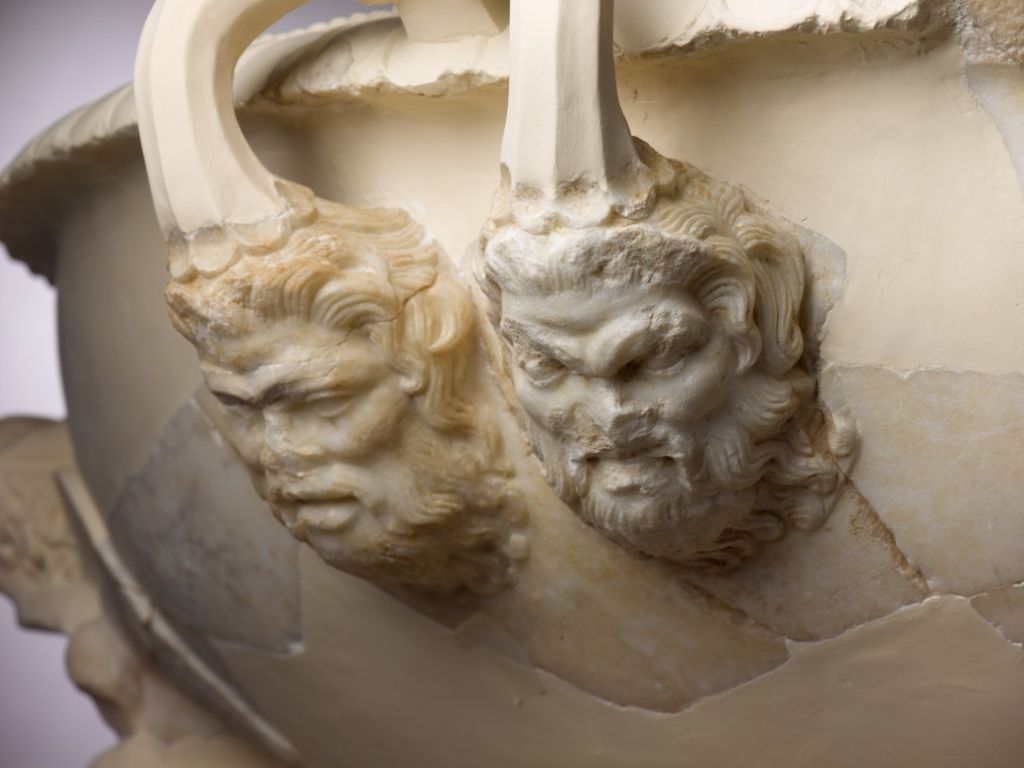
Herod the Great ruled over Judea for 33 years and produced during that time a legacy of massive building projects that would transform the landscape of the ancient Land of Israel. In addition to his most renowned such achievement – the expansion and reconstruction of the Temple in Jerusalem – he also conceived and realized elaborate palaces, fortresses, public buildings, pagan temples, and even entire cities. King Herod’s rise to power was tightly intertwined with the rise of the Roman Empire, whose culture he admired greatly. And while he was guided by his affinity for Roman customs and norms, he attempted nonetheless to attend to the needs of the Jewish citizenry of the region and to show respect for Jewish law, stimulating a notable chapter in the history of imperial relations that formed a bridge between Judea and the Roman world.
King Herod died in 4 BCE at his lavish Winter Palace in Jericho. His funeral procession set out from there for Herodium, on the fringe of the Judean Desert, where he was to be buried. Over time, extensive excavations at Herodium revealed a unique palace-fortress and leisure compound comprising gardens, pools, bathhouses, and residential and administrative buildings – yet no monumental tomb ever came to light. It was only in 2007, after a forty-year search, that archaeologist Ehud Netzer of The Hebrew University of Jerusalem finally discovered King Herod’s resting place: a magnificent funerary complex and mausoleum facing Jerusalem, constructed by the king shortly before his death.
“Herod the Great: The King’s Final Journey” seeks to illuminate Herod’s story – his reign and his role in the history of the region – through a display of the archaeological remains of the architecture he created and the art and artifacts that surrounded his royal life. The centerpiece of the exhibition is a reconstruction of the king’s circular burial chamber, and we feel proud to present the fruits of the meticulous labors of our restoration teams and privileged to be able to exhibit these important finds for the first time.
From TOI’s lifestyle editor, Jessica Steinberg:
Herod was never the most popular guy on the planet. The Roman proxy monarch who was a practicing Jew and ruled the Holy Land for 33 years was a voracious builder, known for massive palaces in the desert, the port at Caesarea and the expansion of the Second Temple complex (the Western Wall is one of the remaining retaining walls of the Temple). He was also accused in the New Testament of murdering his wife and two of his sons, as well as the newborn sons of Bethlehem, in an effort to prevent the much-prophesied birth of Jesus. And while he was a wildly egotistical ruler, seeking ever greater signs of his power and kingship, there are no portraits of him, no stamps or coins bearing his image, no etchings of his face in any of his edifices. Nada. Read more here.
The exhibition runs through January 4, 2014.




The Times of Israel Community.